

Global stock markets, including U.S. stock index futures, surged on Wednesday following reports of a two-week ceasefire agreement between the U.S. and Iran.
U.S. President Donald Trump announced a two-week suspension of strikes against Iran in exchange for the full and immediate reopening of the Strait of Hormuz. He noted that Iran would also suspend its strikes. “This will be a bilateral ceasefire,” the U.S. president emphasized. Iran’s Supreme National Security Council confirmed its agreement to a ceasefire with the U.S., according to Abbas Arakchi, the Islamic Republic’s foreign minister.
On this news, futures on U.S. stock indices are rising by more than 2%. As of 8:51 a.m., the Dow Jones futures index rose by 2.4%, S&P 500 futures rose by 2.7%, while Nasdaq 100 futures jumped by 3.3%.
The MSCI Asia Pacific Index, a composite stock index for the Asia-Pacific region, soared by more than 5%.
Amid expectations of increased Middle Eastern fuel supplies to the global market, June Brent futures had plummeted 14.3% to $93.69 per barrel by 8:52 a.m., while May WTI fell 15.3% to $95.71 per barrel.
Meanwhile, the DXY dollar index, which tracks the dollar’s performance against six major global currencies, is down 1.17%. Analysts believe that cheaper oil, should a long-term peace be established in the Middle East, would exert less upward pressure on inflation and allow the Federal Reserve to continue its course of gradually lowering interest rates.
Amid expectations of a more dovish monetary policy in the U.S. than previously anticipated, the yield on 10-year U.S. Treasuries fell by 5.5 basis points during trading to 4.245%.
The general trend in global markets on Wednesday is rising demand for risky assets and selling of so-called “safe-haven assets” amid signs of easing geopolitical tensions. Gold proved to be a notable exception—the precious metal is rising in price amid a falling dollar, as the weak U.S. currency boosts gold’s investment appeal.
Gold futures are up 3.8% and trading near $4,864 per troy ounce.

Asia-Pacific stock markets rose on Friday, following the rise of Wall Street, due to growing expectations that the cycle of monetary tightening by the Federal Reserve (Fed) is nearing its end.
Stats showing a slowdown in U.S. producer price growth and a larger-than-expected increase in jobless claims confirmed that the U.S. central bank’s rate hike is weakening inflation in the United States and restraining economic growth.
Japan’s Nikkei 225 stock index was up 1.2 percent in trading, following an increase in retailer stocks.
Fast Retailing, which owns the Uniqlo brand, gained 8.5 percent on strong results at the close of trading on Thursday. Fast Retailing increased its net profit and revenue in the first fiscal half of the year and improved its outlook for the full year.
Shares of other Japanese retailers are also up, with Seven & I Holdings up 1.8 percent, Treasure Factory up 9.6 percent and Lawson up 6 percent.
China’s Shanghai Composite stock index added 0.4% in trading, while Hong Kong’s Hang Seng gained 0.1%.
China’s economic growth rate will reach the government’s target of 5 percent in 2023, People’s Bank of China (PBOC) governor Yi Gang said during a meeting of G20 central bank chiefs in Washington.
“China’s economy is stabilizing and recovering, inflation remains low, and the real estate market is showing positive changes,” said Yi Gang, quoted on the NBK website.
Leading the rise in mainland China are stocks of technology companies and battery makers, as well as raw materials for them. Contemporary Amperex Technology Co. gained 2.1%, Tianqi Lithium 6.3%, Ganfeng Lithium 6.2% and China National Software 2.9%.
In Hong Kong, shares of Geely Automobile Holdings (+3.5%), BYD Co. (+1%) and Anta Sports Products (+1.8%) rose. Meanwhile, Meituan (SPB: 3,690) (-1.8%), Tencent (SPB: 700) Holdings (-0.3%) and Sunny Optical Technology Group (-1.1%) are getting cheaper.
South Korea’s KOSPI added 0.53% in trading and Australia’s S&P/ASX 200 gained 0.48%.
Commonwealth Bank of Australia shares gained 1%, National Australia Bank – 1.1%, Fortescue Metals – 0.9%. At the same time, BHP Group securities fell by 0.1%.

Traders are awaiting the release of data from the U.S. Labor Department on the country’s consumer price movements last month, which are considered key to the Federal Reserve’s (Fed) decision on the future direction of monetary policy.
“All markets are clearly focused on the extremely important U.S. inflation data,” notes SPI Asset Management managing partner Stephen Innes, quoted by Market Watch. – Traders are trying to figure out whether the Fed will change course after this data and what the implications for the U.S. economy will be.”
Experts polled by Trading Economics on average expect U.S. inflation in March slowed to 5.2% on an annualized basis from 6% in February.
Higher-than-expected inflation would raise the likelihood of another Fed rate hike by at least another 25 basis points. The U.S. central bank rate hike has already slowed inflation, but it is also holding back the economy. A further rate hike would increase the threat of recession, which would have a negative impact on stock markets, notes Market Watch.
Japan’s Nikkei 225 stock index gained 0.6% in trading.
SoftBank Group shares gained 1.4 percent, Nippon Yusen rose 2.4 percent, Mitsubishi Corp. – by 2.3%, Nippon Steel by 1.8% and Nintendo by 1%.
Bank of Japan data released Wednesday showed the country’s producer price growth slowed to an annualized 7.2% in March from February’s 8.3%. The rate of increase in producer prices last month was the slowest since September 2021.
China’s Shanghai Composite stock index added 0.3 percent in trading, while Hong Kong’s Hang Seng lost 0.8 percent.
The leaders in mainland China are commodities stocks – Petrochina Co. (SPB: 857) gained 3.4 percent, China Petroleum & Chemical Corp. (Sinopec) gained 1.7 percent and Zijin Mining Group Co. – by 0.7%.
Shares of technology giants are becoming cheaper in Hong Kong. Alibaba Group Holding (SPB: BABA) was down 2.4%. On Tuesday, the company unveiled its own artificial intelligence model, a ChatGPT counterpart that works with Chinese and English. The model will be integrated into all business applications in Alibaba’s ecosystem in the near future, the company said.
According to Bloomberg, Chinese authorities are planning to introduce the requirement of safety checks of technologies similar to the popular chatbot ChatGPT.
Shares of Tencent (SPB: 700) Holdings Ltd. fell 4.4% in trading and JD.Com Inc. (SPB: JD) fell 3.4%.
South Korea’s KOSPI stock index is stable in the course of trading, the Australian S&P/ASX 200 added 0.4%.
BHP Group shares rose 2.1%, Rio Tinto – 2.5%, Fortescue Metals – 1.5%.
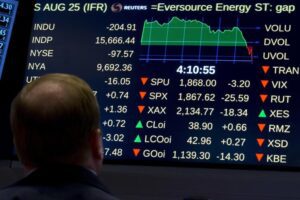
Asia-Pacific stock indices rebounded positively on Monday after the U.S. stock market rallied at the end of last week.
Australian and Hong Kong stock exchanges as well as U.S. and most European countries are closed because of the Christmas holiday.
The Bank of Japan is not going to abandon its ultra-soft monetary policy any time soon, Central Bank Governor Haruhiko Kuroda said.
Last week, the Japanese central bank unexpectedly widened the range within which the yield on ten-year government bonds can fluctuate to plus/minus 0.5% per annum from plus/minus 0.25% previously. Investors took that as a signal that the Bank of Japan was preparing to abandon the ultra-soft monetary policy that it had been pursuing for years.
But Kuroda on Monday rebutted that view, saying that the corridor widening was aimed at boosting the effect of monetary policy and was not the first step in abandoning a major stimulus program. He also noted that the country’s consumer inflation rate could slow below the Bank of Japan’s 2% target in the next fiscal year, which begins in March 2023.
The value of Japan’s Nikkei 225 index rose by 0.65% in trading.
Shares of electronic components maker Sharp Corp. (+3.6%) and commodity companies including JGC Holdings Corp. (+3.5%), Inpex Corp. (+2.5%) and Nippon Steel Corp. (+2.3%) were among the leaders.
In addition, chip maker Advantest Corp. (+1.2%), clothing retailer Fast Retailing (+2%), consumer electronics maker Sony Group (+0.3%), automakers Nissan Motor (+1.9%) and Toyota Motor (+0.3%) went up.
Mitsubishi Electric Corp. and Mitsubishi Heavy Industries Ltd. announced Monday that they intend to merge their generator businesses to become more competitive in the market. The companies plan to sign a definitive agreement at the end of May 2023 and complete the merger of the units by April 1, 2024. Mitsubishi Electric is expected to become the majority shareholder of the new merged company, while Mitsubishi Heavy Industries will become a minority shareholder.
Mitsubishi Electric’s share price rose 1.3 percent and Mitsubishi Heavy Industries rose 2.7 percent.
China’s Shanghai Composite index gained 0.65% over the day.
Technology and consumer companies, including Huizhou China Eagle, up 1.5%; Shenzhen Infinova, Zhejiang Netsun and Xi’an Catering, up about 10%; and automaker BYD, up 4.1%.
The People’s Bank of China on Monday provided banks with 216 billion yuan ($30.9 billion) in reverse repurchase transactions to ensure sufficient liquidity in the financial system at the end of the year. Last week the net inflow of funds into the country’s financial system amounted to 704 billion yuan, the highest weekly infusion since October.
The value of the South Korean Kospi index increased by 0.15%.
Stocks of one of the world’s largest chip and electronics maker Samsung Electronics Co. fell 0.3% and automaker Hyundai Motor rose 0.6%.
A strong rise in quotations showed securities of pharmaceutical companies Kyongbo Pharmaceutical and Samil Pharmaceutical – by 16.3% and 4.5%, respectively.

Equity markets in the Asia-Pacific region (APAC) are down in trading on Friday.
Investors are waiting for more clarity from Chinese authorities after Beijing signaled it was easing a series of tough restrictions against the spread of the coronavirus infection, CNBC writes.
Several major Chinese cities have announced easing of anti-covirus measures. Guangzhou, Shijiazhuang and Chengdu relaxed requirements for the regularity of tests for COVID-19 and the movement of citizens, Bloomberg reported. Markets and public transportation began operating in some areas. In Beijing, sick people are allowed to stay at home instead of being isolated in special centers.
Japan’s Nikkei 225 was down 1.7 percent by 7:11 a.m. Ksk. At a certain point in trading the indicator fell to a three-week low, Trading Economics said.
Shares of automaker Mitsubishi Motors Corp. (-5.6%), bearings and cardan shafts maker NTN Corp. (-5.3%) and electric cables maker Fujikura Ltd. (-4.3%) act as leaders in the decline among index components.
Moreover, shares of such big companies as SoftBank Group (-0.3%), Sony Group Corp. (-1.3%), Fast Retailing Co. (-2.3%) also declined.
China’s Shanghai Composite had lost 0.3% by 7:16 a.m. Ksk, Hong Kong’s Hang Seng had lost 0.6%.
Investors fix profits after a confident rally associated with the softening of the PRC’s position on the anti-covids restrictions, writes Trading Economics.
The most significant decline in quotations on the Hong Kong Stock Exchange is shown by shares of developers Country Garden Holdings Co. Ltd. (-6.4%), Country Garden Services Holdings Co. Ltd. (-5.6%) and Longfor Group Holdings Ltd. (-5.4%).
South Korea’s Kospi index was down 1.4 percent by 7:14 a.m. kk.
One of the world’s biggest chip and electronics maker Samsung Electronics Co. was down 2.9 percent, while car maker Hyundai Motor slid 1.5 percent.
Consumer prices in South Korea rose 5 percent year on year in November, the slowest pace since April 2022, after rising 5.7 percent a month earlier, data from the country’s statistics agency showed. Analysts on average had expected inflation in the country to be 5.1 percent, Trading Economics wrote.
On a monthly basis, consumer prices in November fell by 0.1% after rising 0.3% a month earlier.
The Australian S&P/ASX 200 index lost 0.7% in trading on Friday.
Retail sales in Australia fell 0.2% month-on-month in October, compared with an increase of 0.6% a month earlier, official statistics showed.
This is the first decline in the current year. It is due to the fact that price pressures and rising interest rates have begun to have a negative impact on consumer spending, according to Trading Economics.
Share prices of the world’s largest mining companies BHP and Rio Tinto fell by 1.6% and 1.1%, respectively.

Equity markets in the Asia-Pacific region are rising in trading Thursday, following a significant rise in U.S. stock indices.
Investors are assessing the speech of Federal Reserve (Fed) Chairman Jerome Powell.
He said the U.S. central bank could slow the pace of interest rate hikes following its December meeting. “The time to moderate the pace of rate hikes may come as early as the next meeting,” Powell said during a speech at the Brookings Institution on Wednesday.
In doing so, the Fed chief tried to balance those words with “hawkish” signals, Market Watch notes. Among other things, he said that the final peak in rates should be higher than might have been expected months ago.
In addition, Powell made it clear that the question of a rate cut is irrelevant at this point. “History strongly cautions us against premature policy easing,” he said.
The news from China also had a positive effect on bidders’ sentiment.
Authorities in Guangzhou have lifted restrictions imposed in several areas to combat the spread of the coronavirus. Strict lockdown was in force for several weeks in the city with a population of more than 18 million people, businesses were closed and strict quarantine measures were in place for those who were sick and in contact with them.
China’s Shanghai Composite index was up 0.7 percent by 7:26 a.m. Ksk, while Hong Kong’s Hang Seng was up 1.45 percent.
Shares in Shenzhou International Group, which makes and sells knitwear, rose 9 percent, the jewelry chain Chow Tai Fook Jewellery Group Ltd. – by 6.6% and the Internet company Baidu by 5%.
In addition, retailers Alibaba and JD.com Inc. – rose by 4.3% and 1.5%, respectively, telecoms China Unicom and China Telecom – by 4.6% and 2.2%.
Japan’s Nikkei 225 was up 1.1% by 8:21 a.m. Ksk.
Among the index components, pharmaceutical Eisai (+4.7%), chipmaker Advantest (+4.3%) and cosmetics maker Shiseido (+4.1%) were the biggest gainers.
Moreover, SoftBank Group (+1.8%), Sony (+0.9%) and Fast Retailing (+2.8%) gained their share prices.
South Korea’s Kospi Index was up 0.3% by 8:21 a.m. Ksk.
One of the world’s biggest chip and electronics maker Samsung Electronics Co. gained 0.5% and automaker Hyundai Motor rose 0.9%.
South Korea’s economy grew 3.1 percent in the third quarter of 2022 compared with the same period last year, final data from the Bank of Korea showed. Compared to the second quarter, GDP increased by 0.3%, which was the smallest rate of increase for the year.
The dynamics of both indicators matched both the previously announced data and analysts’ forecasts.
Australia’s S&P/ASX 200 index added nearly 1% in trading Thursday.
Share prices of the world’s largest mining companies BHP and Rio Tinto rose by 2.1% and 3.3%, respectively.



