
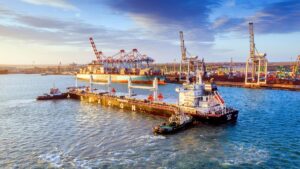
The Mediterranean Shipping Company (MSC) shipping group, headquartered in Geneva and one of the world’s largest, has acquired a 51% stake in the TIS container terminal at the Port of Pivdennyi, according to a report by Latifundist citing data from YouControl.
According to YouControl data, the largest beneficial owners of TIS are MSC owners Diego and Alexa Aponte, each holding 25.5%.
In March of this year, it was reported that global container operator DP World sold its stake in the TIS container terminal nearly six years after acquiring it; the TIS Group bought it back.
According to DP World’s annual report, it owned a 51% stake in TIS Container Terminal Limited, listed as a multipurpose terminal.
According to YouControl, other owners and beneficiaries of the TIS container terminal include Alexey Fedorichev and his “Fedkom Invest SAM” – 18.375%, Oleg Kutateladze – 9.19%, and brothers Yegor Grebennikov and Andrey Stavnitser – 11.72% and 9.72%, respectively.
Viktor Berestenko, President of the Association of International Freight Forwarders of Ukraine, confirmed this information in a comment to Latifundist and noted that MSC’s arrival could, to some extent, intensify competition among container terminals and provide a boost to the development of port infrastructure in Ukraine.
As reported in May 2025, Medlog, a subsidiary of MSC, acquired from Grebennikov a 50% stake in the intermodal logistics operator N’UNIT and a 25% stake in the cross-border terminal “Mostiska.”
In 2024, MSC announced the completion of a deal to acquire a 49.9% stake in the German logistics group Hamburger Hafen und Logistik AG (HHLA), which operates the Odessa Container Terminal (OCT).
The TIS Terminal Group is the largest stevedoring operator in Ukraine. The group comprises five terminals: “TIS-Container Terminal,” “TIS-Coal,” “TIS-Ore,” “TIS-Grain,” and “TIS-Mineral Fertilizers.” The group also owns and operates the largest infrastructure network, which includes a railway station.
According to information on the TIS Group website, the container terminal is the longest (600 m) and deepest (15 m) container terminal in the country. Its container handling capacity is 8 million tons/400,000 TEU per year. In 2021, Maersk consolidated all of its port calls in Ukraine at this terminal.
According to data from the YouControl system, the revenue of Pivdennyi Container Terminal LLC in 2025 decreased by 24.8% to 840.78 million UAH, while net profit fell by 2.8 times to 208.35 million UAH.
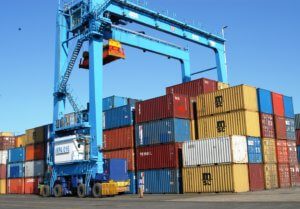
TIS container terminal (Odesa region) in January-September 2018 increased its cargo turnover by 54% compared to the same period in 2017, to 78,200 TEU, the company has said. “This is the result … of investment in the amount of $52 million in the installation of two new STS cranes, the launch of weekly container trains to Kyiv, Dnipro, Kharkiv, and Ternopil, increasing berth 22 to 600 meters,” the company notes.
TIS added that the launch of new Maersk ME-3 service and the high processing speed of 5 STS re-loaders also contributed to the rapid growth in container handling. The TIS group of terminals is the largest stevedoring operator in Ukraine. Cargo turnover in 2017 amounted to 26.012 million tonnes. The depth of berths near the terminals ranges from 15 to 16 meters, the total length of the eight berths of TIS exceeds 1,800 meters with the prospect of expansion by another 1,500 meters.
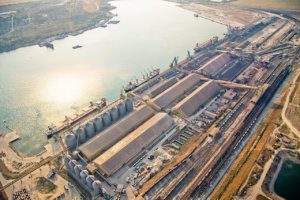
TIS Port (the stevedoring company operating in Yuzhny port, Odesa region) allows participation in the concession of Yuzhny port if the necessary law is adopted. “Yes, it is quite possible that it will be Yuzhny port,” co-owner and CEO of TIS Andriy Stavnitser said in an interview with Interfax-Ukraine. Speaking about smaller ports, he noted that, in his opinion, Ukraine does not need as many ports, and some of them can be closed, and some can be reformatted.
“Kherson, Izmail, Bilhorod-Dnistrovsky – there could be tourist zones, yacht clubs there, for example, which would bring revenues but not losses to the state,” Stavnitser said.
Asked about the considerations on the basis of which Kherson and Olvia ports were made pilot for concession, he noted that it is probably more visible for the Ministry of Infrastructure, but stressed that TIS won’t participate in any of these concessions.
“Not because we are so big, deep-water and do not notice anything else around. There are simply ports whose maintenance costs the state more than profits from them,” Stavnitser summed up. As reported, the Verkhovna Rada adopted as a basis bill No. 8125 on concession.



