

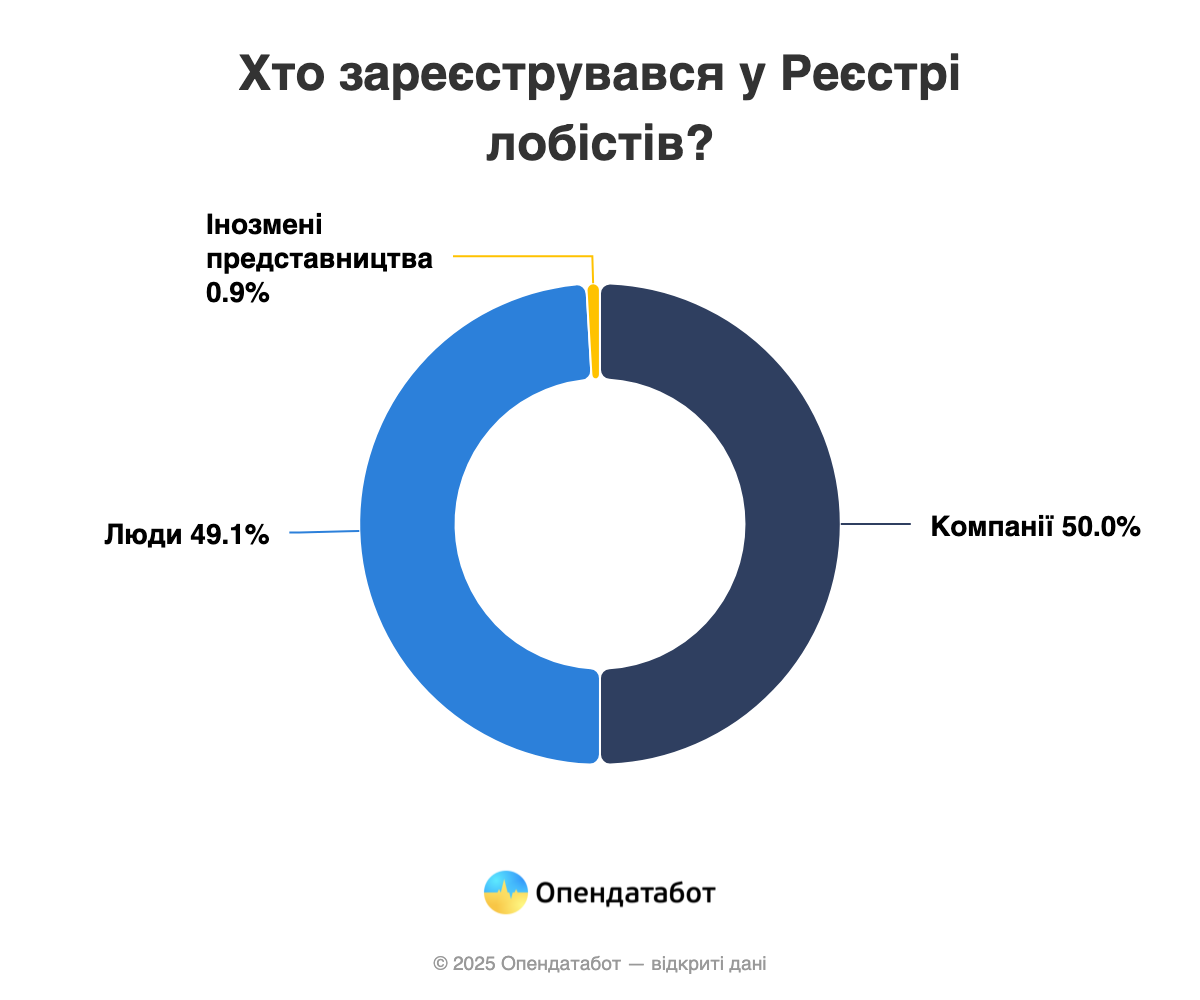
The first state-certified lobbyists have appeared in Ukraine. As of the end of November, 110 participants had been entered into the relevant Register, which is maintained by the National Agency for Corruption Prevention (NAZK), three months after the Law on Lobbying came into force. Among them are 55 companies, 54 individuals, and one foreign representative office. OpenDataBot analysed the purpose of such a Register and how it will affect business and the state.
The newly created NACP Transparency Register, also known as the lobbyist register, has 108 active participants. The list includes businesses, public organisations and ordinary citizens.
We are tracking changes on the Transparency Register (lobbyists) page on OpenDataBot.
You can find out about the first lobbyists in Ukraine on the Open Data Bot Lobbyist Register page. At the same time, if a company is a registered lobbyist, the corresponding marks will be added to the company’s card on its page in Open Data Bot.
In total, 110 participants have been registered since the Register began operating, but two subsequently suspended their participation. These include 55 companies, 54 individuals and one foreign representative office. Among them are businesses such as Philip Morris Ukraine, the Aurora chain of stores, Metro Cash & Carry Ukraine, ArcelorMittal Kryvyi Rih and Oschadbank, which are included in the Open Data Bot Index 2025.
The leader of this year’s Open Data Bot Index in the banking sector, Oschadbank, was one of the first financial institutions to join the Register. The company explains:
“For a bank whose activities are directly dependent on regulatory control, it is important to interact openly and legitimately with the National Bank and other state bodies. Registration in the Transparency Register allows us to operate within the legal framework, distinguishing between legitimate protection of interests and unacceptable forms of influence.”
Inna Boichuk, Director of Corporate Affairs at Aurora, one of the retail leaders in the Open Data Bot Index 2025, notes that the Law on Lobbying and the Register itself are only tools. In order for this mechanism to work and be truly effective in terms of ensuring transparency of influence on decision-making, it is necessary to work systematically to build trust around the newly created lobbying institution.
“This work should involve government stakeholders, business, the media and society as a whole. In particular, business should openly represent its positions, and the authorities should perceive and accept such interaction as a natural part of the democratic decision-making process. Therefore, at this stage, it would be fair to say that the aforementioned law and the Transparency Register are steps towards the formation of a mature culture of influence on the authorities,” comments Inna Boichuk.
Viktoria Kulikova, Head of the Committees Department at the European Business Association, also mentions the technical nuances during the process of establishing the system.
“We expect the Register to become a truly effective tool for transparent communication. At the same time, it is important to improve the legislation: clarify the definitions of concepts, simplify reporting, and provide practical incentives to registered participants. Only then will the system work effectively and promote accountability on all sides. In particular, the current reporting format is quite technically complex for large business associations that have many lobbying issues (regulatory acts to which the Association submits proposals), hundreds of lobbying beneficiaries (member companies) and a great deal of communication with lobbying targets (representatives of state bodies), information about which we will need to enter into the transparency register,” comments Victoria.
A similar opinion is held by the Union of Ukrainian Entrepreneurs, whose team participated in testing the Register before its launch and shared recommendations for improving interaction.
“For the system to work properly, it is important that there is two-way transparency: not only should businesses register and report, but MPs and government officials should also act transparently, honestly and comply with the law. And for the Register to work effectively, improvements to the legislation are needed, in particular clarification of terms, optimisation of reporting requirements and the establishment of additional incentives for registered lobbyists.”
The SUP notes that the main stage of interaction between newly created lobbyists and the state will begin in January 2026, when the first lobbying report will be submitted. It will be then that it will be possible to fully assess the work of the Register — its workload, functionality and ease of use.
OpenDataBot will track updates to the Lobbyist Register. Now, when checking companies or individuals in OpenDataBot services, users will see a mark indicating registration in the Register. This is another step towards transparency in the business environment and accountability of those who influence political decisions.
https://opendatabot.ua/analytics/lobbyists

The first hundred lobbyists have registered in Ukraine’s Transparency Register, an open public platform that collects, processes, and publishes data on lobbying entities and their reports, according to a statement posted on the website of the National Agency for Corruption Prevention (NACP) on Thursday.
“As of November 13, 2025, 101 lobbying entities are registered in the Register, of which 51 are legal entities (on behalf of which 141 representatives can lobby) and 50 are individuals. Two people have terminated their status as lobbyists. So, in total, 191 lobbyists can influence decision-making in the country,” the statement said.
Among the legal entities registered in the Register, there are 27 companies (limited liability and joint-stock), 16 public associations (associations, unions), five law firms (associations, offices), and three others.
“The most popular areas of lobbying are: financial, banking, tax, and customs policy—76 lobbying entities; economic development, regulatory policy, and property—74 entities; legal policy—70 entities; law enforcement—68 entities; innovation and digital transformation – 66 entities; transport, communications, and infrastructure – 65 entities; environmental policy and natural resource use – 64 entities; agricultural and land policy – 63 entities; regional development and urban planning – 62 entities. The smallest number of entities chose the area of “Youth and Sports” – 36 lobbying entities,” the statement said.
The NACP reminds that lobbying entities must submit their first reports on their activities from the date of registration in the Register until December 31, 2025, to the Register between January 1 and January 30, 2026.
As reported, the Lobbyist Transparency Register, provided for by the law on lobbying, officially began operating in Ukraine on September 1. At the same time, the NACP put into commercial operation a key tool for its implementation – the Transparency Register.
Immediately after that, the National Association of Lobbyists (NALU) was created in Ukraine to promote investment and protect business interests. Today, it has offices in London and Zurich.
Source: https://nazk.gov.ua/uk/u-reestri-prozorosti-nazk-zareestruvalysya-pershi-100-lobistiv/



