
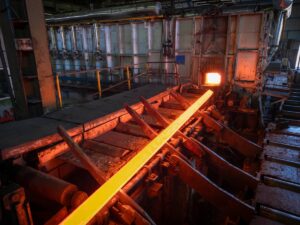
Ukrainian steelmakers reduced total rolled steel production by 6.7% in January–May of this year compared to the same period last year, down to 2.340 million tons.
According to data from the Ukrmetallurgprom association, 537,800 tons of rolled steel were produced in May, 460,800 tons in April, 544,500 tons in March, in February—390,300 tons, and in January—406,400 tons.
As reported, Ukraine’s steel companies increased total rolled steel production by 4.8% in 2025 compared to 2024—to 6.521 million tons.
In 2024, Ukraine increased its production of general rolled steel by 15.8% compared to 2023—to 6.222 million tons from 5.372 million tons. In 2023, total rolled steel production rose by 0.4% to 5.372 million tons, while in 2022 it fell by 72% to 5.350 million tons.
In 2021, before the war, 19.079 million tons of rolled steel were produced, or 103.5% of the 2020 level.
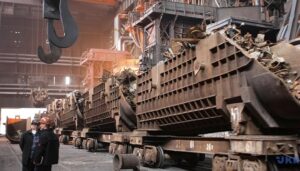
Ukrainian steelmakers reduced steel production by 6.12% in January–May of this year compared to the same period last year, down to 2.875 million tons.
According to data from the Ukrmetallurgprom association, 629,400 tons of steel were produced in May, 517,300 tons in April, 702,300 tons in March, in February—515,000 tons, and in January—511,100 tons.
As reported, Ukraine’s steel companies reduced steel production by 2.2% in 2025—to 7.409 million tons.
In 2024, Ukraine increased steel production by 21.6% compared to 2023—to 7.575 million tons. In 2023, steel production decreased by 0.6% to 6.228 million tons, and in 2022, by 70.7% to 6.263 million tons.
In 2021, before the war, 21.366 million tons of steel were produced, or 103.6% of the 2020 level.
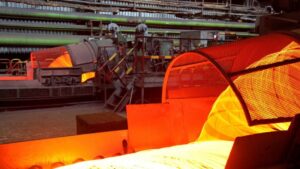
Ukrainian companies reduced their consumption of rolled metal products by 0.96% in January–April of this year compared to the same period last year, down to 1,187,400 tons.
According to a press release from the Ukrmetallurgprom association, 506,400 tons were imported during this period, accounting for 42.65% of the domestic rolled metal consumption market.
According to Ukrmetallurgprom, in January–April 2026, Ukrainian steel companies produced 1.802 million tons of rolled steel (90.9% of the figure for the same period in 2025), of which, according to the State Customs Service of Ukraine, approximately 1.121 million tons, or 62.2%, were exported. In January–April 2025, the export share was 62.3% (1.234 million tons out of a total rolled steel production of 1.982 million tons).
The share of semi-finished products in export shipments in January–April 2026 was 39.25%, which is higher than the figure for the same period in 2025 (32.06%). The share of flat products in export shipments in January–April 2026 significantly exceeds the figure for January–April 2025 (51.29% and 44.89%, respectively). The share of long products, however, is significantly lower than in January–March 2025 (9.46% in 2026 versus 19.04% in 2025).
The import structure in January–April 2026 is characterized by a significant dominance of flat products over long products (61.99% and 25.38%, respectively), however, in January–April 2025, the dominance of flat products over long products was significantly greater (78.86% and 19.12%, respectively).
“In January–April 2026, the domestic market capacity was 1,187,400 tons of rolled steel, of which 506,400 tons, or 42.65%, were imports. In January–April 2025, the domestic market capacity was 1,198,900 tons, of which 450,900 tons, or 37.61%, were imported. Thus, in January–April 2026, there was a 0.96% decrease in domestic market capacity compared to January–April 2025, accompanied by a 4.95% increase in the share of imports,” the press release states.
According to the State Customs Service, the main export markets for Ukrainian rolled metal in January–April were European Union countries (80.2%), other European countries (10.9%), and the CIS (6.3%).
Among metallurgical importers, other European countries rank first (50.4%), followed by Asian countries (20.4%), and EU-27 countries (17.5%).
As reported, Ukraine’s rolled metal market in 2025 increased by 21.73% compared to 2024—to 4.016 million tons. A total of 1.6036 million tons were imported, accounting for 40.07% of the domestic rolled metal consumption market.
Ukraine’s rolled metal market in 2024 shrank by 6.26% compared to the previous year—to 3.2884 million tons, while in 2023 it increased 2.19-fold compared to 2022—to 3.5056 million tons.
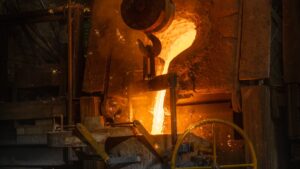
According to preliminary data, Ukrainian steelmakers reduced their production of rolled steel by 9.1% in January–April of this year compared to the same period last year, down to 1.802 million tons.
According to information from the Ukrmetallurgprom association on Monday, 460,800 tons of rolled steel were produced in April, 544,500 tons in March, 390,300 tons in February, and 406,400 tons in January.
As reported, Ukraine’s steel companies increased total rolled steel production by 4.8% in 2025 compared to 2024, reaching 6.521 million tons.
In 2024, Ukraine increased total rolled steel production by 15.8% compared to 2023—to 6.222 million tons from 5.372 million tons.
In 2023, Ukraine increased total rolled steel production by 0.4% compared to 2022—to 5.372 million tons.
In 2022, the country reduced total rolled steel production by 72% compared to 2021—to 5.350 million tons.
In 2021, before the war, 19.079 million tons of rolled steel were produced (103.5%).
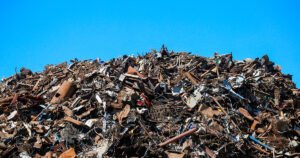
In 2024, ferrous scrap enterprises sharply increased exports of strategic raw materials for steelmaking companies by 60.6% compared to 2023, to 293.1 thousand tons (in 2023, exports amounted to 182.5 thousand tons, in 2022 – 53.6 thousand tons).
According to the Ukrainian Association of Secondary Metals (UAVtormet), scrap collectors increased scrap supplies to Ukrainian steelmakers by 29.8% year-on-year last year to 1.343 million tons.
The technological reserves of ferrous scrap at the enterprises were estimated at 40-50 thousand tons at the end of the year. At the same time, the estimated technological needs of metallurgists for this raw material, according to the Association, are fully met, with an excess of 3.5-5.2%.
Last year, the volume of ferrous scrap procurement increased by 37% to 1.749 million tons. According to UAVtormet, this trend was driven by an increase in steel production at metallurgical and foundry enterprises with a corresponding increase in scrap consumption, as well as the export capabilities of Ukrainian procurement companies during the reporting year.
Scrap imports amounted to 1.2 thousand tons in 2024 and 1.1 thousand tons in 2023.
It is also stated that steel production last year amounted to 7.575 million tons, which is 21.6% more than the previous year.
According to the forecast, Ukraine will produce 6.5-6.8 million tons of steel in 2025 (6.228 million tons were produced in 2023, 6.263 million tons in 2022), and will procure 1.450-1.650 million tons of scrap metal (1 million 277.3 thousand tons in 2023, 996.7 thousand tons in 2022). Steelmakers are also expected to consume 1.1-1.2 million tons of scrap (1 million 34.7 thousand tons in 2023 and 895.7 thousand tons in 2022), export 300-350 thousand tons of scrap (182.5 thousand tons in 2023 and 53.6 thousand tons in 2022), increasing the export of strategic raw materials for steelmakers. Scrap imports are expected to reach 1.5-3 thousand tons.
Earlier, Ukrmetallurgprom President Oleksandr Kalenkov stated in a column on theInterfax-Ukraine website that scrap metal is exported through the European Union, which has a preferential export duty of EUR3 per ton, and from there the raw materials are redirected to real customers. He pointed out that exporting raw materials directly to customers would cost EUR180 in export duties, and the Ukrainian budget has already lost UAH 350 million.
The head of Ukrmetallurgprom called for a temporary ban on the export of ferrous scrap to provide steelmakers with strategically important raw materials during the war. He also clarified that a ton of scrap metal processed into steel brings in ten times the amount of export duties to the EU – up to $300 per ton.
The National Association of Extractive Industries of Ukraine, Ukrmetallurgprom, the Ukrainian Association of Ferroalloy Producers (UkrFA), the All-Ukrainian Union of Construction Materials Producers, and Ukrcement ask President Volodymyr Zelenskyy to instruct the ministries to promptly resume booking employees through the Diia portal.
“We understand and share the president’s desire to put things in order with the booking of workers. However, against the backdrop of questionable decisions by local authorities, the relevant ministries have also completely suspended the booking process,” the letter, which was seen by Interfax-Ukraine, reads.
Its authors recognize that the current reservation procedure is not perfect and contains certain flaws that allow companies that are not in fact critical enterprises to be granted the status of critical enterprises. However, in the associations’ opinion, it is primarily a matter of the possibility of obtaining such a status by decision of local state (military) administrations.
At the same time, the letter states, following a meeting held in early October and the Cabinet of Ministers’ decision to audit the decisions made on reservations, some ministries also suspended the reservation process, although it was declared that this decision did not apply to them. According to the associations, these ministries have completely suspended the processes of confirming the status of critical enterprises and booking employees for truly important enterprises that have already received this status from the relevant ministry. In addition, the possibility of booking employees through the Diia portal has been suspended until November 15.
“We are confident that your instructions were aimed at identifying risks and shortcomings for their further elimination, but were not intended to stop all processes of booking personnel for truly critical enterprises, which could completely stop the economy and lead to catastrophic consequences,” the letter says.
As reported, after the government’s protocol decision of October 8 to audit decisions on recognizing enterprises as critical to the economy, the booking process was effectively paralyzed, which caused protests from many business associations.
On October 22, the government introduced the possibility of repeated audits of companies’ compliance with the criteria of critical importance “if necessary.” The document stipulates that these inspections are to be conducted by the same authorities that initially granted the companies the status of critical. The result of such an audit may be that the company does not meet the criteria of a critical enterprise and that its status is revoked. The authorities must provide a copy of the decision based on the results of the re-inspection to the Ministry of Economy, the Ministry of Defense (the SBU, the Foreign Intelligence Service, the intelligence agency of the Ministry of Defense) and the Ministry of Digital Transformation within one day.
employee, reservations, UKRCEMENT, UKRMETALLURGPROM, ZELENSKY, УкрФА



