
On September 8, the 17th International Conference “Effective Management of Agribusiness Companies” (LFM) will be held. The event will be attended by CEOs of leading agribusiness companies, investors, government officials, experts, innovators, and business owners.
This was reported by Interfax-Ukraine, citing the press service of the organizers—the “Ukrainian Agribusiness Club” and the UCABevent agency.
This year’s conference offers a fresh perspective on agribusiness: how to restructure business models, maintain efficiency amid global changes, adapt to European integration, and prepare for a world where artificial intelligence and autonomous technologies are becoming part of everyday operations.
The organizers promise participants over 8 hours of management training and networking, a format designed for maximum interaction, practical insights, and discussions on key issues. Traditional panel discussions will give way to open dialogue, where participants can ask questions, defend their positions, and influence the direction of the conversation.
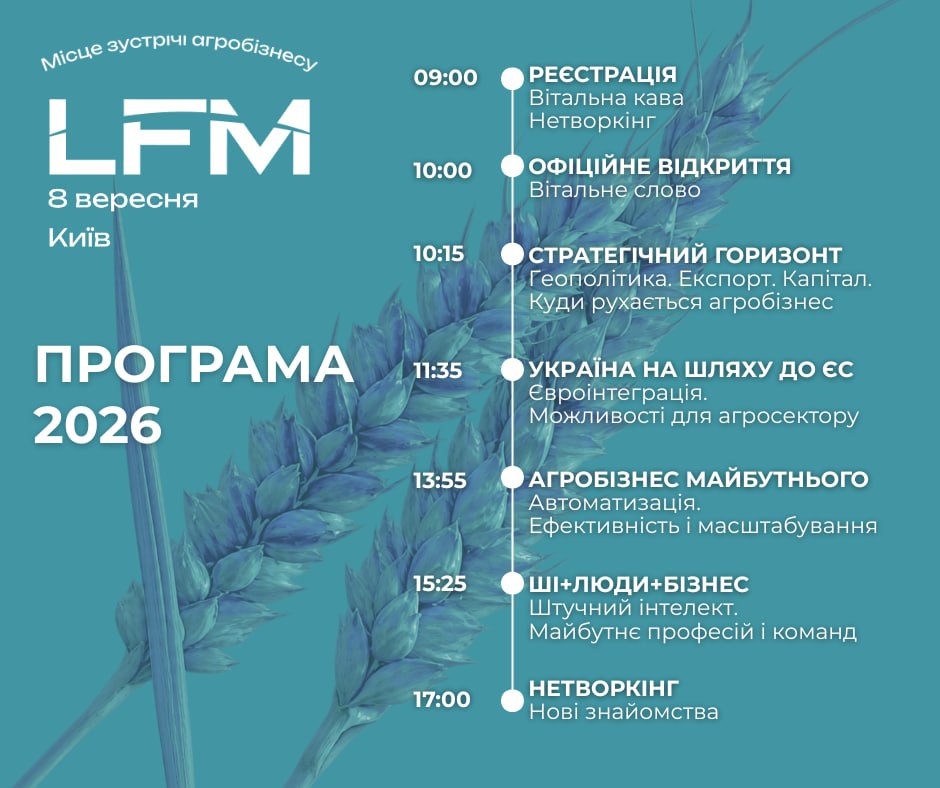
Conference Program
The conference will be opened by Taras Vysotsky, Minister of Economy, Environment, and Agriculture of Ukraine, and Mykola Mazany, CEO of CNH Industrial in Ukraine.
This year’s program consists of four thematic blocks, each of which explores a distinct aspect of agribusiness transformation:
1. The Strategic Horizon of Ukrainian Agribusiness.
Traditional business models no longer guarantee results, and external factors—from logistical constraints and climate risks to shifts in global markets—are forcing companies to rethink their approaches to scaling and management. In this session, we will discuss where the tipping point lies and how businesses can remain resilient in this new reality.
Attendees can expect:
2. Win-win or shock therapy? How Ukraine’s membership will change the EU’s stability.
European integration is creating new rules, standards, and opportunities for the Ukrainian agribusiness sector. What impact will enlargement have on the European economy, and how can the agribusiness sector adapt to the requirements of the Green Deal without losing efficiency?
You’ll find answers to these questions during:
3. Dismantling the Architecture. Is the business community ready to trust processes that humans cannot fully understand?
Agribusiness is entering a period where automation, artificial intelligence, and autonomous technologies are transforming the very logic of production organization. This section focuses on figures, productivity, labor shortages, and the future of the autonomous enterprise:
4. The Last Recruiter. When Will AI Stop Playing the Role of an Assistant?
Artificial intelligence is already transforming not only individual processes but also the labor market itself. The final session of the conference will focus on the professions of the future, the transformation of education, and how businesses can prepare for this new reality.
This part of the conference will cover:
Terms of Participation and Registration
For security reasons, the exact venue will be communicated to registered participants.
Details and registration are available at the following link: https://cutt.ly/7yarHYei

The Verkhovna Rada of Ukraine has appointed Taras Vysotsky, Deputy Minister of Economy, Environment, and Agriculture, as Minister of Agrarian Policy and Food of Ukraine in the new government, according to a correspondent for the Interfax-Ukraine news agency.
The Ministry of Agrarian Policy and Food of Ukraine has been reestablished through the reorganization of the Ministry of Economy, Environment, and Agriculture of Ukraine.
As previously reported, the Ministry of Agrarian Policy and Food was merged into the Ministry of Economic Development, Trade, and Agriculture of Ukraine in 2019. At the end of 2020, the government decided to reinstate the Ministry of Agrarian Policy, and as of 2021, the ministry resumed operations as a separate central executive body.
In July 2025, the Ministry of Agrarian Policy was reorganized once again, and its functions were transferred to the newly created Ministry of Economy, Environment, and Agriculture of Ukraine.
From September 2019 to May 2021 and from July 2025 onward, Vysotsky served as deputy head of the Ministry of Economy, overseeing agricultural policy.
From May 2021, he served as First Deputy Minister of Agrarian Policy and Food until the ministry was merged with the Ministry of Economy. From May 14, 2024, to September 4, 2024, he served as Acting Minister of Agrarian Policy and Food of Ukraine.
The Cabinet of Ministers has introduced a military risk insurance mechanism for farmers, which provides for reimbursement from the budget of up to 60% of the insurance premium paid, according to Taras Vysotsky, First Deputy Minister of Economy, Environment, and Agriculture.
“Access to agricultural insurance in wartime is becoming not just a financial tool, but a key condition for economic stability. That is why the government has introduced a new mechanism: the state reimburses up to 60% of the insurance premium for farmers in frontline communities and up to 45% for other producers,” he wrote on his Facebook page following a meeting with representatives of the agricultural sector.
The Deputy Minister noted that agricultural processing companies are currently facing not only military threats but also challenging weather conditions, such as drought or spring frosts. Due to this combination of factors, the cost of insurance services in the sector remains high.
Vysotsky noted that the Ministry of Economy’s strategic goal is to create a market-oriented system that will combine private insurance, reinsurance, and state support. The ministry is currently consulting with businesses to determine acceptable insurance rates, remove barriers to access to financing, and compile a list of risks that remain uninsured.
“We are ready to carefully consider and gradually implement the solutions and proposals developed by the business community. It is precisely this kind of dialogue that allows us to shape state policy based on the real needs of the economy,” the deputy minister concluded.
As reported, in March 2026, the Cabinet of Ministers adopted Resolution No. 1541, which expanded the military risk insurance program. The maximum amount of insurance premium compensation for businesses was increased from UAH 1 million to UAH 3 million, and the deadline for submitting a claim for payment was reduced to 31 days after the contract is signed. For enterprises operating in frontline regions, compensation for damaged property is available up to UAH 30 million.
The 2026 state budget allocates over UAH 2 billion to support the agricultural sector and related insurance programs, of which UAH 1.8 billion is earmarked to compensate for the cost of Ukrainian-made agricultural machinery under the “Made in Ukraine” policy, as well as separate allocations for partial compensation of insurance premiums for winter crop producers and agricultural processors.
The All-Ukrainian Association of Bakers, the Union “Mukomols of Ukraine” and the Association of bakery enterprises “Ukrkhlebprom” appealed to law enforcement authorities and the National Anti-Corruption Bureau of Ukraine (NABU) with a request to stop the prosecution of the First Deputy Minister of Agrarian Policy and Food Taras Vysotsky and to drop charges against him for using his official position during the state procurement of products in March-April-2022.
“We convincingly ask the leadership of law enforcement agencies, primarily the NABU, to objectively consider all the circumstances and facts, make the right conclusions and stop the prosecution of one of the most decent and professional officials”, – stated in the available “Interfax-Ukraine” appeal of three business associations, uniting the majority of producers of bakery products, flour, cereals and pasta.
The business associations expressed surprise at Vysotskyy’s notification of suspicion of committing a criminal offense under part 2 of Article 364 of the Criminal Code of Ukraine (use of official position to obtain an unlawful benefit for a legal entity contrary to the interests of the service) and assured law enforcement agencies that in this case there was an unfortunate mistake.
“We, as producers of essential products, remember well those extra difficult times of the beginning of the full-scale war with the Russian invaders, which stood on the outskirts of the capital, when it was a question of survival and ensuring food security of the state. A huge role in this process was played by the leadership of the relevant ministry, and first of all by T.M. Vysotsky, because it was thanks to his honest and highly professional actions to manage and coordinate the activities of the industry that it was possible to avoid interruptions and abuses in the supply of food to the population and the AFU”, – said public organizations.
They called the accusations against Vysotskyy groundless and asked law enforcement agencies to carefully familiarize themselves with the position of the Ministry of Agrarian Policy and Food, which they fully share.
As reported, on 24 August, the National Anti-Corruption Bureau of Ukraine (NABU) and the Specialized Anti-Corruption Prosecutor’s Office (SAP) accused the first deputy minister of agrarian policy of Ukraine, Vysotskyy, of abusing 62.5m hryvnyas in the purchase of food products to meet the needs of the state during martial law.
The Ministry of Agrarian Policy published a statement specifying the accusation received by Vysotskyy. In March-April 2022, he allegedly coordinated invoices for regional military administrations (RMAs) for the purchase of imported durum wheat pasta from Olimp LLC and WinsideLight LLC at inflated prices, which caused damage to the state in the amount of UAH 63 million. The investigation indicates that the cost of pasta products as of March-May 2022 ranged from 33.65-36.89 UAH/kg.
“The investigation does not take into account that the State Statistics Service of Ukraine for the period of March-May 2022 provides prices for pasta from durum wheat varieties for 500 g, and the purchase of 1 kg was carried out, so the price exceeded 72 UAH/kg, which excludes damage”, – emphasized in the Ministry of Agrarian Policy and added that the said arithmetical error should be taken into account and corrected by the investigation.
In addition, the investigation was advised to take into account the existence of a public contract for the supply of food products and its terms and conditions, which were not determined by Vysotsky. The Ministry of Agrarian Policy was not a party to the contract, all contracts were agreed upon by the regional military administrations. Vysotsky, in turn, drew the attention of the OVA representatives to the need to conclude deals at the lowest possible prices.




