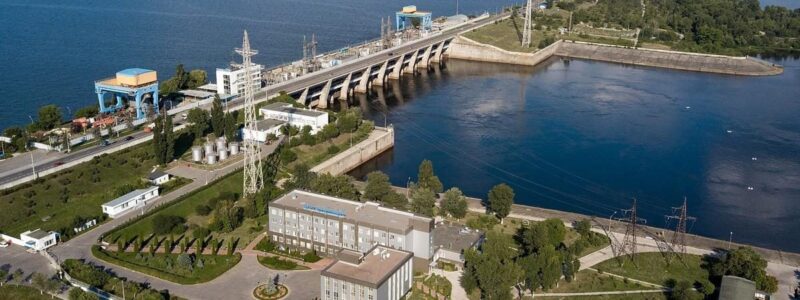
The Agency for Public-Private Partnership Support (PPP Agency) has announced the launch of project preparation for the construction of the Kaniv Pumped Storage Power Plant under the Ukraine Government PPF (Ukraine Government Project Preparation Facility, a program to support the preparation of public investment projects in Ukraine, implemented by the PPP Agency with support from the World Bank).
“We are beginning work on preparing the project for the construction of the Kaniv Pumped Storage Power Plant within the framework of the Ukraine Government PPF. The decision to assign the project for further preparation was adopted by the Interagency Working Group on the Preparation of Public Investment Projects (Project Preparation Unit, PPU) at its 8th meeting. The project initiator is PJSC “Ukrhydroenergo,” according to a Facebook post by the PPP Agency on Wednesday.
The post notes that such large-scale projects “do not start on the construction site” but require thorough preliminary preparation. Accordingly, the PPP Agency will develop a “well-structured investment feasibility study,” an environmental and social impact assessment in accordance with international standards, as well as a clear implementation logic and a sound financing strategy.
To this end, it plans, in particular, to engage consultants through a competitive process.
Given the project’s strategic importance and complexity, the agency will coordinate its preparation with international financial institutions (IFIs), development finance institutions (DFIs), international development partners, and “Ukrhydroenergo.”
The PPP Agency noted that the Kaniv Pumped Storage Power Plant is an important project for the Ukrainian power system, as its highly flexible generating capacity will ensure the balance and reliability of Ukraine’s integrated power system.
As previously reported, in a series of interviews with Interfax-Ukraine and Energoreforma in 2023–2024, Ihor Syrota, then head of Ukrhydroenergo, noted that the company was revising the Kaniv Pumped Storage Power Plant project in light of its experience during the war. According to him, the plant must be buried underground. As he put it, “The Kaniv Pumped-Storage Power Plant project was beautiful, with a glass exterior, but now it needs to be hidden; the plant will be practically invisible.”
At the time, he pointed out that according to the cost estimate prepared in 2014–2015 and converted to hryvnia at the prevailing exchange rate, the Kaniv Pumped-Storage Power Plant would cost EUR 1.5 billion, but this amount would also need to be revised to account for underground construction. According to Syrota, the company had been working to secure loans from international financial institutions for the construction of the pumped-storage power plant, but the war prevented this. However, “Ukrhydroenergo” continued to explore this issue.
At the same time, scientists opposed the construction of the Kaniv Pumped-Storage Power Plant, pointing to the archaeological and historical-cultural value of the area. In response, Syrota noted that the Kaniv Pumped-Storage Power Plant will be built, and there is no more effective regulator of the power system than a pumped-storage plant. He stated that the plant’s operational life would be 100 years and the equipment’s 50 years, and noted that the project had received all necessary permits and was backed by a government decision.
According to information on the “Ukrhydroenergo” website, Ukraine’s Energy Strategy through 2035 calls for the construction of the Kaniv Pumped-Storage Power Plant with a total capacity of 1,000 MW. It will help address the shortage of flexible capacity in Ukraine’s Unified Power System, particularly in light of the projected growth in electricity demand and plans to modernize thermal power plants.
Construction of the Kaniv Pumped-Storage Power Plant began back in 1986 but was halted in 1991. Initially, the plant was designed to have a capacity of 3,600 MW.
Kaniv Pumped-Storage Power Plant, POWER GRID, PPP Agency, UKRHYDROENERGO