
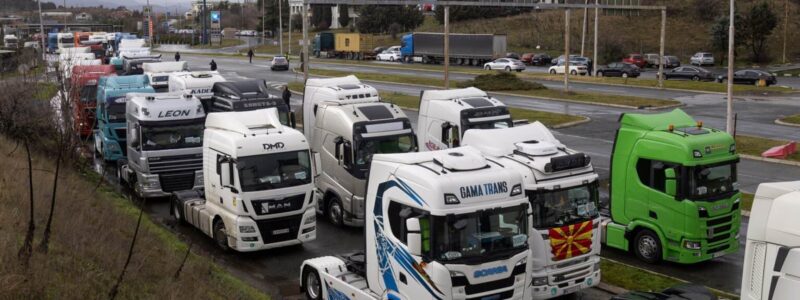
According to the Serbian business publication Parametar, Serbian carriers have officially confirmed preparations for a new regional blockade of freight traffic with the European Union. If a solution to the professional drivers’ issue is not found within the remaining week, freight traffic is scheduled to be halted at the borders of Serbia, Bosnia and Herzegovina, Montenegro, and North Macedonia with the EU starting at 12:00 a.m. on September 14. The action has been declared indefinite—until an acceptable solution is reached by Brussels.
In Serbia, the Association of International Road Carriers PUMEDTRANS plans to stage the action at 21 border crossings and transport points simultaneously. The list includes, in particular, Batrovci on the border with Croatia; Horgos and Kelebia on the border with Hungary; Vatin on the border with Romania; and Gradina on the border with Bulgaria. At major crossings, operations at inbound and outbound freight terminals are expected to be halted; at smaller ones, freight traffic on access roads will be stopped. Controlled passage of vehicles is planned at the intermodal terminal in the port of Novi Sad.
Moreover, this is no longer just a threat, as it was this summer. Following negotiations in early September, carriers decided to go ahead with the protest. On September 1, the European Commission made it clear that it has no intention of changing the basic Schengen rule of a 90-day stay within any 180-day period. Brussels acknowledges the problem faced by drivers, athletes, and other professionals whose jobs require high mobility, but suggests seeking solutions within the framework of existing rules—through long-term visas, residence permits, bilateral agreements, or, in certain cases, cross-border worker status.
For an international truck driver, every day spent in the Schengen Area counts the same as it does for a tourist, even if the driver is merely transiting through Slovenia or Hungary for a few hours. The EES system did not create this restriction, but electronic tracking of entries and exits has made it significantly easier and stricter to enforce. This is precisely what the European Commission confirms.
According to estimates by Serbian carriers, an international driver needs 120–130 days in the Schengen Area per half-year to operate normally. PUMEDTRANS claims that dozens of Serbian drivers are already being turned away at the borders every day, and that the utilization rate of the region’s fleets could have dropped by approximately 50% due to a shortage of available drivers. These are estimates from the industry association itself, not official EU statistics.
The risk is particularly high for Serbia due to the structure of its trade. From January through July 2026, the country’s foreign trade turnover reached 46.6 billion euros, an increase of 6.3% year-over-year. EU countries accounted for 58.6% of this total—approximately 27.3 billion euros in trade over just seven months. On average, this amounts to nearly 129 million euros in trade with the EU per day.
There is also a concrete benchmark for potential losses. During the previous blockade in January, Marko Čadež, president of the Serbian Chamber of Commerce and Industry, estimated the direct losses to the Western Balkan economies resulting solely from the halt in exports at approximately 100 million euros per day. Reuters cited a similar estimate at the time—about 92 million euros per day. The Chamber of Commerce and Industry also warned of fines ranging from 10 to 50 euros for late delivery of components and products
There is also a risk in the opposite direction. A prolonged blockade would delay imports of equipment, components, chemical products, food, and consumer goods into Serbia. However, shortages of food in stores or fuel are not expected after just one or two days of the blockade. A scenario in which the protest lasts a week or longer is significantly more dangerous.
There are no formal plans to block the border for ordinary motorists. But problems for travelers cannot be completely ruled out. The German-Serbian Chamber of Commerce (AHK) has already warned of possible disruptions to both freight and passenger border traffic.
The blockade of freight traffic between Serbia, Bosnia and Herzegovina, Montenegro, and North Macedonia and the European Union, scheduled for September 14, may also partially affect Ukrainian carriers. At the same time, the very reason for the protest—the restriction limiting professional drivers’ stay in the Schengen Area to 90 days within any 180-day period—also applies to Ukrainian citizens if they are traveling under the visa-free regime and do not have another status that allows for a longer stay.
For the bulk of Ukrainian trade with the EU, the direct impact should be limited. The main trucking corridors from Ukraine run directly through Poland, Slovakia, Hungary, and Romania, and Balkan carriers are not blocking these Ukrainian-European crossings. The protest also does not directly affect the main Ukraine–Romania–Bulgaria–Turkey route, nor the route to Greece via Romania and Bulgaria.
The situation is different for Ukrainian cargoes destined for Serbia, Bosnia and Herzegovina, Montenegro, North Macedonia, Albania, or parts of the Adriatic region. For example, a truck traveling from Ukraine to Serbia via Hungary must cross the Serbian-Hungarian border, where protesters plan to halt operations at freight terminals. A similar problem may arise on routes through Romania to Serbia, through Croatia to Bosnia and Herzegovina and Montenegro, as well as at the Bulgarian-Macedonian border.
At the same time, a vehicle’s Ukrainian registration will not guarantee passage. If the protest proceeds as announced and the operation of a freight terminal or access road is physically halted, the delay will affect the entire flow of freight, not just Serbian or Bosnian vehicles.
For Ukraine, the reason behind the Balkan blockade may prove to be far more significant than the blockade itself. Ukrainian international trucking companies are, in fact, in the same legal category as carriers from Serbia, Montenegro, or Bosnia and Herzegovina.
Ukrainian citizens with biometric passports have visa-free access to the Schengen Area, but the standard rules limit stays to no more than 90 days within any 180-day period. Ukraine is explicitly included in the list of visa-exempt third countries in the relevant EU regulation.
Furthermore, on February 13, 2026, the Association of International Road Carriers of Ukraine (AsMAP) issued a separate reminder to Ukrainian carriers regarding the 90/180 rule. The association recommended monitoring entry and exit dates to avoid fines or bans on future entry into the Schengen Area.
In other words, a driver for a Ukrainian transport company who regularly travels, for example, from Ukraine to Germany, France, Italy, or Spain could theoretically face the same problem that Balkan carriers are currently protesting. From the perspective of immigration law, a workday spent behind the wheel of a truck in the Schengen Area still counts as a day spent in the Schengen Area.
The problem became particularly noticeable after the full launch of the European Entry/Exit System (EES). It did not introduce the 90/180-day limit—which already existed—but automated the registration of entries and exits and the calculation of the length of stay. This is exactly how the European Commission explained the situation regarding Balkan drivers on September 1.
At the same time, Ukraine has a very important transportation advantage over most countries in the Western Balkans. The agreement on road freight transport between Ukraine and the EU—the so-called “transport visa-free regime”—has been extended until March 31, 2027. It allows Ukrainian and European carriers to carry out bilateral and transit shipments without the traditional permit system and has become an important part of the “Solidarity Lanes.”
The situation is somewhat different for Ukrainians who legally reside in one of the EU countries. For example, temporary protection or a residence permit allows a person to stay in the country that issued the document for longer than the standard 90 days. However, this does not mean unlimited movement throughout the EU. The European Commission explicitly states that after receiving temporary protection in one EU member state, a Ukrainian citizen may stay in other EU countries for up to 90 days within a 180-day period.
Thus, a Ukrainian driver who has been granted temporary protection—for example, in Poland—has no issues with long-term residence in Poland, but regular trips lasting several weeks through Germany, France, Belgium, the Netherlands, and other countries may still raise questions regarding the permitted duration of stay outside the country of residence.
Brussels itself has already effectively acknowledged the problem. In the first EU Visa Policy Strategy, published by the European Commission on January 29, 2026, international truck drivers are explicitly listed among the professions that may need to stay in various Schengen countries for more than 90 days within a 180-day period. The European Commission has stated that it will explore the possibility of creating a new pan-European “extended short-stay” regime for such professions. However, as of early September, this is merely a direction for future reform, not a current exemption.
Therefore, the Balkan conflict has implications for Ukraine that extend far beyond transportation through Serbia. If carriers in the Western Balkans succeed in securing a special regime for professional drivers at the EU level, Ukrainian international trucking companies will have clear grounds to demand that a similar mechanism be applied to them.
Conversely, if the EU maintains strict enforcement of the 90/180 rule without a pan-European professional exemption, the problem may gradually become more acute for the Ukrainian road transport sector as well. This is particularly important because, since 2022, road transport has become one of the key channels for Ukraine’s foreign trade: the European Commission estimated that, following the implementation of the transport agreement, the volume of Ukrainian road exports to the EU increased by approximately two-thirds, while imports rose by about 300,000 metric tons per month.
Regarding the blockade itself on September 14, the most realistic scenario for Ukraine appears to be as follows: 1–2 days of protests will result primarily in localized delays for cargo bound for the Balkans; a blockade lasting a week could already drive up trucking rates in Southeast Europe, cause vehicles to be rerouted, and increase queues on alternative routes through Hungary, Romania, and Bulgaria. If the protest drags on, the consequences could extend to industrial supply chains between Central Europe, the Balkans, and Ukraine.
#Ukraine #transportation #logistics #driver #EuropeanUnion




