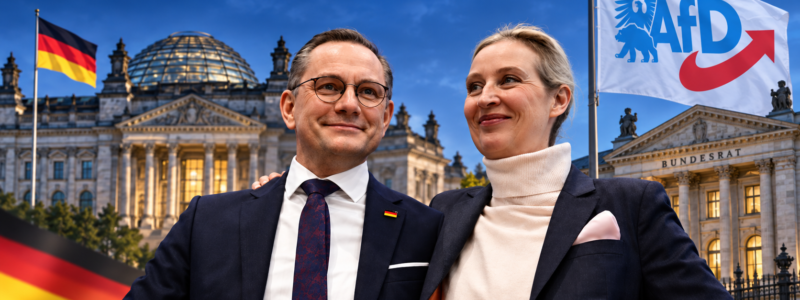
The record victory of the Alternative for Germany (AfD) in the state elections in Saxony-Anhalt does not give the party the ability to independently change Germany’s foreign policy or stop military support for Ukraine, but it is capable of increasing political pressure on the federal authorities, according to an analysis by the Experts Club information and analytical center.
In the September 6 election, AfD received 43.8% of the vote and 39 of the 83 seats in the Landtag. An absolute majority requires 42 deputies. The simplest arithmetic option for creating a majority is an alliance between AfD and the five deputies of the Sahra Wagenknecht Alliance (BSW), which would provide 44 votes. At the same time, there is currently no agreement on such a coalition. The CDU, SPD, Greens and The Left reject cooperation with AfD.
Even if AfD forms a state government, its powers will be focused primarily on education, culture, the police, regional administration, infrastructure and the state budget. Foreign policy and defense, in accordance with Germany’s Basic Law, fall within the competence of the federal government.
“The government of Saxony-Anhalt does not receive a separate vote in NATO and cannot independently cancel federal funding for aid to Ukraine,” emphasized Experts Club founder Maksym Urakin.
Saxony-Anhalt has four of the 69 votes in the Bundesrat. This allows the state government to influence part of federal legislation, especially on issues affecting the powers of the states, but it needs allies among other regions to block decisions.
Magdeburg will also not be able to introduce a political ban on the transit of military cargo for Ukraine. At the same time, state authorities participate in approving certain transport and administrative procedures, so a confrontational stance by the regional authorities could theoretically lead to delays and additional bureaucratic difficulties.
Important Bundeswehr facilities are located in Saxony-Anhalt, including the Army Combat Training Center in the Gardelegen—Letzlingen area, the Klietz training ground, where Ukrainian Leopard 1A5 crews underwent training, as well as logistics units in Burg. At the same time, these structures are subordinate to the federal defense authorities, not to the state government.
The consequences for Ukrainians living in the state itself may become more immediate. AfD advocates reducing social support for Ukrainians, changing approaches to integration programs and strengthening return policies. The state cannot abolish the temporary protection regime established at EU level, but it can influence additional regional programs and administrative practices.