For most of us, “five stars” is synonymous with perfection. However, in Ukraine, this rating often reflects only the quality of the building, not the quality of the stay itself.
The official hotel classification system in Ukraine still relies on state building codes (GSN). The system thoroughly checks the infrastructure: whether the hotel has an elevator and a restaurant, the size of the reception area, and whether it operates 24/7. However, the standards do not regulate the softness of the mattress, the availability of parking spaces, or the staff’s genuine willingness to help in unusual situations.
At the beginning of 2026, only about 220 establishments out of approximately 3,700 had an official category in Ukraine—less than 10% of the market. Among them, there were only about 40 five-star hotels. And when most of the industry operates outside the formal classification system, the premium segment focuses not on state requirements but on international service standards.
For example, in the U.S., Forbes Travel Guide evaluates hotels based on more than 900 criteria, with service accounting for about 70% of the rating. As a result, the Ukrainian market has begun to develop its own hospitality standards—often significantly exceeding the minimum requirements of government regulations.
To understand what the transformation of modern service standards looks like in practice, we analyzed the experience of the Ukrainian complex Apartel Skhidnytsya, which received the prestigious World Luxury Hotel Awards in the category of Luxury Wellness Resort 2025 in Europe. Using this case study as an example, we can see what guests actually pay for at a modern five-star resort.

One of the main shifts in the approach to leisure is the move from basic infrastructure to what hoteliers call “overservice.” This refers to the level of a boutique hotel, but on the scale of a large resort complex.
“In the premium segment, service has long ceased to be merely a set of amenities. Today, it is first and foremost about comfort that requires no extra effort from the guest—from booking dinner to organizing leisure activities or accommodating individual requests. The less a person has to control or decide on their own, and the more they feel that their needs have been taken care of in advance, the higher the actual level of service,” explains Vasily Krulko, entrepreneur and co-founder of the Apartel Resorts hotel chain.
True service begins even before arrival. If a guest’s child loves to play tennis but the property doesn’t have its own courts, the team won’t just shrug their shoulders—they’ll book a court nearby.
All guest requests are recorded in the CRM system: if you’ve ever asked for an extra pillow or four liters of water a day, they’ll be waiting for you automatically on your next visit. It is precisely these details that make guests want to return, and for resorts, this is a key indicator: if the service is consistently good, people return not because of advertising, but because of their own experience.
A beautiful photo shoot no longer gives a hotel an edge. However, a detailed 3D tour that allows guests to walk around the property and view rooms even during the selection phase can be a deciding factor for a guest.
At a Swedish buffet, you might encounter a robot delivering yogurt between tables—a small but noticeable detail that adds a sense of novelty to a premium vacation.
Gradually, technology will also streamline the check-in process. In the future, traditional check-in at the front desk is expected to be replaced by pre-check-in. The idea is that guests can submit their documents and confirm their details while still en route, thereby reducing formalities upon arrival. After arriving, they’ll simply need to pick up their key, without unnecessary waiting or paperwork.

Domestic tourism has grown significantly following the full-scale invasion. According to a study by the digital agency Inweb, 85% of Ukrainians planned to spend their summer vacation within the country in 2025. The Carpathians became the most popular destination, and 54.3% of respondents planned to travel with children. Therefore, a comfortable family vacation and appropriate infrastructure for children have already become a basic requirement.
In addition, about a third of guests travel with pets. Therefore, a pet-friendly hotel must also have a full range of amenities for pets: beds, bowls, welcome kits, and convenient walking routes.
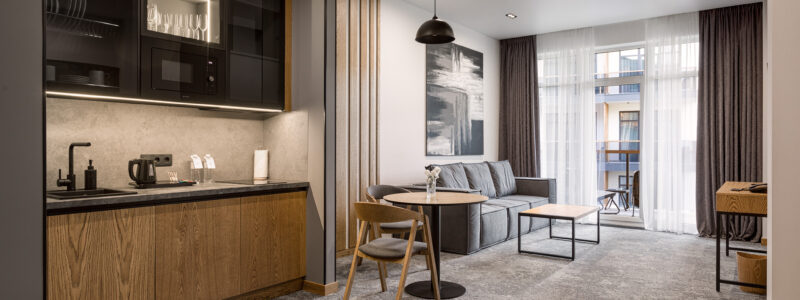
To ensure the vacation remains comfortable for everyone, the space itself becomes crucial. While DBN standards allow a five-star hotel to have rooms starting at 16 m², the Luxury Wellness Resort 2025 standard requires a minimum of 34 m² of fully functional living space, complete with a dining table and a full-size balcony.
Family travel has also driven demand for scale—the “resort-within-a-resort” format, where guests can spend their entire vacation without leaving the premises.
This is achieved through seasonal spaces that operate in different formats: in winter—an ice rink or event venue; in the warmer months—a lounge area or concert stage. The grounds host tea ceremonies, master classes in floristry and pottery, themed tastings, concerts, and other events.
Having a SPA is no longer a competitive advantage today—even lower-category hotels have them. Therefore, the focus is not on the number of zones, but on the guest experience.
Thus, a parmeister appears in the SPA zone, transforming the sauna into a ritual with gongs, and instead of standard wellness programs, a full-fledged biohacking center operates. This is the first complex in Ukraine to implement such an approach, at a time when the market was barely familiar with the term. It involves restoring physical and mental well-being through a combination of natural factors and preventive medicine.
The contrast with formal requirements is telling, since according to DBN, having a nurse on staff is sufficient to obtain 5-star status. Everything else is a matter of the hotel’s own approach to service.

A high level of service is inextricably linked to safety—and to the guest’s sense of that safety. For example, if a guest doubts the cleanliness of a plate in the restaurant, staff can take it to the dishwashing area and demonstrate the entire dishwashing process, including their plate. Such transparency builds trust, as neglecting hygiene can lead to viral outbreaks—as has already happened at popular resorts.
Even technical details affect comfort. For example, using quiet electric equipment instead of gas-powered lawn mowers so the noise doesn’t wake guests in the morning.
Such details may seem insignificant, but they are precisely what shape the overall sense of relaxation. People come to the mountains for peace and quiet, so even technical solutions on the premises begin to influence the quality of the experience.
And finally, privacy. In the premium segment, this is one of the key principles. The resort team has deliberately refrained from publishing photos and videos from actual events where guests are present. If footage from events does appear on social media, it features only people invited specifically for the shoot. “Today, a real guest’s privacy is valued higher than any reach.”
“In many hotels, quality service has long since gone far beyond the formal five-star standard and actually already corresponds to a six- or even seven-star level. It would be interesting if Ukraine were to become the country that introduces such an additional rating. And if the market offers an opportunity to compete for a hypothetical sixth star, we will definitely be among those ready to prove it,” says Ruslan Kachan, CEO of Apartel Skhidnytsya.
As a result, today’s guest pays not so much for square footage or a formal star rating, but for the feeling of a well-planned vacation. A hotel’s ability to anticipate guests’ needs and create a relaxing experience is increasingly referred to as the “sixth star”—a standard that does not exist in official documents but which guests clearly feel during their stay.