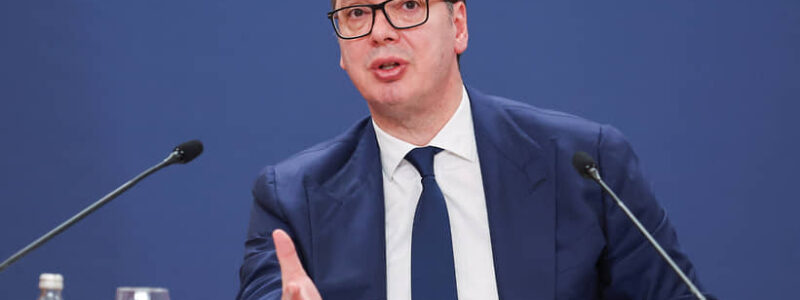
According to Serbian Economist, Serbian President Aleksandar Vucic stated that the country needs “bold and important decisions” and serious reforms in the near future, rather than “revolutionary chaos.” He wrote this in an op-ed for Kurir.
According to Vučić, Serbia must change not only its institutions but also the habits of society, as the country’s future will be determined by hard work, discipline, and the ability to adapt to new technological and energy challenges.
The first point of the plan concerns downsizing the government apparatus. Vučić advocated for a sharp reduction in the number of government members, state secretaries, deputy ministers, and related administrative structures. He also stated the need to abolish a number of agencies, offices, and departments which, in his assessment, lack sufficient justification for their existence. Separately, the president mentioned economic deregulation, including the elimination of unnecessary certification of goods from the EU, which makes them more expensive in Serbia than in the European Union.
The second section concerns labor productivity. Vučić opposed the idea of reducing working hours and stated that Serbia must “work more, not less.” According to him, the country cannot afford an approach that attempts to boost motivation by reducing the number of workdays or hours. He cited Germany as an example, which, in his view, will be forced to increase the workload to compete with China and the United States.
The third point of the plan is a comprehensive reform of education. The president stated that Serbia needs a more open system of higher and vocational education, as well as more active implementation of dual education. According to him, preparing young people for the labor market must become one of the central priorities of educational policy.
The fourth point concerns energy. Vučić stated that Serbia needs to comprehensively address energy issues, including the construction of oil pipelines, gas pipelines, interconnectors, hydroelectric power plants, wind farms, and solar power plants. However, he said that without small and large nuclear power plants, the country will not be able to ensure long-term energy stability. The president called nuclear energy “the cleanest and safest” and noted that one of the main challenges for the future government will be securing the expertise and funding for such projects.
The fifth point is devoted to artificial intelligence, robotics, and modern technologies. Vučić advocated for the “aggressive” acquisition of new knowledge and the continued procurement of supercomputers and construction of data centers. He called data centers “factories of intelligence” that could give Serbia an advantage in the region. At the same time, the president directly linked digital development to the energy sector, noting that the construction of data centers should not be halted due to a shortage of electricity.
For the Serbian economy, the proposed plan represents an attempt to combine administrative reform, increased labor efficiency, technological modernization, and a new energy strategy. In practice, the most challenging aspects may be downsizing the bureaucracy, abandoning populist ideas regarding the labor market, and preparing the country for nuclear energy, which will require significant investment, specialists, a regulatory framework, and public consensus.
https://t.me/relocationrs/2771