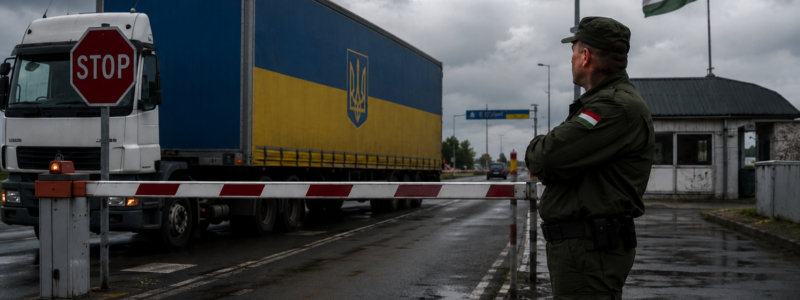
Hungary is reinstating a ban on imports of Ukrainian agricultural products, which had earlier temporarily ceased to be in force due to the expiration of emergency decrees. The new decision is intended to maintain restrictions on Ukrainian goods in the domestic Hungarian market, while the transit of products through the country’s territory, as before, may remain permitted.
According to Hungarian media, the previous ban on the import of more than 20 categories of Ukrainian agricultural products ceased to be in force on May 14 after the expiration of the legal regime on the basis of which it had been introduced. The list of restrictions included grain, oilseeds, flour, poultry meat, eggs and a number of other goods.
After that, Budapest announced its intention to restore the ban, explaining the decision by the need to protect Hungarian farmers and the domestic market. Earlier, Hungarian Minister of Agriculture István Nagy repeatedly stated that the country would not open its market to Ukrainian agricultural products even after the renewal of the trade agreement between the EU and Ukraine.
Hungary’s position remains part of a broader conflict around Ukrainian agricultural exports to the EU. After the start of the full-scale war, the European Union abolished duties and quotas for Ukrainian goods in order to support the Ukrainian economy and compensate for problems with maritime logistics. However, EU border countries, including Hungary, Poland and Slovakia, have stated that cheap Ukrainian products were putting pressure on local farmers.
The Hungarian ban is not a general ban on all Ukrainian exports. It primarily concerns supplies to Hungary’s domestic market. The transit of Ukrainian products to other EU countries or beyond the union had previously been maintained, since for Ukraine land and Danube routes remain an important part of export logistics.
Hungary explains the restrictions by the need to protect farmers from sharp price fluctuations. In 2022, flows of Ukrainian grain and oilseeds to neighboring countries increased sharply due to the reorientation of exports from the Black Sea to European routes. Reuters noted that before the war Hungary annually imported up to 50,000 tonnes of grain and oilseeds from Ukraine, while in 2022 the volume of such supplies rose to 2.5 million tonnes, and in 2023, before the introduction of the ban, amounted to up to 300,000 tonnes.
Corn became the main problematic category for Hungary. According to The Cattle Site, citing customs statistics, during the year after the start of the full-scale war, Ukraine exported 1.7 million tonnes of corn to Hungary, compared with about 30,000 tonnes before the war.
For Ukraine, the Hungarian decision has more political and logistical significance than critical trade significance. The main markets for Ukrainian agricultural exports in the EU are not in Hungary, but in larger consumer and processing countries. However, for border trade and certain commodity groups, the ban limits exporters’ flexibility and increases dependence on licensing, transit routes and agreements with the European Commission.
In 2025, the EU had already revised trade conditions with Ukraine, increasing quotas for a number of goods: for wheat — from 1 million to 1.3 million tonnes, sugar — from 20,000 to 100,000 tonnes, barley — from 350,000 to 450,000 tonnes, and poultry meat — from 90,000 to 120,000 tonnes. These changes were intended to balance support for Ukrainian exports and the interests of farmers in EU countries.