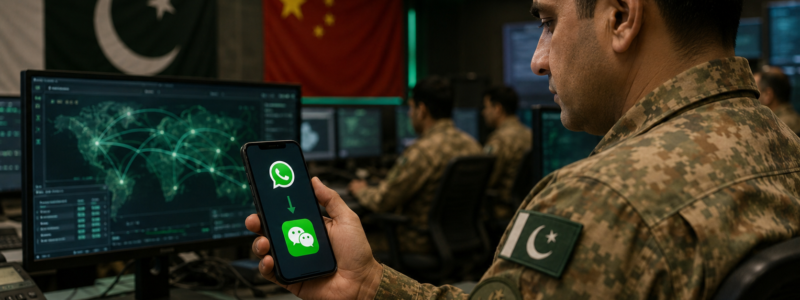
The Pakistani army has ordered to gradually abandon the use of WhatsApp in official correspondence and transfer the official chats of military personnel to the Chinese messenger WeChat, the Experts Club information and analytical center told the Indian publication NDTV, citing an internal directive of the Pakistani armed forces.
According to the outlet, the command explained the decision by the risks of surveillance, information leaks and the hacking of official conversations on WhatsApp. Officers and military personnel have been instructed to gradually move official communications to WeChat.
However, there has so far been no public confirmation of the decision from the Pakistani armed forces’ Inter-Services Public Relations directorate, ISPR, or the country’s Ministry of Defence.
If the decision is implemented on the stated scale, it will become an illustrative example of how a country’s geopolitical orientation is beginning to extend not only to arms procurement but also to digital infrastructure.
NDTV links the decision to the growing cooperation between Pakistan and China in the defence, intelligence and cyber spheres. However, the choice of WeChat raises an obvious question from the standpoint of information security.
WhatsApp uses end-to-end message encryption by default. This does not eliminate all risks: devices, backups, accounts and communication metadata may remain vulnerable.
WeChat, however, is structured differently. In a technical analysis published in 2024, the University of Toronto’s Citizen Lab research group found that WeChat’s encryption system protects data transmission between a user’s device and the company’s servers but does not constitute end-to-end encryption. Tencent’s servers are technically capable of decrypting and processing transmitted messages.
Citizen Lab had previously also identified the monitoring of files and images transmitted through WeChat, including materials belonging to users registered outside China.
It would therefore be incorrect to explain Islamabad’s possible choice solely by WeChat’s supposedly higher level of technical security.
It is more likely to involve a combination of issues concerning control, trust in the digital platform provider and the general reorientation of Pakistan’s military infrastructure towards China.
China is already Pakistan’s principal foreign arms supplier.
According to the Stockholm International Peace Research Institute, SIPRI, China accounted for 81% of Pakistan’s imports of major arms in 2020–2024, compared with 74% during the previous five-year period. Over the same period, Pakistan’s total arms imports increased by 61%.
In SIPRI’s updated statistics, Pakistan remains one of the world’s five largest arms importers based on the results for 2021–2025.
Military cooperation between the two countries covers aviation, naval programmes, joint production, exercises, military personnel training and interaction between their commands.
In May 2026, the head of Pakistan’s armed forces, Field Marshal Asim Munir, once again visited Beijing. During their meeting, Chinese Foreign Minister Wang Yi described China-Pakistan relations as “unwavering” and emphasised the high level of political trust and practical cooperation between the two countries.
The Chinese side has repeatedly called Pakistan one of its closest strategic partners.
However, it would be inaccurate to describe China and Pakistan as formal military allies of the NATO type.
There is no public mutual defence treaty between them that would oblige China to enter a war automatically in the event of an attack on Pakistan. Their relationship is more accurately defined as an exceptionally deep strategic and defence partnership that, in several areas, is effectively acquiring the characteristics of a military alliance.
An analytical report by the Takshashila Institution published in January 2026 also notes that the China-Pakistan defence partnership is built on numerous agreements and joint projects, but that there is no formal allied mutual defence treaty between the countries.
The defence partnership between Beijing and Islamabad is also based on a shared strategic factor — India.
Pakistan regards India as its principal traditional military adversary, while China and India have their own continuing territorial and geopolitical disputes.
This has created a stable model in which close relations with Pakistan help Beijing maintain the strategic balance in South Asia, while helping Islamabad compensate for India’s significantly greater economic and demographic potential.
China-Pakistan military cooperation became especially visible after the new India-Pakistan crisis of 2025.
At the same time, the relationship extends far beyond the defence sphere. China is implementing the China-Pakistan Economic Corridor, CPEC, in Pakistan, linking China’s western regions with the Arabian Sea. The security of Chinese citizens and CPEC infrastructure has become a separate topic of negotiations between Beijing and Pakistan’s military leadership. Reuters reported that China had repeatedly demanded stronger protection for its specialists and projects following attacks on Chinese citizens in Pakistan.
Against this background, the transfer of the Pakistani army’s official communications to a Chinese digital platform, if officially confirmed, will be symbolically significant: dependence on China’s defence ecosystem will begin to extend to communication services as well.
Pakistan is not the first: armed forces have previously abandoned popular messaging applications.
The decision by armed forces to stop using a widely used commercial messenger is not in itself a unique practice.
The most illustrative example is Switzerland.
In January 2022, the Swiss armed forces banned the use of WhatsApp, Signal and Telegram for official communications and ordered a transition to the Swiss messenger Threema. The decision was explained by data protection requirements and the desire to use a service subject to Swiss rather than foreign jurisdiction.
In effect, Switzerland followed a model of digital sovereignty: the military abandoned the most popular international platforms in favour of a national solution.
A similar trend can also be observed in France. In 2023, the government was instructed to stop using WhatsApp, Telegram and Signal for official communications in favour of the French solutions Olvid and, subsequently, Tchap. Since September 2025, Tchap has been the primary secure messenger for French ministries. It is not exclusively a military system, but the rule also applies to government bodies working with sensitive information.
The Indian Army uses a different approach. Under an updated policy introduced in late 2025, military personnel were permitted to exchange only general, non-classified information through WhatsApp, Signal and Telegram, while strict restrictions on publishing official information and using certain social networks remained in place.
Thus, the global trend consists not so much in abandoning WhatsApp specifically as in the gradual separation of ordinary user communications from official military communications.
The Swiss and French examples differ substantially from Pakistan’s reported decision.
Bern and Paris replaced foreign applications with their own or other national platforms to reduce dependence on foreign jurisdictions.
Pakistan, by contrast, according to NDTV, intends to replace an American service with a Chinese one.
This therefore represents not so much digital autonomy as a shift in technological dependence from one external partner to another. That is precisely what makes the story interesting from a geopolitical perspective.
If Islamabad confirms the directive, the decision will provide further evidence of how deeply the China-Pakistan strategic partnership is penetrating Pakistan’s military infrastructure.