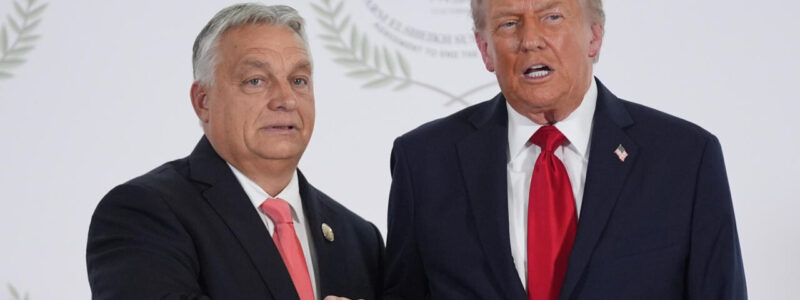
The administration of U.S. President Donald Trump is considering nominating former Hungarian Prime Minister Viktor Orbán for the position of UN Secretary-General, hoping to secure the support of Russia and China. U.S. officials have already discussed this initiative with the Hungarian politician, but a final decision on his participation in the election has not yet been made, The Wall Street Journal (WSJ) reported on October 25, 2026, citing sources in three countries.
According to the publication, the idea of nominating Orbán initially originated within the U.S. administration, after which American officials suggested that the former Hungarian prime minister consider running for the position of UN secretary-general.
Washington hopes that Orbán could become a joint candidate of the U.S., Russia, and China, as he has maintained political contacts with the leadership of all three countries.
A U.S. State Department official told the WSJ that, according to preliminary estimates, Orbán can count on the support of eight out of the 15 members of the UN Security Council. Under favorable circumstances, the number of votes in his favor could rise to ten.
However, to recommend a candidate for Secretary-General, at least nine Security Council votes are required, provided there is no veto from any of the five permanent members—the U.S., Russia, China, the United Kingdom, and France.
Thus, even with the support of Washington, Moscow, and Beijing, Orbán’s appointment will depend on the stance of the remaining Security Council members, primarily London and Paris.
According to the WSJ, representatives of the Trump administration view Orbán’s political experience and his ideological affinity with the American conservative MAGA movement favorably.
In particular, officials in Washington are noting his long-standing policy of restricting migration, his conflicts with European institutions, and his experience governing the country amid international political pressure.
It is expected that, should Orbán be officially nominated, U.S. President Donald Trump and Vice President J.D. Vance may publicly support him. However, according to the publication’s sources, such an announcement may be postponed until after the U.S. midterm elections in November 2026.
Orbán himself, according to journalists, has expressed interest in the proposal but is not ready to launch a campaign without sufficient confidence in his chances of being elected.
The White House, Moscow, and Beijing have not officially confirmed the information regarding the coordinated nomination of the Hungarian politician. Furthermore, as of October 26, his name is not included in the list of officially nominated candidates published by the UN.
The WSJ report was published in the Opinion section. The publication cites its own sources regarding the negotiations.
The term of current UN Secretary-General António Guterres ends on December 31, 2026. His successor is scheduled to take office on January 1, 2027.
According to the UN Charter, the Secretary-General is appointed by the General Assembly upon the recommendation of the Security Council. The election of the organization’s new leader will take place sometime in 2026.
Several international politicians and diplomats are vying for the position, including Rafael Gross, Director General of the International Atomic Energy Agency, and Rebecca Greenspan, Secretary-General of the United Nations Conference on Trade and Development.
Orbán’s potential nomination could spark further debate regarding the foreign policy direction of the future UN leadership, particularly in the context of the Russia-Ukraine war.
During his tenure as head of the Hungarian government, Orbán maintained contacts with Russian President Vladimir Putin and repeatedly opposed certain EU sanctions and financial decisions regarding Russia and Ukraine.
In particular, his government blocked the approval of certain European initiatives to provide financial support to Kyiv, explaining its position by the need to protect Hungary’s national economic interests.
Following Orbán’s defeat in the parliamentary elections on April 12, 2026, the new government led by Péter Magyar announced its intention to improve relations with European institutions.
Viktor Orbán was born on May 31, 1963, in Székesfehérvár, Hungary. He graduated from the Faculty of Law at Eötvös Loránd University in Budapest. In 1988, he became one of the founders of the Fidesz party. He first served as Hungary’s prime minister from 1998 to 2002, then returned to the post in May 2010 and held it until 2026. During his years leading the country, he established a conservative political agenda based on national sovereignty, restrictions on immigration, and a critical stance toward certain aspects of European Union policy. In the parliamentary elections on April 12, 2026, his party, Fidesz, was defeated by the opposition party Tisa, led by Péter Magyar. Orbán stepped down as prime minister after 16 years of uninterrupted rule.