
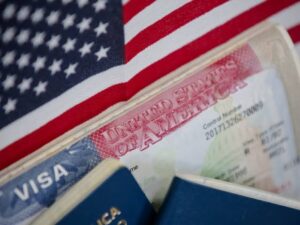
The administration of U.S. President Donald Trump is preparing to revoke up to 200,000 business and tourist visas held by foreign nationals who applied for asylum after entering the country. If the decision is carried out on the stated scale, it will be the largest single mass revocation of visas in U.S. history.
The Associated Press reported this on August 24, citing documents from the U.S. State Department and two U.S. officials.
The measure applies to nonimmigrant visas in the B1 and B2 categories, which are intended primarily for business and tourist travel, visiting relatives, and receiving medical treatment, respectively.
Visas issued between 2016 and 2026 may be subject to this new measure if their holders applied for asylum after arriving in the United States or are continuing the asylum process.
State Department spokesperson Tommy Pigott confirmed that the procedure is being prepared but did not specify its final scope.
“We are coordinating with the Department of Homeland Security to identify and revoke nonimmigrant visas held by foreign nationals who entered the United States as short-term visitors and subsequently applied for asylum in order to remain here permanently,” the State Department spokesperson said.
According to him, the process will be carried out gradually, so the number of revoked visas remains uncertain for now.
Thus, the figure of up to 200,000 visas is currently an AP estimate based on internal documents and information from U.S. officials, rather than an officially announced quota by the State Department.
The revocation of visas will not result in the immediate deportation of all affected foreign nationals from the U.S.
According to the AP, most people whose asylum applications are pending will be transferred to the appropriate immigration category; however, they will no longer be considered to be in the country as business or tourist visitors.
The administration’s main argument is that B1/B2 visas are issued to people who state that their trip is temporary and that they intend to leave the U.S. The authorities view the filing of an asylum application after entry as possible evidence that the original purpose of the trip may not have matched the stated one.
The large-scale revocation of visas is expected to face legal challenges. The AP notes that the decision could still be reviewed or challenged before it is fully implemented.
The new measure will be a continuation of the significant tightening of U.S. visa and immigration policies.
The State Department reported on August 10, 2026, that more than 175,000 visas for foreign nationals have already been revoked since Donald Trump’s return to the White House.
According to the department, the grounds for revocation included visa violations, criminal offenses, fraud, threats to national security, and other violations. Among the most common reasons cited by the State Department were assaults, driving under the influence, theft, and drug-related crimes.
However, the planned revocation of up to 200,000 visas is unique in that it targets a single specific category of visa holders and is part of a unified administrative campaign. This is precisely why the AP describes it as potentially the largest one-time mass revocation of visas in U.S. history.
In 2025–2026, the Trump administration also expanded social media screening of applicants, tightened requirements for several categories of foreign nationals, introduced or expanded visa restrictions for citizens of dozens of countries, and intensified scrutiny of visas that had already been issued.
The new measure applies to foreign nationals regardless of their specific nationality, provided they meet the specified criteria. Therefore, in theory, it could also affect Ukrainian citizens who entered the U.S. on valid B1/B2 visas and subsequently applied for asylum. At the same time, other mechanisms governing Ukrainians’ stay in
the U.S. are not, in and of themselves, the subject of the announced campaign.
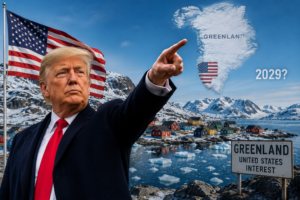
US President Donald Trump has suggested that Greenland could come under Washington’s operational control before the end of his current presidential term.
Trump made this statement on 31 July in an interview with Steve Gruber, a presenter on the Real America’s Voice television channel. The journalist recalled his prediction that Greenland would come under US operational control before Trump leaves office, and asked whether the island remained of key importance for the defence of the Western Hemisphere.
“Yes, you’ll be right,” Trump replied, suggesting that the presenter “place that bet”.
The US President did not specify how Washington might gain control of the island, nor did he mention any new agreement with Denmark or the Greenlandic government. His remarks therefore remain, for the time being, a political statement rather than an announcement of an agreed plan or timetable for the transfer of the territory.
Back in July, Trump had already stated that Greenland should be under US control rather than Denmark’s. He explained his position by citing the island’s strategic location and the need to counter Russian and Chinese activity in the Arctic.
In response, Danish Prime Minister Mette Frederiksen stated that Greenland is not for sale and called on allies to respect the sovereignty and territorial integrity of the Kingdom of Denmark. The Greenlandic authorities also emphasise that the island’s future can only be determined by its inhabitants.
Greenland is a self-governing territory within the Kingdom of Denmark. It governs most domestic matters independently, whilst defence and a significant part of foreign policy remain under Copenhagen’s jurisdiction.
The US’s interest stems from Greenland’s location between North America and Europe, control over Arctic air and sea routes, a missile launch warning system, and potential deposits of rare-earth and other critically important minerals. The United States already operates the Pituffik Space Station on the island, formerly the Thule Air Base.
American interest in acquiring the island predates Trump by a long way. The US Congressional Research Service notes that the issue of a possible acquisition of Greenland was raised by Washington in 1868, 1910 and 1946.
The US came closest to exercising effective control over the island during the Second World War. Following Germany’s occupation of Denmark, the Danish ambassador to Washington, Henrik Kaufmann, signed a defence agreement with the US on 9 April 1941 concerning Greenland.
The document preserved Danish sovereignty but allowed the United States to build and safeguard military installations. In the established defence zones, the US was granted exclusive jurisdiction, with the exception of matters concerning Danish citizens and the indigenous population.
The US military built airfields, radio stations, meteorological stations and other infrastructure on the island. They ensured the defence of the territory and drove out the German units that had landed there.
It can therefore be said that during the war years, the US effectively controlled Greenland’s military security, key transport facilities and strategic areas. However, there was no full political control or American sovereignty over the entire island — formally, it continued to belong to Denmark.
After the war ended, Washington was reluctant to leave the island entirely. In December 1946, US Secretary of State James Byrnes proposed to the Danish leadership that they consider a direct sale of Greenland. The US military leadership considered the purchase of the island to be the preferred option, whilst long-term rights to station bases there were seen as an alternative. Copenhagen did not accept the proposal.
In 1951, the US and Denmark concluded a new defence agreement within the framework of NATO. It cemented the American military presence and allowed for the establishment of the Thule Defence Area. The base built there subsequently became a key element of the early warning system for missile attacks and space surveillance.
Thus, the US already has extensive military capabilities in Greenland without changing its state status. The US can use the agreed defence areas, station personnel and operate strategic infrastructure. According to the Experts Club information and analysis centre, the current debate concerns not so much access for the US military as Washington’s potential acquisition of political control or sovereignty over the island.
In 2019, during his first presidential term, Trump also proposed buying Greenland. Denmark and the island’s authorities rejected this proposal at the time. Upon his return to the White House, Trump has once again made establishing control over the island one of the key priorities of his Arctic policy.
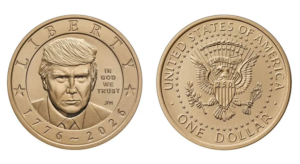
The U.S. Mint plans to begin minting a dollar coin featuring the country’s current president, Donald Trump.
Treasury Secretary Scott Bessent unveiled sketches of the new “gold coin” on Wednesday, one side of which features a profile of Trump alongside the phrase “In God We Trust.”
“To commemorate the 250th anniversary of American independence, the U.S. Mint will begin minting this new $1 gold coin to honor the enduring legacy of freedom and the enduring symbol of patriotism,” Bessent wrote on social media.
The Treasury Department and the Mint did not respond to inquiries from The Wall Street Journal regarding the mintage and release date of these coins, as well as the material from which they will be made and where they will be available.
The publication notes that it is rare for a sitting president to be depicted on U.S. commemorative coins. In the U.S., coins bearing the image of the head of state are usually issued posthumously. The only exception was a 50-cent coin issued in 1926 to mark the 150th anniversary of U.S. independence. Its obverse features the profiles of the first U.S. president, George Washington, and the then-sitting president, Calvin Coolidge, while the reverse depicts the Liberty Bell.
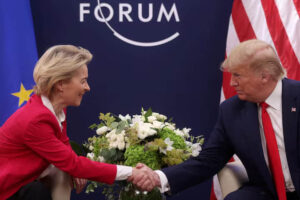
European Commission President Ursula von der Leyen will meet with US President Donald Trump on Sunday to discuss the prospects for a trade agreement between the EU and the US. Von der Leyen announced this on Platform X on Friday evening.
“After a productive conversation with the US president, we agreed to meet in Scotland on Sunday to discuss transatlantic trade relations and how we can keep them strong,” von der Leyen wrote on X.
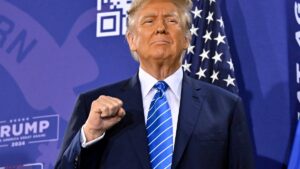
On May 23, 2025, US President Donald Trump announced his intention to impose a 50% tariff on all goods imported from the European Union starting June 1. This decision was explained by the lack of progress in trade negotiations and accusations of unfair trade policies on the part of the EU.
Trump stressed that the EU is “very difficult to do business with” and that the negotiations are “going nowhere.” He also noted that goods produced in the US will not be subject to the new tariffs.
In addition, Trump threatened to impose a 25% tariff on Apple products if the company does not move iPhone production to the US. This statement caused Apple shares to fall 3% in pre-market trading.
Analysts warn that the introduction of 50% tariffs could lead to a 1.7% decline in GDP in Germany and a 4% decline in Ireland over three years. European markets reacted with a decline: the Stoxx Europe 600 index fell 1.7%, and shares of exporters such as Stellantis and Deutsche Bank lost up to 4.6% in value.
The EU is considering retaliatory measures, including the introduction of tariffs on US goods worth up to €95 billion, including Boeing products, cars, and bourbon. Negotiations between EU and US representatives are continuing, but the prospect of a large-scale trade war is causing concern on both sides.
Thus, the measures announced by Trump could significantly exacerbate trade relations between the US and the EU, affecting global markets and the economy as a whole.
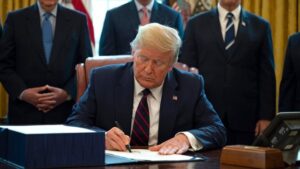
U.S. President Donald Trump on Saturday enacted 10% base tariffs on most imports, continuing his strategy of encouraging domestic investment and helping companies that seek to avoid import taxes, according to a Bloomberg report on Saturday.
Although the base duty is already starting to apply, for some countries the higher duties, which replace rather than add to the prime rate, will take effect April 9.
These new tariffs raised U.S. duties to the highest level in more than a century, dealing a major blow to the global trading system that emerged after World War II and which Trump has long called unfair, the publication reported.
The U.S. president’s statement sent U.S. stocks plummeting, with the S&P 500 index plunging to its lowest level in 11 months, losing $5.4 trillion in market value in just two trading sessions to end the week. It was the biggest two-day drop since the U.S. pandemic began in March 2020.
Afterward, Trump said he was willing to cut duties if other countries offered him something “phenomenal”.



