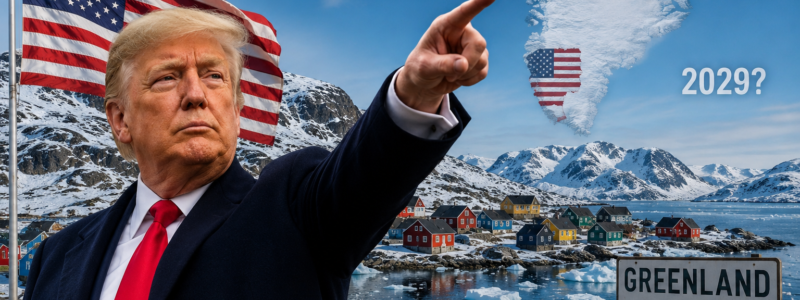
US President Donald Trump has suggested that Greenland could come under Washington’s operational control before the end of his current presidential term.
Trump made this statement on 31 July in an interview with Steve Gruber, a presenter on the Real America’s Voice television channel. The journalist recalled his prediction that Greenland would come under US operational control before Trump leaves office, and asked whether the island remained of key importance for the defence of the Western Hemisphere.
“Yes, you’ll be right,” Trump replied, suggesting that the presenter “place that bet”.
The US President did not specify how Washington might gain control of the island, nor did he mention any new agreement with Denmark or the Greenlandic government. His remarks therefore remain, for the time being, a political statement rather than an announcement of an agreed plan or timetable for the transfer of the territory.
Back in July, Trump had already stated that Greenland should be under US control rather than Denmark’s. He explained his position by citing the island’s strategic location and the need to counter Russian and Chinese activity in the Arctic.
In response, Danish Prime Minister Mette Frederiksen stated that Greenland is not for sale and called on allies to respect the sovereignty and territorial integrity of the Kingdom of Denmark. The Greenlandic authorities also emphasise that the island’s future can only be determined by its inhabitants.
Greenland is a self-governing territory within the Kingdom of Denmark. It governs most domestic matters independently, whilst defence and a significant part of foreign policy remain under Copenhagen’s jurisdiction.
The US’s interest stems from Greenland’s location between North America and Europe, control over Arctic air and sea routes, a missile launch warning system, and potential deposits of rare-earth and other critically important minerals. The United States already operates the Pituffik Space Station on the island, formerly the Thule Air Base.
American interest in acquiring the island predates Trump by a long way. The US Congressional Research Service notes that the issue of a possible acquisition of Greenland was raised by Washington in 1868, 1910 and 1946.
The US came closest to exercising effective control over the island during the Second World War. Following Germany’s occupation of Denmark, the Danish ambassador to Washington, Henrik Kaufmann, signed a defence agreement with the US on 9 April 1941 concerning Greenland.
The document preserved Danish sovereignty but allowed the United States to build and safeguard military installations. In the established defence zones, the US was granted exclusive jurisdiction, with the exception of matters concerning Danish citizens and the indigenous population.
The US military built airfields, radio stations, meteorological stations and other infrastructure on the island. They ensured the defence of the territory and drove out the German units that had landed there.
It can therefore be said that during the war years, the US effectively controlled Greenland’s military security, key transport facilities and strategic areas. However, there was no full political control or American sovereignty over the entire island — formally, it continued to belong to Denmark.
After the war ended, Washington was reluctant to leave the island entirely. In December 1946, US Secretary of State James Byrnes proposed to the Danish leadership that they consider a direct sale of Greenland. The US military leadership considered the purchase of the island to be the preferred option, whilst long-term rights to station bases there were seen as an alternative. Copenhagen did not accept the proposal.
In 1951, the US and Denmark concluded a new defence agreement within the framework of NATO. It cemented the American military presence and allowed for the establishment of the Thule Defence Area. The base built there subsequently became a key element of the early warning system for missile attacks and space surveillance.
Thus, the US already has extensive military capabilities in Greenland without changing its state status. The US can use the agreed defence areas, station personnel and operate strategic infrastructure. According to the Experts Club information and analysis centre, the current debate concerns not so much access for the US military as Washington’s potential acquisition of political control or sovereignty over the island.
In 2019, during his first presidential term, Trump also proposed buying Greenland. Denmark and the island’s authorities rejected this proposal at the time. Upon his return to the White House, Trump has once again made establishing control over the island one of the key priorities of his Arctic policy.