
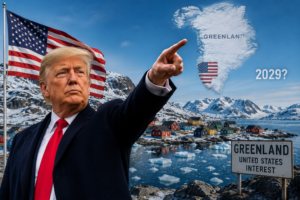
US President Donald Trump has suggested that Greenland could come under Washington’s operational control before the end of his current presidential term.
Trump made this statement on 31 July in an interview with Steve Gruber, a presenter on the Real America’s Voice television channel. The journalist recalled his prediction that Greenland would come under US operational control before Trump leaves office, and asked whether the island remained of key importance for the defence of the Western Hemisphere.
“Yes, you’ll be right,” Trump replied, suggesting that the presenter “place that bet”.
The US President did not specify how Washington might gain control of the island, nor did he mention any new agreement with Denmark or the Greenlandic government. His remarks therefore remain, for the time being, a political statement rather than an announcement of an agreed plan or timetable for the transfer of the territory.
Back in July, Trump had already stated that Greenland should be under US control rather than Denmark’s. He explained his position by citing the island’s strategic location and the need to counter Russian and Chinese activity in the Arctic.
In response, Danish Prime Minister Mette Frederiksen stated that Greenland is not for sale and called on allies to respect the sovereignty and territorial integrity of the Kingdom of Denmark. The Greenlandic authorities also emphasise that the island’s future can only be determined by its inhabitants.
Greenland is a self-governing territory within the Kingdom of Denmark. It governs most domestic matters independently, whilst defence and a significant part of foreign policy remain under Copenhagen’s jurisdiction.
The US’s interest stems from Greenland’s location between North America and Europe, control over Arctic air and sea routes, a missile launch warning system, and potential deposits of rare-earth and other critically important minerals. The United States already operates the Pituffik Space Station on the island, formerly the Thule Air Base.
American interest in acquiring the island predates Trump by a long way. The US Congressional Research Service notes that the issue of a possible acquisition of Greenland was raised by Washington in 1868, 1910 and 1946.
The US came closest to exercising effective control over the island during the Second World War. Following Germany’s occupation of Denmark, the Danish ambassador to Washington, Henrik Kaufmann, signed a defence agreement with the US on 9 April 1941 concerning Greenland.
The document preserved Danish sovereignty but allowed the United States to build and safeguard military installations. In the established defence zones, the US was granted exclusive jurisdiction, with the exception of matters concerning Danish citizens and the indigenous population.
The US military built airfields, radio stations, meteorological stations and other infrastructure on the island. They ensured the defence of the territory and drove out the German units that had landed there.
It can therefore be said that during the war years, the US effectively controlled Greenland’s military security, key transport facilities and strategic areas. However, there was no full political control or American sovereignty over the entire island — formally, it continued to belong to Denmark.
After the war ended, Washington was reluctant to leave the island entirely. In December 1946, US Secretary of State James Byrnes proposed to the Danish leadership that they consider a direct sale of Greenland. The US military leadership considered the purchase of the island to be the preferred option, whilst long-term rights to station bases there were seen as an alternative. Copenhagen did not accept the proposal.
In 1951, the US and Denmark concluded a new defence agreement within the framework of NATO. It cemented the American military presence and allowed for the establishment of the Thule Defence Area. The base built there subsequently became a key element of the early warning system for missile attacks and space surveillance.
Thus, the US already has extensive military capabilities in Greenland without changing its state status. The US can use the agreed defence areas, station personnel and operate strategic infrastructure. According to the Experts Club information and analysis centre, the current debate concerns not so much access for the US military as Washington’s potential acquisition of political control or sovereignty over the island.
In 2019, during his first presidential term, Trump also proposed buying Greenland. Denmark and the island’s authorities rejected this proposal at the time. Upon his return to the White House, Trump has once again made establishing control over the island one of the key priorities of his Arctic policy.

Oil prices fell significantly on Thursday, with traders’ attention shifting back to supply and demand prospects after the hype around Greenland subsided.
Speaking at the World Economic Forum in Davos on Wednesday, US President Donald Trump said that the United States wants to immediately begin negotiations to purchase Greenland from Denmark and does not intend to use military force to seize the island.
Trump later wrote on Truth Social that he had abandoned plans to impose tariffs on a number of European countries in February because he had been able to agree with NATO Secretary General Mark Rutte on a basis for further negotiations on Greenland.
“We are now seeing a decline in the risk premium associated with events surrounding Greenland and the situation in Iran,” said Saxo Bank analyst Ole Hansen.
The price of March Brent futures on the London ICE Futures exchange at 13:15 GMT is $64.42 per barrel, which is $0.82 (1.26%) lower than at the close of previous trading.
WTI crude oil futures for March delivery on the New York Mercantile Exchange (NYMEX) rose in price by $0.76 (1.25%) to $59.86 per barrel.
On Thursday, the market’s attention is focused on the weekly report on energy reserves in the US, which will be released at 7:00 p.m.
Estimates from the American Petroleum Institute (API), published on Wednesday night, showed an increase in US oil reserves last week of 3.04 million barrels.
Traders also continue to monitor the situation in Kazakhstan, where oil production at the Tengiz and Royal fields was suspended this week due to problems with the power distribution systems.
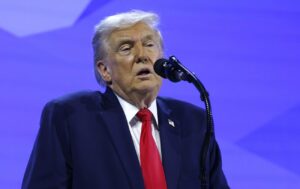
US President Donald Trump, speaking at the World Economic Forum in Davos, reiterated his intention to seek control over Greenland and, commenting on the topic, said: “I’m just asking for a piece of ice.”
According to Reuters and AP, Trump claimed that the US would not use force to obtain the island, while insisting on the need for negotiations and calling Washington’s request a “small request” in the context of the US’s role in ensuring the security of its allies.
Greenland is an autonomous territory within the Kingdom of Denmark. Trump’s statements about a possible change in the island’s status previously provoked a sharp reaction in Europe, where the inadmissibility of a forceful scenario and the importance of respecting sovereignty were emphasized.
The island is interesting for its reserves and prospects for the extraction of critically important minerals, including rare earth elements, which are important for high-tech industries and energy transition.
Greenland is also associated with the planet’s largest reserves of fresh water in the form of ice – together with Antarctica, the ice sheets contain more than 99% of the Earth’s fresh ice.
Its key advantage is its geography: its location on Arctic and North Atlantic routes, including the GIUK (Greenland-Iceland-United Kingdom) area, which NATO considers a strategic maritime “corridor” between the Arctic and the Atlantic.

Gold and silver prices hit new highs on Monday amid increased demand for safe-haven assets due to the situation surrounding Greenland.
Traders fear that increased pressure from US President Donald Trump, who is laying claim to Greenland, will provoke a large-scale trade war between the US and Europe.
On Saturday, Trump announced that he would impose 10% tariffs on a number of European countries that support Denmark and Greenland starting in February. From June 1, 2026, the tariffs for these countries will be 25% and will remain in effect “until an agreement is reached on the full purchase of Greenland by Washington,” Trump said.
European countries are ready for a coordinated response to the introduction of US tariffs, said European Commission President Ursula von der Leyen. According to the Financial Times, EU countries are considering imposing tariffs on US goods worth €93 billion or a series of restrictions on American companies.
The trade tensions surrounding Greenland are different from last year’s situation with the US imposing large-scale tariffs, notes Charu Chanan, chief investment strategist at Saxo Markets in Singapore.
“The use of tariff threats within NATO is a kind of blow to confidence that could provoke a more persistent risk premium on asset values,” she says.
The spot price of gold rose 1.6% to $4,670.47 per ounce by 9:30 a.m. on Monday, while silver rose 3.4% to $93.1755 per ounce. During the session, the price of gold rose to a record $4,690.59 per ounce, and silver to $94.1213 per ounce.
“Geopolitical risks are intensifying,” said Kyle Rodda, an analyst at Capital.com Inc. in Melbourne. “New trade uncertainty is clouding the growth outlook, and US foreign policy is undermining confidence in the dollar. This is the perfect set of conditions for gold and silver prices to rise.”
US stock index futures are down 0.8-1.3% on Monday. Trading activity on the futures market is weak as US exchanges are closed for the Martin Luther King Jr. holiday.
Reference: The Experts Club analytical center previously released a video analysis of the twenty largest silver-producing countries and their competition for leadership in 1971-2024 – https://www.youtube.com/shorts/HvKK-YET8vs
The Experts Club also previously presented an analysis of the world’s leading gold-producing countries — https://youtube.com/shorts/DWbzJ1e2tJc?si=BywddHO-JFWFqUFA

US President Donald Trump has announced the introduction of 10% tariffs against Denmark, Norway, Sweden, France, Germany, the UK, the Netherlands, and Finland from February 1, Clash Report reports.
“Starting February 1, 2026, all of the above countries (Denmark, Norway, Sweden, France, Germany, the United Kingdom, the Netherlands, and Finland) will be subject to a 10% tariff on all goods shipped to the United States of America. On June 1, 2026, the tariff will be increased to 25%,” he wrote on the social network Truth Social.
Trump noted that these countries are directly opposing US attempts to take over Greenland.
“These tariffs will be assessed and payable until an agreement is reached on the complete and absolute purchase of Greenland,” he added.
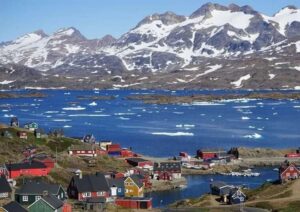
The potential cost of a hypothetical deal on the purchase of Greenland by the United States could be up to $700 billion, a number of media outlets reported, citing NBC News. The publications claim that the assessment was prepared by experts and former U.S. officials, and U.S. Secretary of State Marco Rubio was allegedly tasked to draft a proposal for the purchase of the island in the coming weeks.
At the same time, it is emphasized that this is not an official price position of the US government, but a calculation within the framework of discussions around the initiative of President Donald Trump. According to NBC News’ retelling of the story, the $700 billion amount is comparable to more than half of the Pentagon’s annual budget, illustrating the scale of the financial and political hurdles to any such “deal.”
The reaction from Copenhagen and Nuuk remains negative. Denmark and Greenland authorities have publicly stated that the island is not for sale and that the issue of the autonomous territory’s status is related to sovereignty and the right to self-determination. Reuters reported this week that after a meeting in Washington between Rubio and U.S. Vice President J.D. Vance, the Danish and Greenlandic sides, while not changing their “no-sale” position, agreed to set up a working group to discuss a wide range of issues related to security and cooperation around the island.
The new $700 billion estimate falls in line with a number of previous, highly divergent “paper” estimates that have appeared in recent years. For example, The Washington Post in 2019 within the hypothetical valuation called a very wide range of possible price – from hundreds of millions of dollars to $1.7 trillion.
U.S. interest in Greenland is usually explained by a combination of security and resource factors. The island occupies a key position in the Arctic and North Atlantic, and is also seen as a potentially significant territory in terms of access to minerals and strategic infrastructure.
At the same time, even if there is political will in Washington, the “purchase” scenario is constrained by basic legal and political limitations: Greenland is an autonomous territory within the Kingdom of Denmark, and its status and future, according to the position of local and Danish authorities, cannot be subject to external “bargaining”. Against this background, analysts call the most realistic continuation of the plot not a change of sovereignty, but bargaining around increased U.S. cooperation with Denmark and Greenland – on defense, infrastructure and investment – without formally changing the island’s status.



