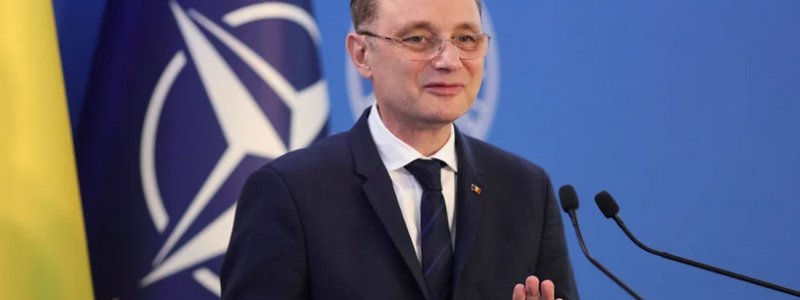
Romanian Prime Minister Luca Niculescu stated that a possible unification of Romania and the Republic of Moldova depends on the will of the citizens of both countries; however, Bucharest’s current priority remains strengthening bilateral economic cooperation and supporting Moldova’s accession to the European Union. The head of the Romanian government made these remarks on October 27, 2026, in an interview with TVR Moldova during an official visit to Chisinau.
“This will happen when the citizens of both countries want it,” Niculescu said, responding to a question about the prospects for unification.
According to him, there are close historical, cultural, and economic ties between Romania and Moldova, which is why the issue of a possible unification remains a topic of public debate.
At the same time, the prime minister emphasized that the Romanian government is currently focused on further bringing the two countries closer together and accelerating Moldova’s European integration.
Niculescu made his first foreign visit after taking office as Prime Minister of Romania to Chisinau, where he held talks with his Moldovan counterpart, Vasile Tofan, and President Maia Sandu.
During the talks, the parties paid particular attention to expanding trade and economic cooperation, developing energy infrastructure and transportation links, and attracting Romanian investment.
According to Niculescu, trade between Romania and Moldova reached approximately €4.5 billion in 2025. Romanian investments have created about 12,000 jobs in Moldova.
The development of transport corridors across the Prut River remains one of the priorities of bilateral cooperation. The parties discussed accelerating the construction of a bridge in the Ungheni area, modernizing border infrastructure, and organizing joint control at the Cantemir–Fălciu crossing.
In the energy sector, discussions focused on expanding electrical interconnections between the two countries, including the construction of the Bălți–Suceava power line.
In addition, Moldova is interested in purchasing natural gas to be produced on the Romanian Black Sea shelf as part of the Neptun Deep project once it becomes operational.
During the visit, the prime ministers also reviewed the progress of the Chisinau substation modernization project, which is part of the new 157-km Vulcanesti–Chisinau power transmission line.
The new energy infrastructure is expected to strengthen Moldova’s independence from electricity supplies via the Transnistrian region and expand opportunities for imports from the European market.
The parties paid special attention to the participation of Romanian businesses in the Moldovan economy. Industry, energy, technology, and transportation infrastructure were cited as promising areas.
Moldovan Prime Minister Vasile Tofan also proposed viewing the country as a platform for Romanian companies to participate in Ukraine’s reconstruction projects.
The issue of regional security was another key topic of the talks against the backdrop of Russia’s ongoing war against Ukraine.
Tofan stated that the security of Ukraine, Moldova, and Romania is closely intertwined, and that Russian air attacks and airspace violations pose threats to the entire region.
According to the Moldovan prime minister, more than 100 unauthorized overflights have been recorded in the country’s airspace since the start of the full-scale war.
Niculescu confirmed Bucharest’s intention to continue supporting Moldova’s European integration, including facilitating the opening of the remaining negotiation chapters by the end of 2026.
Thus, the Romanian government views economic integration, the development of shared infrastructure, and Moldova’s accession to the EU as priority areas for cooperation. The possible political unification of the two states remains a separate issue, the resolution of which, according to Niculescu’s position, must be based on the will of their citizens.
Romania and the Republic of Moldova share a border approximately 680 km long and have close linguistic and cultural ties. Most of the territory of modern-day Moldova was part of Romania from 1918 to 1940. Following the collapse of the Soviet Union, the Republic of Moldova declared its independence on August 27, 1991. Romania has been a member of the European Union since 2007, while Moldova was granted EU candidate status in June 2022, and official accession negotiations began in June 2024.
ECONOMY, EUROPEAN UNION, MOLDOVA, ROMANIA, UKRAINE

Related: