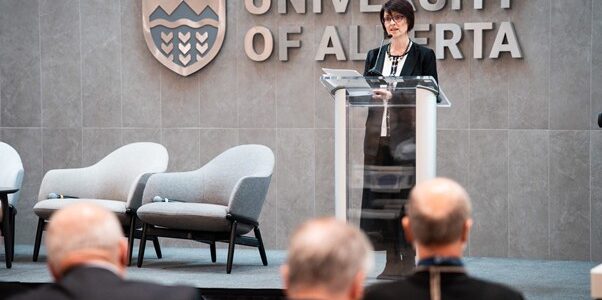
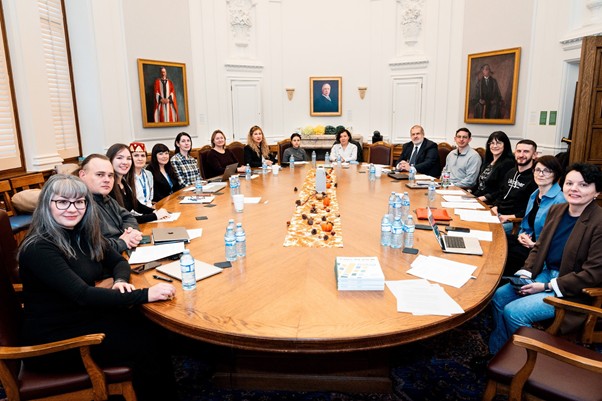
Edmonton, Canada. On October 28–31, 2026, the Canadian Institute of Ukrainian Studies (CIUS) at the University of Alberta hosted an international symposium titled Recentring the Humanities: Ukraine and the World. The three-day discussion centered on how the experiences of Ukraine and Ukrainians around the world are reshaping contemporary understandings of global history, society, and culture.
Following the start of Russia’s full-scale invasion in 2022, Ukraine found itself at the center of international attention. Symposium participants examined how Ukraine’s growing geopolitical and cultural significance has influenced scholarly discourse itself.
Discussions focused, in particular, on whose testimonies historians rely on, how the experiences of indigenous peoples are reshaping notions of the nation, and the place of Ukrainian studies within the humanities. The symposium brought together internationally renowned scholars, human rights activists—including Nobel Peace Prize laureate Oleksandra Matviychuk—diplomats, and representatives of several international initiatives. The discussions in Edmonton were accessible online.
Historians Yaroslav Hrytsak and Serhii Plokhy, along with literary scholar Tamara Gundorova, opened the discussion on Ukraine and the global humanities. The discussion was moderated by KIUS Director Natalia Khanenko-Friesen. In the evening, Metropolitan Boris Gudziak delivered a lecture at the Horowitz Theater at the University of Alberta on the challenges and opportunities facing the global Ukrainian community.
A separate plenary session was dedicated to the indigenous peoples of Ukraine. Participants included Alim Aliyev, Rory Finnin, Martin-Oleksandr Kyslyi, and Yanush Panchenko. As Natalia Khanenko-Friesen explained, the inclusion of Crimean Tatar studies in the program reflected the broader question of how to define Ukrainian studies today.
“We deliberately paid special attention to the Crimean Tatar theme in the symposium program. Crimean Tatar studies are of fundamental importance to Ukrainian studies. Without them, it is impossible to rethink the very concept of Ukrainian studies. To understand who Ukrainians are, one must understand who the Crimean Tatars are and be familiar with the history and experiences of Ukraine’s other indigenous peoples and cultural communities,” said KIUS Director Natalia Khanenko-Friesen.
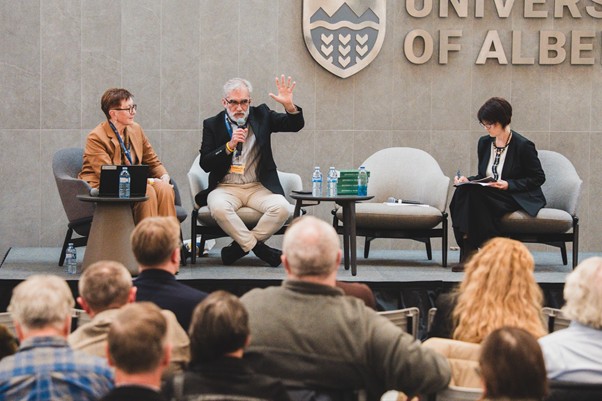
The issue of justice in the context of Russia’s war against Ukraine was discussed by human rights activist Oleksandra Matviychuk, Chairman of the Mejlis of the Crimean Tatar People Refat Chubarov, and researcher Kristina Guk. Another plenary discussion, featuring historian Marcy Shore, philosopher Volodymyr Yermolenko, and literary scholar Vitaliy Chernetskyi, focused on how Ukraine’s experience is prompting scholars to rethink their approaches to understanding and interpreting the world.
Young scholars also presented their research in a “toloka” format. Separate sessions were devoted to the future of historical scholarship in Ukraine and to countering propaganda that uses the past as a weapon. A discussion on Ukraine’s place in the world, featuring Ukraine’s Ambassador to Canada Andriy Plakhotnyuk, Nataliya Tsmots, and Roman Vashchuk, was moderated by Volodymyr Sheyko, director of the Ukrainian Institute.
The symposium’s program was strategically designed. The organizers set a goal: to go beyond established academic discussions and offer a new perspective on Ukraine’s place in the global scientific and socio-political landscape.
That is why the thematic sessions brought together representatives from various academic disciplines, creating an opportunity to rethink how scientific discourse, public diplomacy, and international public debate are transforming under the influence of contemporary global challenges—above all, Russia’s full-scale war against Ukraine. The organizers sought not only to make sense of these changes but also to initiate an interdisciplinary dialogue capable of influencing the future development of Ukrainian studies and their place in the global humanities.
About CIUS. The Canadian Institute of Ukrainian Studies was established in 1976 at the University of Alberta with the support of the Ukrainian community in Canada and the Government of Alberta. As University President Bill Flanagan noted in his anniversary message, it was the first institute in Canada and the second in the Western world dedicated entirely to Ukrainian studies. Among its achievements are the English-language Encyclopedia of Ukraine and the English translation of Mykhailo Hrushevsky’s History of Ukraine-Rus. CIUS also supports research on the Holodomor, the teaching of the Ukrainian language, and the study of modern Ukraine.