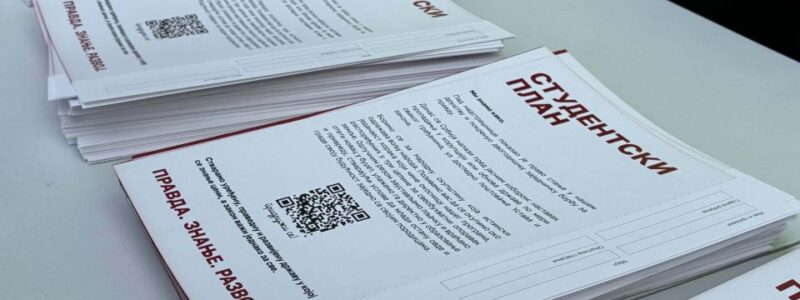
The question of Serbia’s possible participation in sanctions against Russia may be put to a nationwide referendum. Ilija Srdanović, a representative of the Student List, raised this possibility, as reported by the Serbian publication Parametar on November 8, 2026.
According to Srdanović, key foreign policy decisions should be made with public opinion in mind, rather than determined by a single politician or a small group of officials.
The proposal came amid preparations to form a new Serbian government following the October 25 snap parliamentary elections, which were won by the “Student List.”
However, no official decision has yet been made to hold a referendum. Neither a possible date for the vote nor the wording of the question to be put before the public has been determined.
Previously, representatives of the “Student List” opposed the imposition of sanctions against Russia. In a statement dated September 30, they emphasized the need to maintain Belgrade’s current policy.
At the same time, European integration remains one of the “Student List’s” stated foreign policy priorities. The European Union expects Serbia to gradually align its foreign policy with that of the EU, including sanctions against Russia.
The situation is complicated by Belgrade’s economic and energy ties with Moscow. Russia remains an important partner for Serbia in the supply of natural gas, and Russia’s stake in the oil company NIS continues to be of significant importance to the country’s energy sector.
As Parametar notes, Radomir Saicić, a representative of the “Student List,” previously announced that the future government would hold talks in Moscow regarding a long-term gas agreement. At the same time, contacts with Washington are planned regarding the issue of U.S. sanctions against NIS.
Experts point out the complexities of a potential referendum. In particular, political scientist Ognjen Gogić notes that the EU’s sanctions policy includes various types of restrictions targeting individuals, companies, and specific economic sectors. Therefore, formulating a single question for the vote may prove to be a difficult task.
Under Serbian law, a nationwide referendum is called by the National Assembly. To hold it, the established procedure must be followed, and the National Assembly must pass a corresponding resolution.
Thus, a potential referendum on sanctions against Russia remains, for now, a political initiative. It is also unclear how its results might affect Serbia’s ongoing negotiations on accession to the European Union.
Source: Parametar.rs — Studentska lista najavila mogućnost referenduma o sankcijama Rusiji, November 8, 2026.