

András Baku has become Hungary’s new president, according to Hungarian media reports.
“On Tuesday, the Hungarian Parliament elected 73-year-old lawyer and former Chief Justice of the Supreme Court András Baku as the country’s new president,” the reports state.
It is noted that 140 lawmakers voted in favor of his candidacy, while six voted against it. Representatives of the former ruling coalition, Fidesz—the Christian Democratic People’s Party—had announced in advance that they would not participate in the vote.
Hungary’s new Prime Minister, Péter Magyar, has repeatedly stated since his election in May that he intends to reform the Hungarian government; in particular, he has sought the resignation of President Tamás Szujók. Magyar believes that Szujók was not fulfilling his role and was serving the interests of former Prime Minister Viktor Orbán and his government.
Szujok refused to step down voluntarily, stating that he saw neither constitutional nor legal grounds for doing so. Later, in July, the Hungarian parliament approved a package of constitutional reforms that, among other things, provided for the president’s resignation. As a result, last week Szujok signed the constitutional amendments and stepped down from his post.
Magyar nominated renowned Hungarian chess grandmaster Judit Polgár for the position of the country’s new president, but she declined the offer.
The president in Hungary performs mainly ceremonial functions. The government is headed by the prime minister.
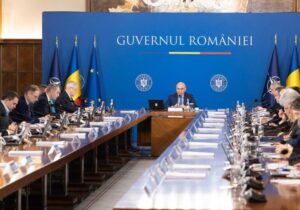
The Parliament of Romania has supported a vote of no confidence in the government of Prime Minister Ilie Bolojan, leading to the سقوط of the pro-European cabinet and opening a new phase of political uncertainty in one of the key countries on the eastern flank of the EU and NATO.
A total of 281 deputies voted in favor of the no-confidence motion, exceeding the required minimum of 233 votes. Only four parliamentarians voted against. This result became one of the largest no-confidence votes in the history of Romanian parliamentarism.
The political crisis escalated after representatives of the Social Democratic Party (PSD) withdrew from the government. Following this, the Social Democrats, together with right-wing and far-right forces, initiated the consideration of the no-confidence motion at a joint session of the Chamber of Deputies and the Senate. Immediately after the announcement of the voting results, Bolojan left the parliament building and returned to the government residence.
One of the causes of the crisis was disagreements over fiscal austerity measures. Bolojan’s cabinet pursued a course of deficit reduction, tax increases, and spending cuts, which provoked resistance from the Social Democrats. After PSD’s withdrawal from the coalition, the government effectively lost its stable majority.
Bolojan remains acting prime minister until a new government is formed; however, his powers will be limited. The President of Romania, Nicușor Dan, is expected to begin consultations with political parties to find a new cabinet formula. Possible scenarios include restoring a pro-European coalition in a revised composition, appointing a technocratic prime minister, or forming a new minority government.
The political situation is further complicated by the fact that the Romanian parliament remains highly fragmented. Following the parliamentary elections of December 1, 2024, no party secured a majority in either the Chamber of Deputies or the Senate.
In the Chamber of Deputies, the Social Democratic Party (PSD) became the largest force with 86 seats. It is followed by the right-wing nationalist Alliance for the Union of Romanians (AUR) with 63 seats, the National Liberal Party (PNL) with 49 seats, the liberal Save Romania Union (USR) with 40 seats, the far-right S.O.S. Romania with 28 seats, the Party of Young People (POT) with 24 seats, and the Democratic Alliance of Hungarians in Romania (UDMR) with 22 seats. An additional 19 seats are held by representatives of national minorities.
In the Senate, PSD secured 36 seats, AUR — 28, PNL — 22, USR — 19, S.O.S. Romania — 12, UDMR — 10, and POT — 7 seats.
Politically, the parliament is now условно divided into three blocs. The first consists of moderate pro-European parties: PSD, PNL, USR, UDMR, and representatives of national minorities. In theory, they could form a new majority, but they have significant disagreements over budget, taxation, and social policy. The second bloc is the nationalist and eurosceptic flank, primarily AUR, S.O.S. Romania, and POT. The third consists of situational groups and individual deputies, whose role increases in tight votes.
The crisis in Bucharest has not only domestic but also regional significance. Romania remains one of the most important countries for Ukraine’s logistics, exports via the Danube and the Black Sea, hosting NATO infrastructure, and maintaining security on Europe’s eastern flank. Any prolonged political uncertainty may complicate decision-making on budgetary, defense, and infrastructure issues.
Economic risks are also substantial. Political instability increases concerns about Romania’s sovereign ratings, access to EU funds, and the stability of the national currency. Bucharest must implement reforms and meet deficit reduction targets to maintain access to significant resources from European recovery funds.
According to the analytical center Experts Club, the fall of the Romanian government creates three main risks for the region: slower fiscal consolidation, increased volatility in financial markets, and weakened political predictability in matters of support for Ukraine.
“For Ukraine and the entire region, it is important that the political crisis in Romania does not turn into institutional paralysis. Romania is not a peripheral player, but one of the key hubs of Eastern European security, Danube logistics, and interaction with the EU. If a new government is formed quickly and maintains a pro-European course, the effect will be limited. However, if the crisis drags on, it may affect infrastructure projects, defense coordination, and the investment climate across the region,” said the founder of Experts Club, Maksym Urakin.
According to him, the factor of far-right forces that supported the no-confidence vote is of particular importance.
“The no-confidence vote itself does not mean a turn away from the EU or NATO. However, it shows that protest against fiscal austerity and social pressure can be used by forces advocating a more confrontational and less predictable foreign policy. For neighboring countries, this is a signal: economic fatigue of the population is becoming a security factor,” Urakin noted.
Experts Club believes that the baseline scenario remains an attempt by the president and moderate parties to restore a manageable pro-European configuration without the participation of the far right. However, even in this case, the new government will have to balance between EU requirements for deficit reduction, social discontent, and the need to maintain Romania’s active role in regional security.
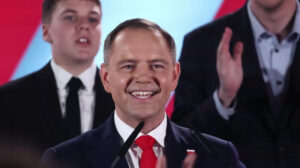
Karol Nawrocki, candidate from the Law and Justice party, has won the second round of the presidential election in Poland, according to Gazeta Wyborcza.
According to the Polish National Electoral Commission, after 100% of the votes were counted, he received 50.89%.
It is noted that his opponent, Warsaw Mayor Rafal Trzaskowski, received 49.1% of the vote.
A week before the election, Polish Prime Minister Donald Tusk called presidential candidate Nawrocki’s statement that Poland would never support Ukraine’s accession to NATO treason.
Earlier, the Experts Club think tank released a video analysis dedicated to the most important elections in the world in 2025. For more details, see here — https://youtu.be/u1NMbFCCRx0?si=6L76qeuNamxg6py1
ECONOMY, EXPERTS_CLUB, Karol Navrotsky, POLITICS, PRESIDENT OF POLAND, URAKIN

Voting in the presidential election began in Romania at 7:00 a.m. on Sunday. The second round features George Simion, representative of the right-wing Alliance for the Unity of Romanians, and Nicușor Dăncilă, the incumbent mayor of the capital Bucharest, who received the most votes in the first round on May 4.
“We voted so that only Romanians decide our future, for Romanians and for Romania,“ Simion told reporters outside a polling station.
“We decide what kind of country we want to be: a country of hope, dialogue, and development,” Dănălescu wrote on Facebook.
According to Reuters, despite the fact that 38-year-old Simion won 41% of the vote in the first round and 55-year-old Dan only 21%, opinion polls show that they have almost equal chances of winning, or show a slight advantage for Simion. Earlier, the Experts Club think tank released a video analysis dedicated to the most important elections in the world in 2025. For more details, see here —
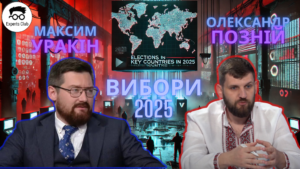
The world is entering a phase of political change in 2025. Important elections will take place in different countries, the results of which can significantly affect both geopolitics and internal processes of states. In a new YouTube video, Maksym Urakin, founder of the Experts Club think tank, and Oleksandr Poznyi, co-founder of the Active Group research company, analyze the main political events of the year and the possible consequences for Ukraine.
After the scandalous cancellation of the presidential election results, a second vote is scheduled for December 2024 in Romania. The election brought unexpected results, and the winner of the first round campaigned exclusively on TikTok. This sparked discussions around the world, as it was the first time a social network played a key role in the political process. However, the country’s Constitutional Court canceled the election results due to the detected Russian influence, and a new vote is scheduled for May 2025.
“The situation in Romania is unprecedented, as the Constitutional Court has annulled the first round of elections. This may cause political turbulence, which will affect the country’s foreign policy,” said Maksym Urakin, founder of the Experts Club information and analytical center.
In his turn, Oleksandr Poznyi emphasized that this case proves that influence technologies are changing, and social networks such as TikTok can become a key tool for voter mobilization.
“This is a dangerous signal for Ukraine as well, because we see that political forces are beginning to use this platform as a way to manipulate public opinion,” added Pozniy.
On February 23, early elections to the Bundestag will be held after the coalition collapse in 2024. The main struggle will be between the Christian Democratic Union (CDU) and the Social Democratic Party of Germany (SPD), but the right-wing Alternative for Germany (AfD) party, which has anti-immigration and pro-Russian rhetoric, may also play an important role.
“The struggle between the CDU and the SPD will be intense. If the AfD gets second or even first place, it could change Germany’s policy towards Ukraine. So far, the mainstream parties are not ready to form a coalition with them, but their influence is growing,” Maksym Urakin believes.
The parliamentary elections in Moldova will also determine the country’s foreign policy course.
“Moldova is facing a choice between the European path and the pro-Russian vector. This choice will have a significant impact on regional policy. The elections will decide whether the country will continue its European course under the leadership of President Maia Sandu or whether the Socialists, represented by Igor Dodon, will be able to regain power,” said Poznyi.
He also emphasized that Moldova is a parliamentary republic, and even if Sandu wins the presidential election, it does not guarantee that her political force will retain a majority.
On May 18, Poles will elect a new president, as Andrzej Duda cannot run for a third time. Experts believe that this is one of the most important elections for Ukraine, as Polish support is strategic. The tense confrontation between Law and Justice and the opposition will determine the future of Polish-Ukrainian relations. The Ukrainian issue will play an important role, but voters are more focused on domestic issues, such as the situation with Polish farmers who are unhappy with Ukrainian grain imports.
“Candidates will have to maneuver between supporting Ukraine and protecting national interests,” says Mr. Poznyi.
Serbia is one of the few countries in Europe that continues to balance between the EU and Russia. President Aleksandar Vucic has twice hinted at the possibility of early elections in 2025, especially amid protests and the escalating situation in Kosovo.
In October, elections will also be held in Canada and Argentina, which could change the foreign policy courses of these countries. On September 8, Norway will vote, and on November 16, Chile will vote.
“The elections in Canada are important for Ukraine, as further assistance will depend on them. It is also worth following the processes in Norway, which supports European security,” summarizes Maksym Urakin.
The year 2025 promises to be full of important political events that could change the international agenda. Ukraine must take into account the possible consequences of elections in strategic countries and prepare for new challenges on the global stage.
For more details about the elections to be held this year, please watch the video:
Subscribe to the Experts Club channel here:
https://www.youtube.com/@ExpertsClub

The survey, conducted by Active Group in cooperation with the Experts Club think tank, revealed citizens’ attitudes to various aspects of social and economic life in Ukraine, including the initiative to refund part of the cost of Ukrainian goods, the government’s influence on business, the level of trust in law enforcement, financial stability of citizens, and forecasts for the hryvnia exchange rate.
A significant proportion of respondents (44%) have heard of the initiative to refund the cost of purchasing Ukrainian goods, with opinions divided on its impact on living standards. Most respondents believe that the government will increase taxes to finance this initiative.
According to Andriy Yeremenko, founder of the sociological research company Active Group, this raises concerns among the population, as most are not ready for an increase in the fiscal burden.
The study also revealed a deep distrust of government institutions (57% of citizens) and law enforcement agencies (62%) in the context of relations with business, in particular due to the lack of transparency and efficiency of their work. The majority of respondents believe that the state hinders rather than helps business to develop, and this trend has increased compared to previous months.
A significant number of Ukrainians (up to 60%) are experiencing financial difficulties, including increased debt and lack of savings for a rainy day. Respondents also expressed concern about the future of the hryvnia exchange rate, with the majority (55%) expecting it to fall.
In the context of utility bills, the vast majority (67%) of respondents believe that the level of tariffs is too high, which further emphasizes the general dissatisfaction with the financial situation and government policy in this area.
According to Oleksandr Poznyi, Director of Active Group, these results demonstrate the serious challenges faced by Ukrainian society in the context of the war and the current economic situation.
Earlier, Maksym Urakin, the founder of the Experts Club think tank, noted that in 2024 Ukraine’s public debt may exceed GDP for the first time, which poses significant risks to economic stability in the country.
For more details, please see the video at the link:
https://www.youtube.com/watch?v=8hkvHhyzGLQ
You can subscribe to the Experts Club channel here:
ACTIVE_GROUP, ANDRIY_EREMENKO, ECONOMY, EXPERTS_CLUB, OLEXANDR_POZNYI, POLITICS, SOCIOLOGY, TAXES, URAKIN



