
Turkey has identified another 1,070 people who, according to the investigation, obtained Turkish citizenship through fake real estate transactions. This marks the second major wave of investigations into schemes involving the granting of citizenship through residential property investments.
Turkish Justice Minister Akın Gürlek announced the new operation on September 21. The investigation is being conducted by the Istanbul Chief Prosecutor’s Office in collaboration with police units responsible for combating illegal migration.
Investigators examined real estate transactions conducted through the companies Gül İnşaat, Beyaz İnşaat, and LİV İnşaat. The audit covered sales to 734 foreign nationals, with 274 transactions deemed fictitious or suspicious. The total value of the transactions exceeded 3.5 billion Turkish lira, or approximately $72 million.
According to the Turkish Ministry of the Interior, among the 1,070 people who obtained citizenship under these agreements, 263 were direct investors, while another 807 were their family members. Of these, 1,015 received citizenship at the same time as the initial decision, and another 55 children received it later. In addition, 11 individuals were identified whose citizenship application processes were still ongoing.
As part of the operation, judicial measures were applied to 2,011 real estate properties, one hotel, 86 vehicles, two yachts, and 42 bank accounts. State administrators were appointed to 30 companies. Legal proceedings have been initiated against 88 suspects, and dozens of people have been detained.
This is already the second wave of the investigation. The first major operation took place on August 4, 2026. At that time, the investigation established that another 687 people had obtained Turkish citizenship through artificially inflated appraisal reports and fictitious real estate sales. The prosecutor’s office has initiated proceedings to revoke their citizenship. In that case, authorities estimated the amount of investments that did not actually reach Turkey at approximately 2.5 billion lira.
Thus, the two most recent investigations in Istanbul alone involve at least 1,757 cases of citizenship acquisition linked to suspicious real estate transactions, when combining the 687 individuals from the first wave and the 1,070 from the second. However, these two figures pertain to specific criminal investigations and do not cover all reviews of investment-based citizenship in the country.
At the same time, the Turkish Ministry of the Interior has, for the first time, released broader statistics on the review of citizenship obtained through investment programs. According to the ministry, as of September 21, citizenship decisions had been revoked for 5,391 individuals, including investors and their family members. Additionally, citizenship was revoked after it had been granted for 743 individuals, specifically for reasons related to public order and national security. In total, this amounts to 6,134 individuals.
As of February 11, 2026, citizenship grants were separately revoked for 1,393 individuals associated with 458 investors whose documents certifying that their investments met the established requirements were annulled. Citizenship was also revoked from seven other individuals on grounds of national security and public order.
Turkish authorities have not published a breakdown of the 1,070 individuals implicated in the current investigation by their country of origin. No similar official breakdown was published regarding the 687 individuals identified in August either. Therefore, reports claiming a predominance of Russians, Iranians, citizens of Middle Eastern countries, or other nationalities in these specific cases are not currently supported by official documents.
The scheme being investigated by law enforcement agencies was based on fictitious or inflated real estate values and the simulation of required financial transactions. In some cases, real estate with a significantly lower actual value was valued much higher in the documents in order to formally meet the requirements of the citizenship-by-investment program.
Turkey allows foreign investors to apply for citizenship, specifically through the purchase of real estate valued at no less than $400,000. The property must meet established requirements, and the investment and flow of funds are subject to verification by government agencies.

Turkey intends to participate in the Caspian Sea–Black Sea–Europe energy corridor (Black Sea Energy) project, which is designed to ensure the supply of “green” electricity from the South Caucasus to the European Union market, said Turkish Minister of Energy and Natural Resources Alparslan Bayraktar.
According to him, the project involves connecting the power grids of Azerbaijan and Georgia, followed by the transmission of electricity via an undersea cable across the Black Sea to Romania and on to Hungary. At the invitation of the Azerbaijani side, Turkey expressed its intention to join the initiative and supported its implementation.
Ankara’s interest in the project is also confirmed by preliminary negotiations with Baku. On August 1, Azerbaijan’s Minister of Energy Parviz Shahbazov reported following a meeting with Bayraktar in Istanbul that the parties had discussed Turkey’s potential cooperation within the framework of the “Caspian–Black Sea–Europe” energy corridor and had also agreed to accelerate the implementation of other joint energy projects.
According to Bayraktar, cooperation between Turkey and Azerbaijan in the electricity sector is currently developing along three fronts.
The first involves integrating Nakhchivan’s power grid with Turkey’s and organizing electricity exchanges. In the future, this route could be connected to the main territory of Azerbaijan via the Zangezur Corridor.
The second direction is the “green” energy corridor connecting Azerbaijan, Georgia, Turkey, and Bulgaria. It is intended to facilitate the export of renewable electricity generated in Azerbaijan through Georgia and Turkey to Bulgaria and onward to EU markets. In August 2026, Baku and Ankara separately agreed to accelerate the implementation of this project.
The third initiative is Black Sea Energy itself. The main participants in the project remain Azerbaijan, Georgia, Romania, and Hungary. The four countries signed an agreement on strategic partnership in the development and transmission of “green” energy in Bucharest on December 17, 2022. The European Union supports the project, viewing it as a new supply route for renewable electricity from the South Caucasus to the EU.
In July 2026, the project moved to the next phase of implementation following the completion and approval of feasibility studies. The project operator, Green Energy Corridor Power Company, has begun developing the conceptual design, engineering solutions, and procurement strategy.
According to recent statements by the Azerbaijani side, the plan is to gradually export up to 3.9–4 GW of green electricity through the corridor, starting in 2032. The project has also been included in the TYNDP 2026 portfolio of the European Network of Transmission System Operators for Electricity (ENTSO-E).
A key infrastructure element will be a high-voltage subsea direct-current cable between Georgia and Romania. The preliminary construction cost is estimated at approximately 3.5 billion euros, with a construction period of three to four years. It was previously reported that up to 2.3 billion euros in European funding could be secured. However, in the latest Global Gateway documents, 2.3 billion euros is also cited as the indicative investment amount for the strategic Black Sea electricity interconnector, so the final financing structure for the project is still to be finalized.
The European Commission views Black Sea Energy as one of the tools for diversifying the EU’s energy supply and integrating renewable generation from the South Caucasus. The project is intended to connect the Caspian Sea region to the European power grid via Georgia and Romania, while also strengthening the energy resilience of the participating countries.
If Turkey joins, the project will take on additional significance, as Ankara will be able to participate in several parallel transmission routes for Azerbaijani “green” electricity to Europe—via the Black Sea and via the Turkey–Bulgaria overland corridor.
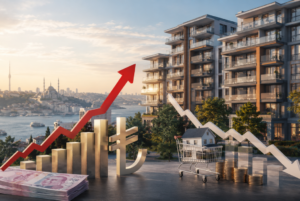
Prices for housing in Turkey in July 2026 rose by an average of 23.3% in local currency compared to last year; however, high inflation completely offset this increase: in real terms, real estate prices fell by 6.6%, according to the July market review by the platforms Emlakjet and Endeksa. The data was published on August 14.
The average price per square meter of housing nationwide reached 41,700 Turkish lira, or approximately $871, while the average price of a property sold was 5.21 million lira, which corresponds to approximately $109,000.
At the same time, July saw the first small positive sign in short-term trends: prices rose by 1.9% in nominal terms over the month and by approximately 0.5% when adjusted for inflation. However, one month is not yet enough to speak of a sustained recovery in the real value of Turkish housing.
Ankara’s Prices Are Rising Faster Than Istanbul’s and Antalya’s
Among the 30 provinces with the highest number of transactions, the most notable growth was recorded in Ordu—32.4% over the year. This is the only province among those analyzed where growth was positive even after adjusting for inflation—about 0.4%.
Ankara ranks second with a nominal increase of 28.7%, although in real terms, housing in the capital became approximately 2.5% cheaper. Next are Kocaeli—up 28.5%, Denizli—27.1%, and Elazığ—26.9%.
In Istanbul, a square meter of housing cost an average of 65,100 liras in July, and the average price of a property was about 7.16 million liras, or $149,500.
In Antalya, one of the main markets for foreign buyers, the average price per square meter reached 55,500 lira, and the average price per property was about 6.1 million lira, or $127,500. In Izmir, the average price was about 54,000 lira per square meter and 6.48 million lira per property.
Muğla remains Turkey’s most expensive province, home to resort centers such as Bodrum and Marmaris. Here, the average price per square meter reached 87,200 lira, and the average price per property was 11.34 million lira, or nearly $237,000. This is more than double the national average.
Housing sales have fallen sharply
The rise in prices is occurring against the backdrop of a significant decline in the number of transactions. According to the Turkish Statistical Institute (TÜİK), statistics on residential and commercial real estate sales for July were published on August 13, 2026. A total of 123,603 residential properties were sold nationwide during the month, which is approximately 17% less than a year earlier.
Istanbul remained the largest market with 22,600 transactions, followed by Ankara with 9,640, Izmir—6,550, and Antalya—6,300.
At the same time, the sales breakdown sends mixed signals. The number of mortgage transactions rose by 23.7%, while sales of new homes fell by 8.6% and those of existing homes dropped by as much as 20.8%. This may indicate a gradual return to the market of some buyers who are able to take advantage of bank financing.
Thus, the rise in the value of Turkish real estate in lira remains, to a large extent, a consequence of inflation. For investors, it is more important to pay attention not only to nominal growth of 20–30%, but also to real price trends, exchange rates, and rental yields. As of the end of July, the average property in Turkey is nominally significantly more expensive than a year ago; however, its real value continues to decline.
Open4Business recently conducted a separate analysis of the composition of foreign buyers of Turkish real estate. As of June 2026, Russian citizens ranked first with 381 purchases, while Ukrainians acquired 170 properties and tied for second place with Iranian citizens. In total, foreigners purchased 2,015 residential properties in June. From January through June, foreign demand totaled 9,083 properties, down 9.2% from the previous year.
Ukrainians remain one of the largest groups of homebuyers in Turkey, even over the long term. In 2025, Ukrainian citizens purchased 1,541 properties and ranked third among foreign buyers, trailing only Russians and Iranians. Thus, the decline in real prices for Turkish housing is of direct interest to Ukrainian private investors, who continue to maintain an active presence in this market.

In July 2026, Ukrainian citizens purchased 145 residential properties in Turkey and ranked third among foreign homebuyers in the country, according to data from the Turkish Statistical Institute (TÜİK) published on August 13.
Russian citizens purchased the most residential properties among foreign buyers in July—394 properties. Iranian citizens ranked second with 189 transactions, while Ukrainians ranked third with 145 properties.
Thus, Ukrainian citizens accounted for approximately 6.8% of all residential property sales to foreigners in Turkey that month.
However, compared to June, activity among Ukrainian buyers declined slightly. In June, Ukrainians purchased 170 properties and tied for second place with Iranian citizens. In July, the number of transactions by Ukrainians decreased by approximately 15%, but Ukraine remained among the top three foreign buyers of Turkish real estate.
In total, 2,120 residential properties were sold to foreigners in Turkey in July, which is 1.9% more than in July of last year. Foreigners accounted for 1.7% of total residential property sales.
At the same time, the overall situation in the Turkish real estate market was significantly worse: in July, 123,603 thousand houses and apartments were sold in the country—17% fewer than a year earlier. Sales of new housing fell by 8.6% to 42,529 thousand units, while sales of resale housing dropped by 20.8% to 81,074 thousand
Thus, demand from foreign buyers in July appeared more stable than in the domestic market. However, over a longer period, foreign demand remains lower than last year’s levels. From January through July 2026, foreigners purchased 11,203 thousand residential properties in Turkey, which is 7.3% less than during the same period in 2025.
Ukrainians have maintained a strong presence in the Turkish real estate market for several years now. In 2025, Ukrainian citizens also ranked third among foreign buyers, purchasing 1,541 thousand residential properties. Ahead of them were Russians, with 3,649 thousand transactions, and Iranian citizens, with 1,878 thousand.
For comparison: in 2024, Ukrainians were also among the top three foreign buyers, purchasing 1,631 thousand properties.
Thus, despite a slight decline in July compared to June, Ukraine remains one of the three largest foreign markets for Turkish residential real estate, alongside Russia and Iran.

Turkey has called on Russia and Ukraine to agree to a moratorium on attacks on ships and maritime-related facilities in the Black Sea amid a sharp increase in attacks on the commercial fleet.
Turkish Foreign Minister Hakan Fidan stated on August 8 that Ankara is proposing that the parties establish a special mechanism to halt mutual attacks in the Black Sea.
“We have called on both sides to establish a mechanism for declaring a moratorium,” Fidan said in an interview with the Turkish state news agency Anadolu. According to him, Ukraine had previously put forward a similar proposal, after which Turkey conveyed it to the Russian side and is now awaiting Moscow’s response.
The Turkish foreign minister noted that the war has effectively spread to the entire Black Sea. While the attacks initially targeted mainly military ports and warships, commercial vessels are now increasingly coming under fire.
Ankara is particularly concerned about attacks on vessels linked to Turkey—those flying the Turkish flag, owned by Turkish companies, or carrying Turkish crew members.
According to Fidan, Russia and Ukraine are also attacking logistics facilities of strategic importance to the opposing side, and the further escalation of such actions is becoming “extremely dangerous.”
Ankara’s statement came after a sharp deterioration in the security situation for commercial shipping.
According to data from Ukraine’s Ministry of Community and Territorial Development, as cited by Reuters, in July alone, Ukraine recorded 35 attacks on ships in ports, 22 attacks on ships at sea, and 67 strikes on port infrastructure.
By comparison, Reuters counted 14 attacks on ships in the Ukrainian sector of the Black Sea throughout all of 2025. At the same time, Ukraine has intensified its strikes on tankers linked to the Russian oil trade. Both Moscow and Kyiv claim that their targets are facilities associated with military activities.
The escalation is already affecting global trade in grain and oil. More than 90% of the country’s agricultural exports pass through Ukrainian Black Sea ports, while the Russian ports of Novorossiysk and Tuapse remain major export hubs for grain and petroleum products.
The cost of war risk insurance for ships calling at Black Sea ports has risen to approximately 2% of a ship’s value, up from about 1% two weeks earlier, while the cost of chartering oil tankers on certain routes has exceeded $300,000 per day.
Amid rising risks, reports emerged that Turkey had begun restricting the passage of certain commercial vessels into the Black Sea. However, on August 9, two Turkish officials told Reuters that traffic through the Bosphorus and the Dardanelles was proceeding as usual. Ankara has indeed implemented temporary additional security measures, but these do not mean that the straits are closed to commercial shipping.
Passage is governed by the 1936 Montreux Convention, which grants Turkey control over the Bosphorus and the Dardanelles and special powers regarding military vessels, while ensuring freedom of passage for civilian vessels.
For Ankara, the security of the Black Sea is of fundamental economic importance. Large volumes of Russian and Ukrainian agricultural products, oil, and petroleum products pass through this region, and Turkish shipowners are actively engaged in these routes.
Since the start of the full-scale war, Turkey has maintained contacts with both Kyiv and Moscow and has sought to play the role of mediator. Ankara has not joined Western sanctions against Russia, yet it continues to cooperate with Ukraine and has repeatedly acted as a mediator on issues related to Black Sea shipping.
Turkish authorities have begun the process of revoking the citizenship of 687 foreigners who, according to investigators, obtained Turkish passports through fictitious real estate transactions and forged property appraisal reports. The original source of this information was a statement by Turkish Justice Minister Akin Gürlek, published on August 4, 2026. The operation was coordinated by the Organized Crime Investigation Bureau of the Istanbul Chief Prosecutor’s Office. Investigative actions took place simultaneously in 16 provinces across the country.
According to the investigation, participants in the scheme purchased relatively inexpensive real estate and then, using forged expert reports, artificially inflated its value to the minimum threshold required to obtain Turkish citizenship. The transactions were accompanied by fictitious bank transfers designed to create the appearance of investment inflows.
As a result, Turkish authorities estimate that the country was deprived of approximately 2.5 billion Turkish lira—or roughly $52 million—that was supposed to have been invested by foreign applicants.
As part of the investigation, arrest warrants were issued for 90 people, and 72 suspects have already been detained. The government has placed seven companies that may have been linked to the scheme under its control. Additionally, 1,045 properties, a hotel in Bodrum, 15 vehicles, a yacht, and funds in ten bank accounts have been seized.
It is important to note that this does not yet involve the automatic and immediate revocation of passports, but rather the initiation of legal proceedings. Citizenship will be revoked once it is confirmed that a specific applicant obtained it based on fraudulent documents or a transaction that did not meet legal requirements.
Turkey’s investment citizenship program has been in effect since 2017. Currently, a foreigner can apply for a Turkish passport by purchasing real estate worth at least $400,000. The property cannot be sold for three years, its value must be verified by an authorized appraisal company, and payment must be made through the banking system. Alternative options include an investment or a bank deposit of at least $500,000.
The Ministry of Justice, the Istanbul Prosecutor’s Office, and the Turkish media have not yet disclosed the nationalities of the 687 individuals initially implicated. However, data on previous participants in the investment program and foreign buyers of Turkish real estate allow us to identify groups that potentially used such services more frequently.
Between 2018 and 2021, approximately 19,600 foreigners obtained Turkish citizenship through the investment program. Iran, Iraq, Afghanistan, and Russia were cited as the main countries of origin for applicants, and since 2022, Ukrainian and Russian citizens have significantly increased their purchases of Turkish real estate and have become the most prominent groups of applicants for investment-based citizenship.
According to official statistics from the Turkish Statistical Institute (TÜİK), in 2025, Russians purchased 3,649 residential properties in Turkey, Iranian citizens purchased 1,878, and Ukrainian citizens purchased 1,541. These three countries ranked first among foreign buyers of Turkish housing. This trend continued in 2026. In June, Russian citizens purchased 381 residential properties, while Ukrainians and Iranians each purchased 170 properties.
Based on this data, it is most likely that among the 687 investors under investigation are citizens of Russia, Iran, and Ukraine, who are simultaneously among the largest real estate buyers and the most active participants in the investment citizenship program. The list of those under investigation may also include individuals from Iraq and Afghanistan who participated in the program in previous years.
Additional risks may arise for the spouses and children of investors if they obtained citizenship as family members of the primary applicant. Turkish authorities have not yet clarified whether such relatives are included in the announced total of 687 people or whether their status will be reviewed automatically or through separate procedures. The investigation will likely lead to stricter scrutiny of appraisal companies, bank transfers, intermediaries, and the sources of funds. For new applicants, this may mean longer processing times and additional requirements, but it does not indicate that the investment citizenship program itself is being shut down.



