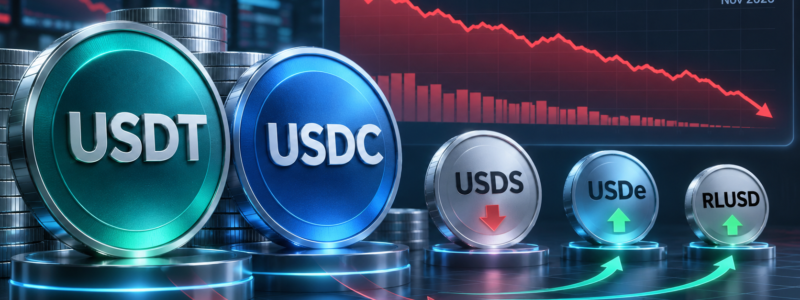
The total market capitalization of stablecoins amounted to approximately $290.8 billion on November 9, 2026, declining by 1.6% over the past seven days and by 4.2% over the month. This is evidenced by data from the DefiLlama analytical platform. Tether’s USDT remains the largest stablecoin, with a market capitalization of approximately $176.8 billion.
Its share of the sector’s total capitalization reaches 60.8%, giving Tether a dominant position in the market for digital assets pegged to the value of traditional currencies.
USD Coin (USDC) ranks second, with a market capitalization of approximately $70.5 billion.
Thus, the two largest stablecoins account for approximately $247.3 billion, or more than 85% of the total market.
Over the past seven days, USDT’s market capitalization declined by approximately 1.3%, while USDC’s fell by 1.5%.
Sky Dollar (USDS) demonstrated a more significant decline, with its market capitalization falling by almost 15% over the week to $5.43 billion.
At the same time, certain digital assets demonstrated the opposite trend.
For example, the market capitalization of Ethena USDe increased by approximately 9.7% over seven days to $4.97 billion.
Growth was also recorded for Ripple USD (RLUSD), whose market capitalization reached approximately $2.69 billion, increasing by more than 11% over the week.
These dynamics indicate a redistribution of liquidity among individual stablecoins against the backdrop of an overall market contraction.
Stablecoins are used by cryptocurrency exchanges and investors for settlements, liquidity storage, facilitating trading operations, and cross-border transfers.
Digital assets pegged to the US dollar are the most widespread. Depending on the issuance model, they may be backed by cash, short-term government bonds, and other reserve assets.
A decline in the total market capitalization of stablecoins may indicate a reduction in the amount of digital dollars in circulation and a decrease in available liquidity in certain segments of the cryptocurrency market.
However, a change in market capitalization does not necessarily mean an equivalent withdrawal of funds by investors. The figures are also influenced by the issuance and redemption of tokens, fluctuations in the value of collateral, and changes in market structure.
In recent weeks, the contraction of the stablecoin segment has coincided with capital outflows from cryptocurrency ETFs and declines in the prices of Bitcoin and Ethereum.
At the same time, stablecoins continue to play an important role in the digital finance infrastructure, facilitating settlements between cryptocurrency platforms and the traditional financial system.