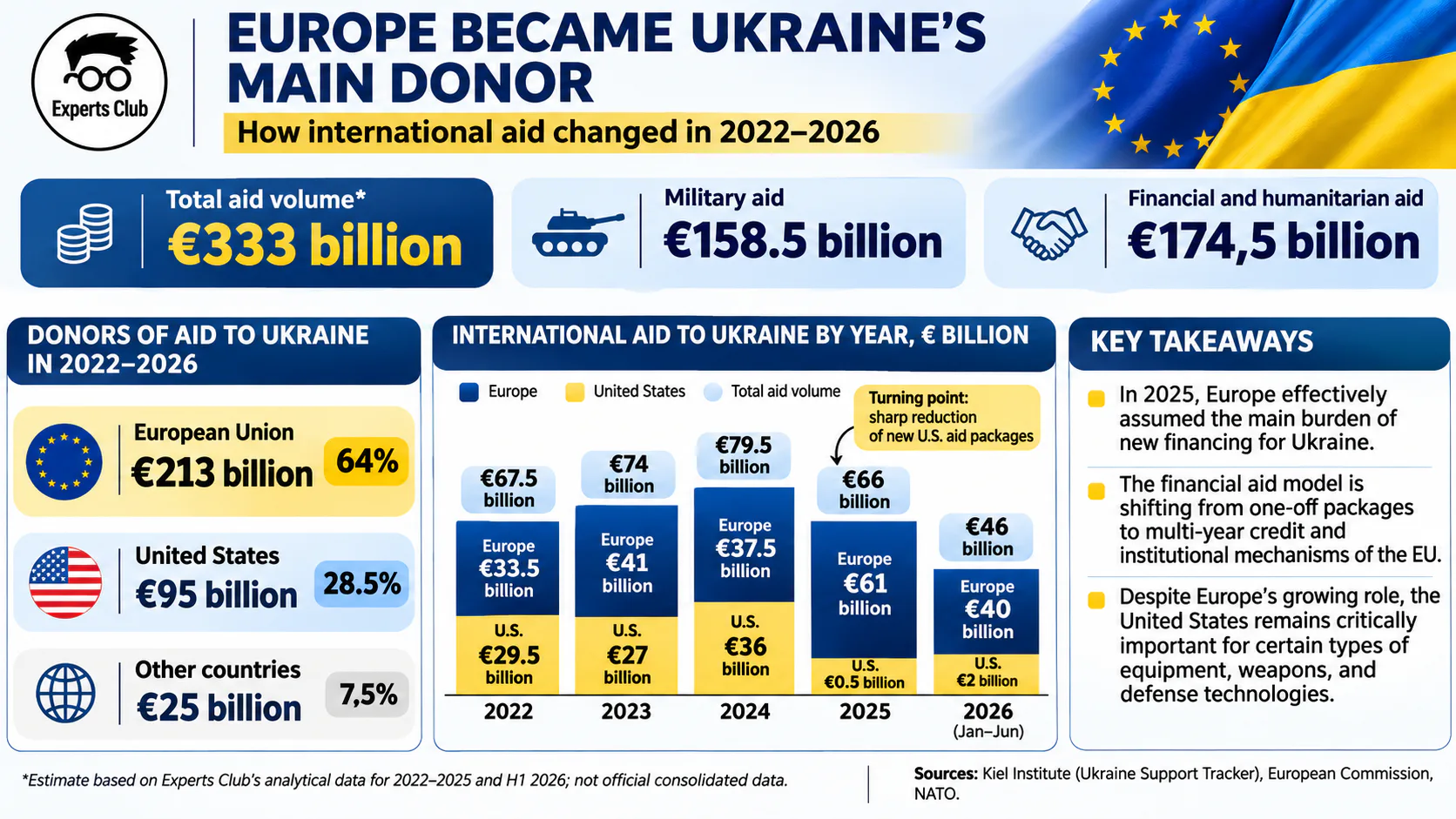
European countries and European Union institutions have become the main source of international support for Ukraine following a sharp reduction in new US aid packages in 2025. According to analytical estimates, European donors accounted for approximately 64% of total assistance during 2022–2025 and the first half of 2026, compared with 28.5% from the United States, reports the Experts Club information and analytical center.
Calculations based on an analytical infographic put total international assistance over this period at €333 billion. Military support accounted for €158.5 billion, while financial and humanitarian assistance totaled €174.5 billion. European donors contributed an estimated €213 billion, the United States €95 billion, and other countries €25 billion. These figures are not an officially verified record of resources actually received and depend on the methodology used to classify and measure assistance.
Annual figures illustrate the gradual restructuring of international support. Total aid was estimated at €67.5 billion in 2022, €74 billion in 2023, and €79.5 billion in 2024. The turning point came in 2025, when European assistance increased from €37.5 billion to €61 billion, according to the original infographic, while US assistance declined from €36 billion to just €0.5 billion.
Independent research by the Kiel Institute for the World Economy confirms Europe’s growing role. New European military aid allocations in 2025 increased by 67% compared with the annual average for 2022–2024, while financial and humanitarian allocations rose by 59%. Nevertheless, total new military aid allocations from all donors remained approximately 13% below the average annual level recorded during the previous three years.
In the first half of 2026, international assistance amounted to an estimated €46 billion under the infographic’s methodology, including €40 billion attributed to Europe and €2 billion to the United States. A central component of the new financing framework is the €90 billion Ukraine Support Loan for 2026–2027. Approximately €60 billion is intended for defense requirements, while €30 billion is allocated to budget support and macroeconomic stability.
The European assistance model increasingly relies on multi-year loans, joint financing instruments, and revenues from immobilized Russian sovereign assets. However, the United States remains a critical supplier of certain weapons, air defense systems, and defense technologies. The PURL mechanism, for example, allows European partners to finance purchases of US-made military equipment for Ukraine, maintaining an important transatlantic defense relationship.
According to the IMF’s baseline scenario, Ukraine’s external budget financing requirement for 2027 is estimated at $52.6 billion. As of November 10, 2026, approximately $32.6 billion of that amount had yet to be covered by confirmed financing sources. On November 18, the European Commission proposed an additional support package of up to €45 billion, including up to €25 billion for defense and €20 billion for budgetary needs. The initiative remains subject to legislative approval.
Experts Club analysts emphasize that the principal challenge is not simply the nominal value of international commitments, but the timing of actual disbursements, lending conditions, and the delivery of military equipment. Europe’s greater financial role improves the predictability of support but also increases Ukraine’s dependence on European institutional decisions. Long-term resilience will require diversified funding sources, expanded domestic defense production, and the timely implementation of agreed reforms.