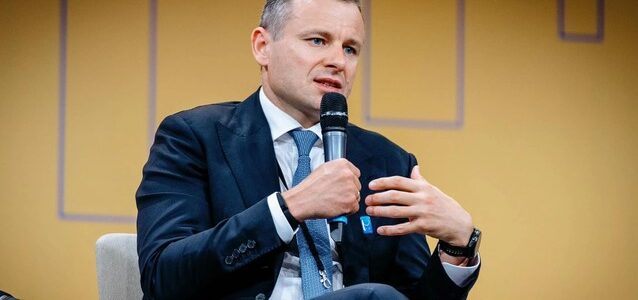
Ukrainian Finance Minister Serhiy Marchenko called, during preparations for the second reading of Bill No. 14327-d on Ukraine’s accession to the Single Euro Payments Area (SEPA), to engage in “maximum communication” with European counterparts so that the adopted law would meet European requirements, including on the most contentious issue of law enforcement agencies’ access to the future registry of bank accounts and safe deposit boxes.
“Because if we pass a law that isn’t recognized, we will in fact discredit the process itself in many ways and fail to achieve the desired result. “That is why I have a great request—first and foremost to my dear fellow Members of Parliament—to find the strength and opportunity to take a balanced approach to considering any amendments that may arise before the second reading,” he said at the expert roundtable “Follow the Money: When Will Ukrainians Get ‘Financial Visa-Free Travel’?” organized in Kyiv by the Council of Europe Office in Ukraine, The Kyiv Independent, and the NGO AML HUB.
According to Marchenko, there is currently a chance to pass this law in its entirety, in part thanks to the understanding that further delays will result in Ukraine joining SEPA under even more complex requirements.
“This is a complex bill in terms of passing through parliament, but I hope that there is now every reason to expect that it can secure the necessary number of votes. From an economic perspective, of course, this opens many doors for us and will actually allow us to achieve a certain level of compliance,” the minister noted.
Andriy Pyshnyy, Governor of the National Bank of Ukraine, confirmed that the economic impact of Ukraine’s accession to SEPA will be felt immediately upon joining.
“Experts estimate potential savings in the tens and hundreds of millions of euros. Moldova’s experience is telling: after joining SEPA, the base minimum cost of a single transfer in euros decreased from EUR20 to EUR1.26,” Pyshnyy said.
He also emphasized that it is now of fundamental importance that the final version of the document does not omit any provisions on which the success of Ukraine’s application to join SEPA depends.
According to him, Ukrainian banks have already begun preparatory work for technical connection to the SEPA infrastructure and are actively negotiating this issue with their correspondent banks and other EU banks.
Meanwhile, during further discussion, representatives of the opposition factions in the Verkhovna Rada noted that they are currently unwilling to vote in favor of the provision granting direct access to the future registry of bank accounts and safe deposit boxes to all 10 law enforcement agencies, as well as to the State Financial Monitoring Service and the National Agency of Ukraine for the Identification, Tracking, and Management of Assets Derived from Corruption and Other Crimes (ARMA).
Nina Yuzhanina of the “European Solidarity” faction stated that support for Bill No. 14327-d is contingent upon prior reform of the State Financial Monitoring Service, while Serhiy Vlasenko of the “Batkivshchyna” faction called for stricter liability for breaches of bank secrecy, specifically introducing a provision mandating the dismissal of any investigator who allows such information to be disclosed.
Olga Vasilevska-Smaglyuk, deputy chair of the Committee on Finance, Tax, and Customs Policy from the ruling “Servant of the People” faction, recalled that the initial version of the bill, following the recommendation of European partners, provided for direct access by all 10 law enforcement agencies, but due to a lack of trust, the version adopted as a basis granted direct access only to the Economic Security Bureau (ESB), ARMA, and the National Agency for the Prevention of Corruption (NAPC).
The committee deputy chair, who has long and vigorously advocated for the law’s adoption, reiterated that the creation of a registry administered by the Ministry of Finance would involve entering only basic identification data on individuals, while information on the movement of funds or the contents of safes would not be included and, as before, would require a court order.
According to Vasylevska-Smaglyuk, although the European Commission’s position on the full implementation of EU directives—granting access to all 10 law enforcement agencies, the State Financial Monitoring Service, and ARMA—remains in effect, there are theoretically compromise options. One of them, based on the experience of EU countries (in particular Germany, Poland, and
Liechtenstein), is granting law enforcement agencies access to the registry’s data through prosecutorial bodies—the Office of the Prosecutor General and the Specialized Anti-Corruption Prosecutor’s Office (SAPO). Another is granting such access through the tax service.
At the same time, a source at the Ministry of Finance of Ukraine, speaking with the Interfax-Ukraine news agency, expressed doubt that European partners would agree to such a compromise.
As reported, on November 10, the Verkhovna Rada adopted in principle the revised draft law No. 14327-d on Ukraine’s accession to SEPA, as well as the related law No. 15503 amending the Civil Code to ensure compliance with European Union legislation and the relevant criteria established by the European Payments Council, with the aim of Ukraine’s accession to SEPA.
BANK, MINISTRY OF FINANCE, PAYMENT, SEPA, UKRAINE

Related: