

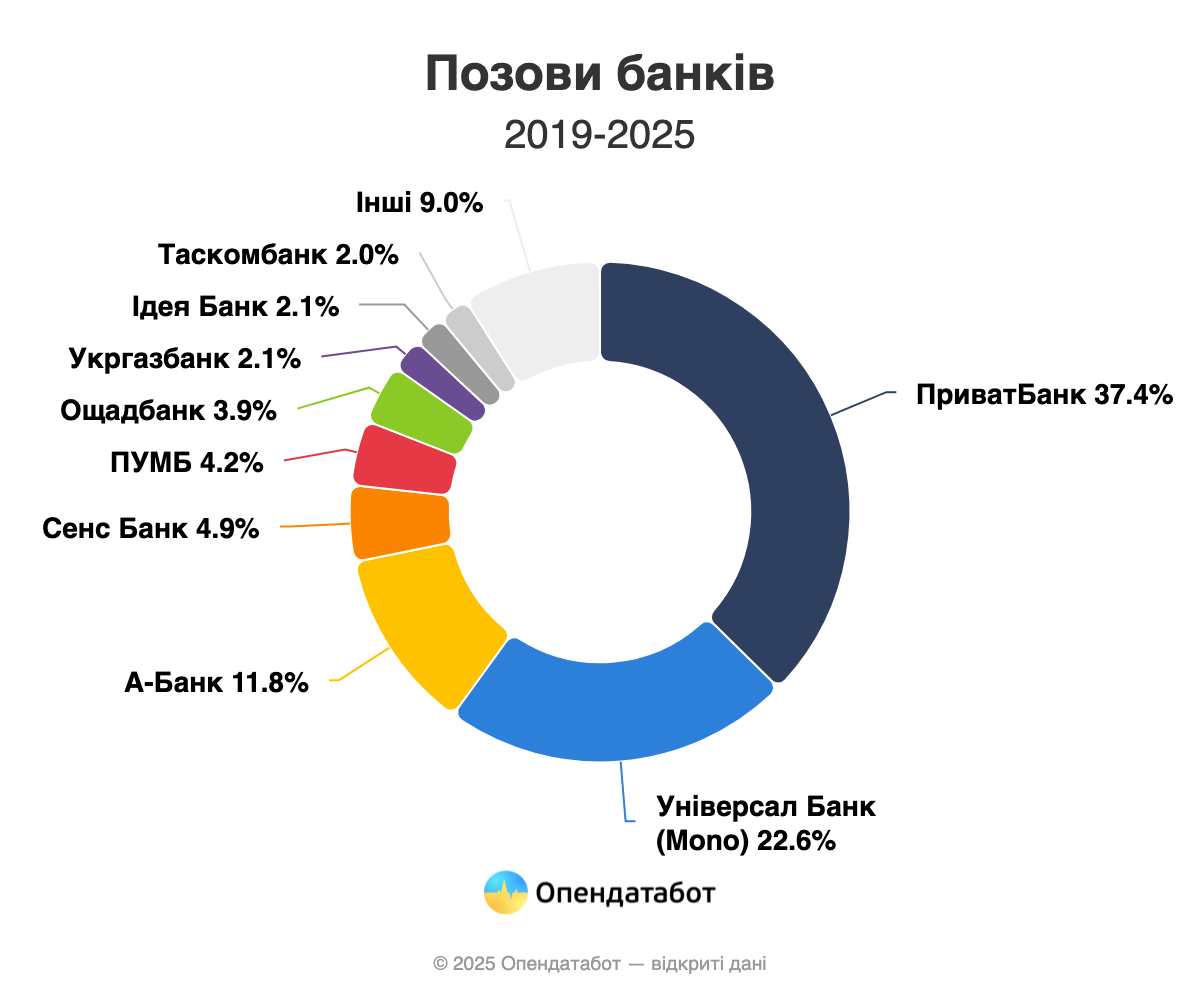
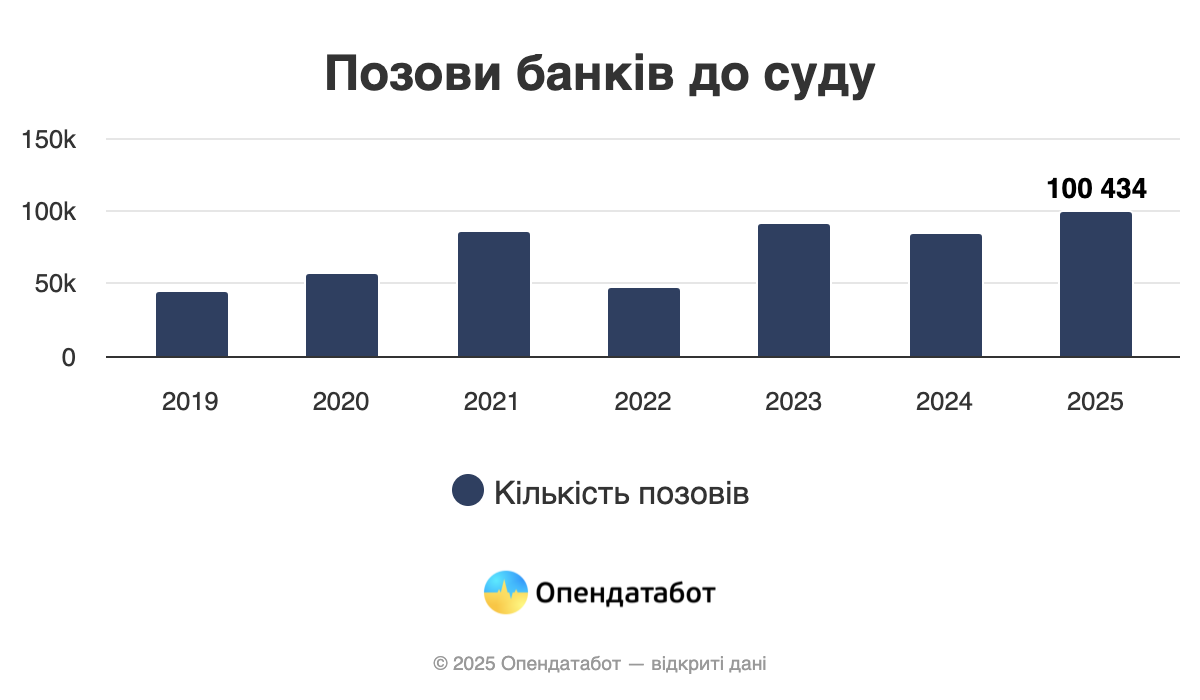
Banks are increasingly suing their debtors. According to the State Judicial Administration of Ukraine, a record 100,000 lawsuits were filed by Ukrainian banks this year. This is almost 1.5 times more than in the same period last year. In total, more than half a million lawsuits against debtors have been filed by banks over the past 7 years. Universal Bank (Mono), Privat and A-Bank account for 70% of the claims.
100,434 lawsuits against debtors were filed by Ukrainian banks. This is 1.5 times more than in the same period last year and a record for the last 7 years. A total of 511,865 lawsuits have been filed by banks since 2019.
Universal Bank/Mono (28,213 claims), A-Bank (22,221), and Privat (20,278) accounted for more than 70% of all claims this year. FUIB (9 , 225) and Sense Bank (6,831) are far behind.
In general, over the past 7 years, Privatbank has remained the unchanged leader in lawsuits against debtors – 191,353 lawsuits. It is followed by Universal Bank (115,702), A-Bank (60,421), Sense Bank (25,283) and FUIB (21,476).
TASKOMBANK saw the largest increase in the number of claims this year, up 3.5 times. PrivatBank (1.8 times), Kredobank (1.7 times), Accent Bank (1.6 times), and Sens Bank (1.6 times) also saw a significant increase.
At the same time, many banks have significantly reduced the number of court appeals. Unex Bank (4 times), Credit Agricole (2 times) and Ukrgasbank (2 times) showed the biggest drop.
It is worth noting that the ranking of the most “litigious” banks has been updated this year. New players entered the top – Radabank and Bank Alliance, which were not on the list last year. Instead, Accordbank and Unex Bank dropped out of the top twenty.
https://opendatabot.ua/analytics/banks-courts-2025
€16 million, with EU support, will support procurement of modern trolleybuses and infrastructure improvements
The European Bank for Reconstruction and Development (EBRD) is lending €16 million to the City of Cherkasy in Ukraine to finance the purchase of modern trolleybuses and the upgrade of related infrastructure for the city. The investment will strengthen sustainable urban mobility and ensure uninterrupted public transport services amid the wartime challenges facing Ukraine.
The loan, fully guaranteed by the City, will be co-financed by an investment grant of up to €4 million from the EBRD Shareholder Special Fund and will benefit from partial first loss risk cover under the European Union’s Ukraine Investment Framework Municipal Infrastructure and Industrial Resilience Programme (UIF MIIR). This promotes green transition and resilience in Ukraine’s economy by supporting sustainable investments in green city infrastructure, greening logistics chains, energy efficiency and green technology transfers.
The financing will enable Cherkasyelektrotrans, the municipal public transport operator in Cherkasy, to expand its fleet with new low-floor trolleybuses, modernise depots and other infrastructure, and extend and realign three trolleybus routes.
The project forms part of the EBRD’s Resilience and Livelihoods Framework, aimed at safeguarding essential municipal services during wartime. It will improve mobility for residents, including internally displaced people, and significantly reduce polluting emissions, contributing to better air quality. Aligned with the Paris Agreement’s mitigation and adaptation goals, the project is classified as 100 per cent green finance.
It also promotes inclusion by increasing accessibility for passengers with limited mobility and supporting gender equality through a partnership with UN Women’s She Drives programme, which will train and certify women and youth as trolleybus drivers.
By investing in Cherkasy’s public transport system, the EBRD is helping to maintain vital services, strengthen resilience and advance Ukraine’s green transition during a time of unprecedented challenge.
The EBRD has substantially increased its investments in Ukraine since Russia began its full-scale war there in 2022, deploying more than €8.5 billion to support energy security, vital infrastructure, food security, trade and the private sector.

On Monday, December 8, in Ukraine without significant precipitation, only in the south of the country, in the afternoon in some places and in the central regions of light rain, in the western regions at night and in the morning in some places fog, reports Ukrhydrometcenter.
The wind is southeast, east, 7-12 m/s, in the southeastern part in some places gusts of 15-20 m/s. The temperature at night from 2° warm to 3° frost, during the day 0-5° warm; in Transcarpathia and the south of the country at night 1-6° warm, during the day 4-9°.
In Kiev on December 8, no significant precipitation, winds southeast, east, 5-10 m / s, the temperature at night about 0 °, during the day 2-4 ° warm.
According to the Central Geophysical Observatory named after Borys Sreznevskyi, the temperature at night is about 0°, and in the daytime 2-4° warm. Borys Sreznevsky, in Kiev on December 8, the highest daytime temperature was 12.2 in 1960, the lowest nighttime temperature was -19.7 in 1959.
Tuesday, December 9, rain and wet snow in the east at night and in the north during the day; no significant precipitation in the rest of the country. At night and in the morning in the Carpathian region, central and southern regions in some places fog.
Wind southwest, on the Left Bank southeast, 5-10 m/s. The temperature at night from 2° warm to 3° frost, during the day 0-5° warm; in Transcarpathia and the south of the country at night 1-6° warm, during the day 4-9°.
In Kiev on December 9, no significant precipitation at night, rain in the afternoon, wind southwest, 5-10 m/s. The temperature at night is about 0°, during the day 2-4° of heat.
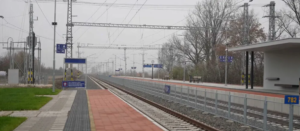
According to Serbian Economist, regular rail service between Belgrade and Budapest will start on February 20: passengers will once again be able to travel between the two capitals by train without changing trains. After modernization, the line is designed for train speeds of up to 160 km/h, which significantly reduces travel time and makes the train competitive with road transport.
In fact, this is not only about the “return of the train” between the two capitals, but also about Serbia’s inclusion in the wider Central Europe-Balkans-Aegean Sea transport corridor. Belgrade is gaining a stronger role as a transit hub for freight and passenger flows, and the route is becoming more attractive for logistics and industrial projects.
https://t.me/relocationrs/1894
Internal and external debt of Ukraine in 2011-2025
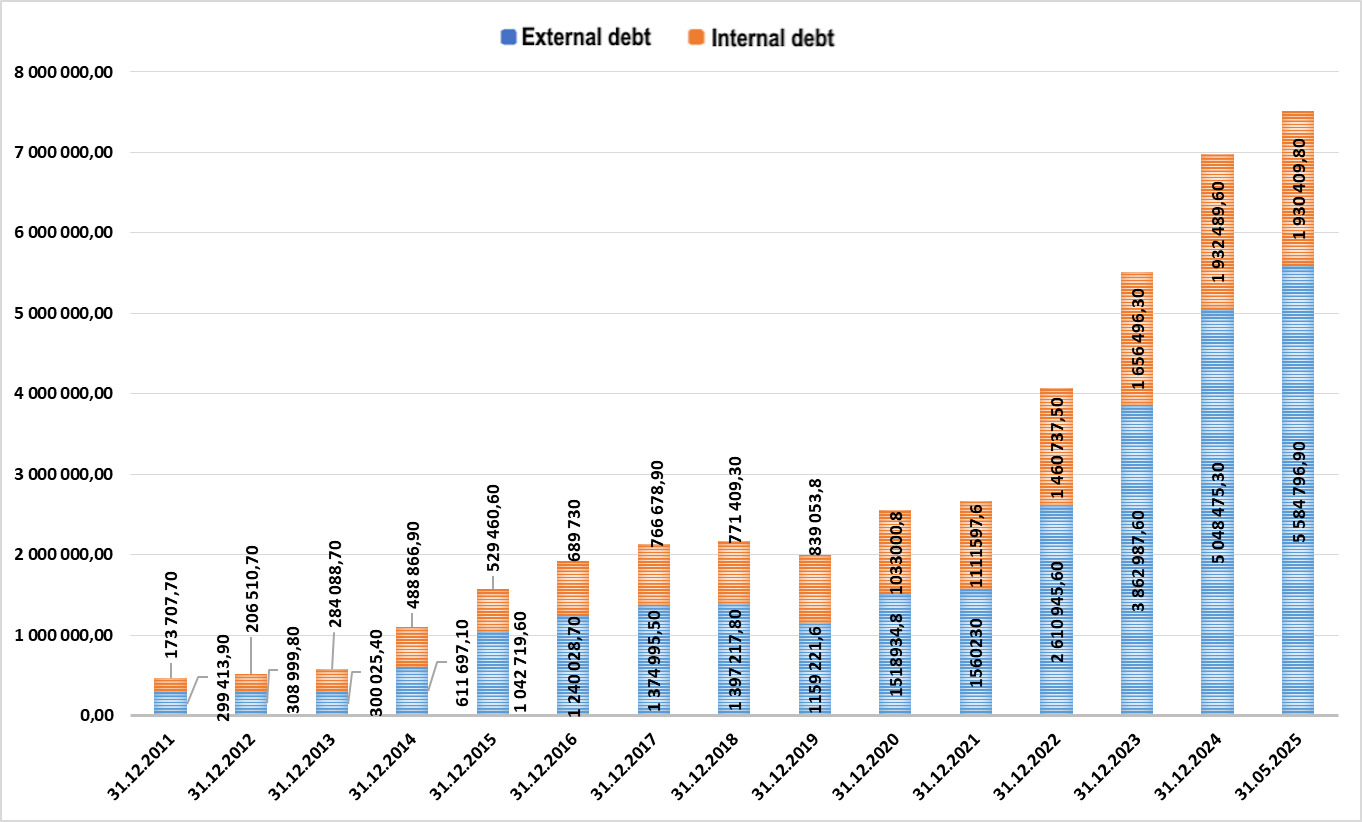
Source: Open4Business.com.ua
According to Serbian Economist, the island hotel Sveti Stefan near Budva, which is iconic for Montenegrin tourism, may resume operations by May 1, 2026, after many years of inactivity, as the Montenegrin government and the complex’s tenant, Adriatic Properties, are close to reaching an agreement on its reopening.
According to the draft agreement, existing contracts with the tenant and Aman Resorts will remain in force, the parties waive their claims in arbitration proceedings, and each party bears its own costs in London, with the exception of Adriatic Properties’ obligation to compensate Sveti Stefan Hotels for approximately £50,800 previously paid to the arbitration court.
A key element of the project is the obligation of the tenant and Aman to prepare the complex for opening no later than May 2026, with the lease term extended for another four years to compensate for the period of downtime and lost revenue.
A separate section sets out obligations to work with the local community: priority employment for residents of Budva and Paštrovici, purchasing products from local producers, regular fairs for local goods, educational and scholarship programs for young people, and year-round tours of the region. A new advisory body, tentatively called the “Bankada Council,” will be responsible for monitoring the implementation of these points and will report annually to the government. It may be headed by Serbian tennis player Novak Djokovic, which, according to Vijesti sources, will give the project additional publicity and credibility.
According to media reports, Djokovic has been acting as an informal mediator between the Montenegrin government, Aman Resorts, and Adriatic Properties in the dispute over Sveti Stefan since early 2025 and is discussing the possibility of participating in the project as an investor and representative of the Aman hotel chain.
The Sveti Stefan complex, which includes the island hotel of the same name, the Milocer villa, and the adjacent beaches, has been closed since 2021 amid a conflict between the state and the tenant over beach access and guest privacy.
Sveti Stefan is a historic fortified island village on the Adriatic coast a few kilometers from Budva, which was transformed in the mid-20th century into an elite resort where European monarchs, world politicians, and Hollywood actors vacationed over the years. In 2007, the Montenegrin government signed a 30-year lease agreement for the Sveti Stefan-Milocer complex with Adriatic Properties, a company linked to Greek businessman Petros Stathis, and operational management was transferred to Singapore-based luxury operator Aman Resorts. In 2015, the lease was extended until 2049, with the annual rent reduced to approximately €1.1 million.
https://t.me/relocationrs/1886



