
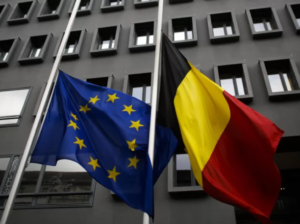
Belgium is demanding “independent” and “autonomous” guarantees from EU countries in exchange for its support for a loan to Ukraine using frozen Russian assets, Euractiv reports.
The documents, which are currently being discussed by EU ambassadors, come amid frantic efforts by the bloc to persuade Belgium to back the so-called reparations loan ahead of a crucial European Council summit in Brussels next week.
Euroclear, a securities depository headquartered in Brussels, holds the vast majority of the EUR210 billion in frozen assets that will be used to support Kyiv’s military efforts, making Belgium a key player in the EU negotiations.
In a series of amendments to the Commission’s legal proposal, which was first circulated to EU ambassadors last week, Belgium notes that the guarantees must be “independent and autonomous so that they remain in force even if the loan is declared invalid.”
Other key Belgian demands include: other EU states covering potential legal costs that Moscow may claim from any member state; EU capitals refraining from concluding new investment agreements with Russia and cancelling all existing agreements; and a number of other measures to protect Belgium from potential reprisals by Moscow.
Luxembourg and Belgium signed a bilateral investment agreement with the then USSR in 1989, which has not been revoked to date.
In addition, it requires that Euroclear itself “not be liable” for providing the reparations loan, and that its “directors be liable only in cases of gross negligence.”
The Russian Central Bank announced that it would file a lawsuit against Euroclear in a Moscow court on Friday.
Belgium has repeatedly criticized the Commission for continuing with the loan program and has called on other EU countries to support the issuance of joint debt obligations instead. However, the latter option is currently being blocked by Hungary, which is also strongly opposed to the loan program.
The Ukrainian agricultural sector is faced with the need to implement EU standards, which could cost the industry up to €2.5 billion annually, but at the same time opens up strategic opportunities for integration and strengthening Ukraine’s role in global food security, said Andriy Dykun, chairman of the All-Ukrainian Agrarian Council (AUC).
“Calculations show that the introduction of European eco-standards will cost the Ukrainian agricultural sector approximately €2.5 billion per year, which amounts to €70-150 in additional costs per hectare. We must incorporate these standards into our legislation. And at the same time, no one is even talking about giving Ukraine subsidies,“ the association’s press service quoted him as saying at the conference ”Agribusiness in Ukraine.”
He added that environmental standards are currently under pressure in Europe itself.
“It is important to understand that these standards are not yet a certainty in the EU itself. European farmers are also under a lot of pressure, and their green course is constantly changing,” Dykun noted.
After unification, Ukraine and Europe together will be the largest food producer in the world.
“We are the only country that will join the EU with agriculture better than in any other EU country — we are coming in with a high level. But we must unite with Europe not with an “outstretched hand,” but as an equal partner, which together with the EU will become the world’s largest food producer. This needs to be worked out professionally,” the VAS chairman concluded.
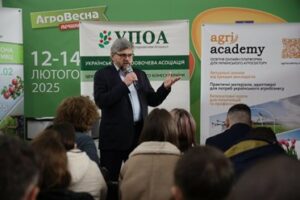
Greenhouse business without mistakes: take the new course “Greenhouse Agro Solutions” from leading industry experts at AgriAcademy
A new professional online course, “Greenhouse Agro Solutions,” created by a team of leading experts in Ukraine’s greenhouse sector, is now available on AgriAcademy, a platform offering free certified courses for Ukrainian agribusiness.
This innovative course for the greenhouse business was created by the winner of the national competition for the development of online training courses for SMEs in the Ukrainian agricultural sector — the Green Agro Solutions Public Association. The course is already available for enrollment, and its first online presentation attracted more than 100 farmers and representatives of agricultural companies, which indicates a high demand for modern professional content for agribusiness.
A year ago, the Food and Agriculture Organization of the United Nations (FAO), in partnership with the Ministry of Agrarian Policy and Food of Ukraine and the Ministry of Education and Science of Ukraine, announced an open call for proposals for the development of online training courses. This initiative is funded by Ireland through the EBRD Small Business Facility and the FAO. The EBRD Small Business Promotion Fund is financed by Ireland, Italy, Japan, South Korea, Luxembourg, Norway, Sweden, Switzerland, Japan, the TaiwanBusiness – EBRD Technical Cooperation Fund, and the United States of America.
The goal was to develop online training courses to address the shortage of professional knowledge and skills in the agricultural sector, food and processing industries, with a focus on small and medium-sized enterprises (SMEs) in Ukraine. The competition received 74 preliminary applications and 54 sets of documents, of which 35 were selected for final evaluation by an expert commission. Vitaliy Vorontsov, head of the Green Agro Solutions advisory service, received a certificate for funding the development of the course from the FAO.
“It is a great honor for our team that the idea of the Greenhouse Agro Solutions course won the competition and was selected by AgriAcademy for implementation. We are sincerely grateful to the organizers and partners of the project for their trust and the opportunity to create a training product that will help Ukrainian farmers gain the most up-to-date knowledge,” said Vitaliy Vorontsov, head of the agricultural advisory service of the Green Agro Solutions public association.
The course program is designed to provide entrepreneurs and farmers with systematic knowledge on the creation, modernization, and management of greenhouse farms — from engineering and microclimate to economics, innovation, and sustainable development.
“In the course of our work, we sought to create a truly unique course — one that had never been seen before in Ukraine. A course that combines engineering, agronomy, biosecurity, economics, and innovation. To this end, I assembled one of the strongest teams of specialists in the greenhouse sector—practitioners, engineers, scientists, and experts who work every day in greenhouses, on projects, and in real production conditions. Our task was simple and at the same time very important: to create a course that would be understandable, practical, and useful for small and medium-sized businesses, farmers, students, and anyone who wants to develop modern greenhouse production in Ukraine.
I believe that this course will become a new growth point for the greenhouse industry, help develop the professional community, and support those who are building the future of the Ukrainian agricultural sector,” emphasizes Vitaliy Vorontsov.
About the course: practical tools, innovations, and adaptation to the new realities of the greenhouse sector
The course program has been developed taking into account the challenges faced by Ukrainian greenhouse farms—climatic risks, energy costs, lack of technical information, and the consequences of war on production infrastructure.
The training covers ten key modules:
Course developers: the team shaping the greenhouse sector
The course was created by experts with many years of experience in applying technologies for the greenhouse business:
It was thanks to this victory that the team of expert practitioners was able to go the whole way – from concept to the creation of a full-fledged training program, which was developed, tested, and prepared for launch in 2025.
The course gives farmers access to the tools they need to modernize their greenhouses, reduce costs, increase yields, and implement energy-saving solutions.
Accessible technical education contributes to the restoration of production, increases the competitiveness of farmers, and strengthens the country’s food security.
The program is shaping a new culture of greenhouse management, where engineering, technology, and environmental approaches work together.
The course is free and already available on the AgriAcademy platform!
The platform also offers over 30 certified online courses for Ukrainian agribusiness.
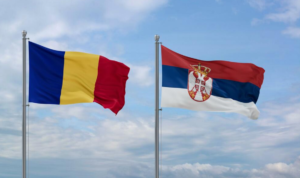
According to Serbian Economist, representatives of the Serbian and Romanian governments have recently officially confirmed their intention to develop a major transport project — to build a modern motorway that will provide a direct road link between the capitals of the two countries.
The project combines two national infrastructure plans:
— the Romanian A9 motorway (Timișoara–Moravița), which will connect Timișoara with the Serbian border, and
— the Serbian Belgrade–Vatin motorway with access to the Romanian border.
According to an intergovernmental agreement signed by the transport ministers of Serbia and Romania, both countries are working to agree on the technical details so that the roads connect at the border and create a continuous high-speed route from Belgrade to Timișoara.
In Romania, the section of the motorway between Timișoara and the Moravița border crossing is already in the preparation and design stage, and individual sections of the construction have been handed over to contractors.
This route is of strategic importance to both countries:
• It will strengthen transport links between the countries and improve freight and passenger transport logistics.
• The connection to the European motorway network will help integrate Serbian and Romanian infrastructure into European transport corridors.
The project is expected to be financed by both European funds and national budgets, and its implementation will be a step towards closer economic and transport integration in the region.
https://t.me/relocationrs/1926
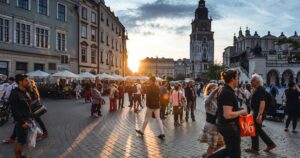
According to Serbian Economist, Krakow, Poland, has been recognized as the cleanest city in the world by Radical Storage, which analyzed more than 70,000 tourist reviews of the 100 largest destinations from Euromonitor International’s Top 100 City Destinations index.
According to the study, 98.5% of reviews mentioning Krakow’s cleanliness were positive. The top five also included Sharjah in the UAE (98% positive reviews), Singapore (97.9%), Warsaw (97.8%), and Doha (97.4%).
The top 20 cleanest cities in the world include Krakow, Sharjah, Singapore, Warsaw, Doha, Riyadh, Prague, Muscat, Dubai, Fukuoka, Abu Dhabi, Zurich, Edinburgh, Los Angeles, Lima, Cancun, Porto, Copenhagen, Taipei, and Valencia, with all of them receiving over 94% positive reviews for cleanliness.
Radical Storage indicates that it selected 100 cities from the Euromonitor Top 100 City Destinations index for analysis and reviewed the 10 most popular attractions in each city. Only English-language Google reviews from October 2024 to November 2025 that contained the words “clean” or “dirty” were taken into account, after which the mentions were classified as positive or negative. A total of 71,692 mentions of ‘clean’ and 10,165 mentions of “dirty” were processed.
According to the company, the authors of the study attribute the high rankings of Krakow and Warsaw to Poland’s investments in waste management systems and the improvement of public spaces, as well as the involvement of residents in city clean-up campaigns.
Serbian cities are not included in the study.
https://t.me/relocationrs/1923
Insurance premiums accrued under international Green Card insurance agreements concluded by member companies of the Motor (Transport) Insurance Bureau of Ukraine (MTIBU) decreased by 3.9% in January-December 2025 compared to the same period in 2024, to UAH 5.042 billion.
According to the MTIBU website, the number of Green Card contracts concluded during this period decreased by 4.3% to 1.308 million.
At the same time, the amount of compensation paid on claims increased by 0.75% to EUR 46.125 million, while the number of claims paid decreased by 8.52% to 13,300.
The MTIBU is the only association of insurers providing compulsory civil liability insurance for owners of land vehicles for damage caused to third parties.
The Green Card is a system of insurance protection for victims of road traffic accidents, regardless of their country of residence and the country of registration of the vehicle. It covers 45 countries in Europe, Asia, and Africa.
According to a decision adopted by the General Assembly of the Council of the International Motor Insurance System “Green Card” in Luxembourg in May 2004, Ukraine has been a full member of this system since January 1, 2005.



