
On November 19–20, 2025, Kyiv became the center of discussion on the future of food security and technological development in the agricultural sector. In parallel with the AgroExpo 2025 exhibition, the IV International Conference “Food from Ukraine” was held, organized by the Ministry of Economy, Environmental Protection and Agriculture of Ukraine in conjunction with the Ministry of Foreign Affairs of Ukraine and the Federation of Employers of Ukraine, with the support of the European Bank for Reconstruction and Development (EBRD).
The large-scale exhibition and business forum brought together those who are shaping the future of the agricultural sector: from representatives of the EU, G7, African countries, and the Global South to Ukrainian government officials, leaders of industry associations, manufacturers of machinery and equipment, and companies in the domestic food industry. It was a space where international diplomacy, innovative business, and science came together in direct dialogue. The organizers set themselves an ambitious goal: to show the world that the Ukrainian agricultural sector, despite the challenges of war, remains a driver of innovation. That is why special attention was focused on demonstrating modern technologies in production and processing, new solutions in agricultural engineering, and promoting Ukrainian food products to global markets.
Education has become a critical element linking technology, business, and practical development in the agricultural sector. That is why, for the first time, the exhibition featured the capabilities of AgriAcademy, a free online platform for agricultural education and certified online courses from leading Ukrainian and international experts. AgriAcademy.org is a free online learning platform for agricultural workers and students of agricultural education institutions, launched by the EBRD in December 2022 as part of its food security support program in Ukraine. Its goal is to strengthen the competitiveness and sustainable development of agriculture, which has suffered significant losses due to the war.
AgriAcademy as a navigational beacon amid technology, innovation, and the challenges of war
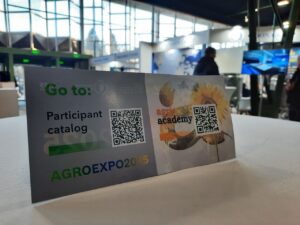
Visitors to the exhibition could see AgriAcademy information banners with QR codes that led directly to the course catalog. This format attracted considerable attention—farmers actively tested the QR codes, photographed the banners, and many participants learned for the first time about the possibility of certified free training in Ukrainian.
The AgriAcademy team handed out flyers with direct links to certified courses, and this simplicity of interaction became an advantage: specialists from various companies were able to register on the spot without delay.
According to many participants, today, when the industry is experiencing a shortage of personnel and technologies are changing faster than businesses can adapt, quality education is no longer an option — it is a necessity for recovery and growth.
Why interest in AgriAcademy is growing
After the war began, thousands of agricultural workers lost access to structured forms of training. AgriAcademy has become the answer to this problem — a platform that provides:
You can register and take courses here: https://agriacademy.org/courses-catalog/
The training programs cover areas such as crop production, berry growing, horticulture, agronomy, irrigation, animal husbandry, crop processing, organic production, and sustainable development.
By the end of 2026, AgriAcademy plans to launch 20 new courses that meet current market demands.
“Grow with us — with AgriAcademy!”
This message, present at the exhibition, became a key reminder that the future of agribusiness is impossible without continuous learning.
The labor shortage, which is getting worse every year, requires investment not only in technology but also in people. Companies that work with modern knowledge are more efficient, productive, and competitive.
AgriAcademy – training that works for results
Go to training:
https://agriacademy.org/courses-catalog/
AgriAcademy is a free online training platform created on the initiative of the EBRD as part of its food security support program in Ukraine. Its goal is to strengthen the competitiveness and sustainable development of agriculture, which has suffered significant losses due to the war.
The platform’s creation and management (including course development, training tours, etc.) is supported and funded by the EBRD, as well as:
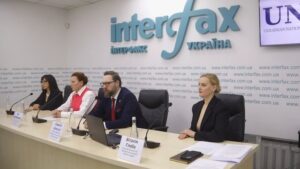
The National Association of Lobbyists of Ukraine (NALU) calls on Viktor Pavlushchik, head of the National Agency for Corruption Prevention (NAZK), to refrain from taking steps that, in the Association’s opinion, could restrict the independence of the lobbying profession and introduce excessive control over their activities.
“We appeal to the head of the NACP, Viktor Pavlushchik, with a public call to stop pressuring the independent profession of lobbyists and to move towards an open dialogue with the professional community. The regulation of lobbying should be based on European standards of transparency, not on manual control of the market by a state body,” said Oleksiy Shevchuk, chairman of the board of the National Association of Lobbyists of Ukraine, at a press conference at the Interfax-Ukraine agency on Wednesday.
According to him, decisions regarding the monitoring and reporting of lobbyists should be made after public consultations with the NALU as a specialized organization.
Yana Tsymbalenko, the NALU’s anti-corruption commissioner, emphasized that the independence of the lobbying profession is an important component of a democratic decision-making system.
“Lobbying is about transparency in representing interests, not about shady deals. Any initiatives by the regulator that could be perceived as pressure on the profession should be discussed openly, taking into account best European practices. We are ready to cooperate with the NACP, but on the basis of partnership, not subordination,” Tsymbalenko stressed.
https://interfax.com.ua/news/press-conference/1121821.html
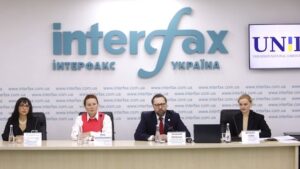
The National Association of Lobbyists of Ukraine (NALU) has announced the introduction of an anti-corruption officer within its structure, stating its intention to become a model of transparent regulation of the lobbying profession and calling on the National Agency for Corruption Prevention (NAZK) to engage in open dialogue on monitoring the activities of lobbyists.
Oleksiy Shevchuk, Chairman of the Board of the National Association of Lobbyists of Ukraine, announced that the Association is introducing the position of anti-corruption officer in accordance with European approaches to transparency and requirements adopted after the NALU was included in the European Parliament’s Transparency Register.
“The National Association of Lobbyists of Ukraine is introducing an anti-corruption officer, complying with EU requirements and confirming that the profession of lobbyist in Ukraine must be transparent, understandable, and operate exclusively within the legal framework and pay taxes,” Shevchuk said at a press conference at the Interfax-Ukraine agency on Wednesday.
According to him, the NALU is the first public organization in Ukraine to formalize the institution of an anti-corruption officer in the professional community of lobbyists. “No gray schemes, no gray money, no tax-free payments. We are setting an example of how modern lobbying should work—as transparent interaction between business and parliament, not corruption,” the chairman of the board emphasized.
At the same time, Shevchuk criticized the NACP’s approved procedure for monitoring the activities of lobbyists, which, according to him, was adopted without public consultation with the professional community. He considers this approach to be interference by a state body in an independent profession.
“The National Agency for Corruption Prevention is actually trying to establish control over the profession of lobbyists by adopting documents without discussion with the market. Just as the state does not interfere in the work of lawyers, private executors, or notaries, it should not usurp influence over lobbyists. Any accountability mechanisms must be discussed publicly with the professional community,” he stressed.
The head of the NLA emphasized that in the absence of open discussion, the association will appeal to parliament, the government, the Office of the President, and European institutions with a report on the risks of excessive interference by the NACP in the regulation of lobbying.
Lyudmila Kozhura, director of the Vadym Hetman KNEU Law Institute and Doctor of Law, in turn, stressed that for European democracies, systematic interaction between state regulators and lobbyist associations is an established practice.
“If Ukraine is moving towards the European community and adopting the best democratic standards, the state must establish regular dialogue with the National Association of Lobbyists of Ukraine. In the EU, the US, and Canada, regulators systematically hold consultations and discussions with lobbyist associations. This format of cooperation should also be introduced in Ukraine, and we are open to this interaction,” Kozhura stressed.
The anti-corruption commissioner of the NALU is Yana Tsymbalenko, an associate professor at Igor Sikorsky Kyiv Polytechnic Institute, a candidate of sciences in public administration, and an expert in corruption prevention. She noted that any new tools related to the transparent profession of lobbying in Ukraine should be implemented openly.
“Lobbying is not corruption; lobbying is anti-corruption if it is carried out transparently and in the interests of society. The profession of lobbyist requires not only a high level of professionalism, but also a clear understanding of ethical standards and the consequences of decisions made. However, the NACP’s decision to regulate the activities of lobbyists seems premature, to say the least, without broad professional discussion. As the authorized person for corruption prevention, I will ensure maximum transparency in the Association’s activities and prevent any shady practices,” Cymbalenko emphasized.
Executive Director of the National Association of Lobbyists of Ukraine Vitalia Globa reported that the NALU board unanimously supported the introduction of the institution of anti-corruption commissioner and a public appeal to the NACP.
“The National Association of Lobbyists of Ukraine is open to dialogue, cooperation, and professional participation in the preparation of regulations concerning the regulation of the lobbying profession. At the same time, we insist that no decisions regarding the professional activities of lobbyists can be made without the involvement of the relevant association, without professional discussion and transparent procedures,” she added.
Vitalia Globa recalled that earlier, the NALU sent an official notification to the NACP stating that the Association is the first professional organization in the field of lobbying and protecting business interests in Ukraine, brings together leading experts, and is ready to cooperate on regulatory decisions.
NALU representatives also reported that the Association has already developed guidelines on transparency rules for lobbyists and a model contract with businesses, and is preparing educational programs in cooperation with leading universities and international partners. Offline meetings with representatives of lobbying communities in the UK, the US, and EU countries are expected to be held.
The National Association of Lobbyists of Ukraine brings together more than 40 specialists, which is about 40% of the total number of lobbyists registered in the transparency register. The organization calls for an open discussion of the NACP draft document with the involvement of industry representatives, in particular from the fuel, agricultural, energy, and tobacco sectors.
https://interfax.com.ua/news/press-conference/1121804.html
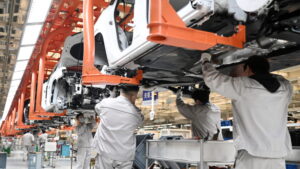
According to Serbian Economist, the Chinese company Techron Automotive plans to build its first foreign plant for the production of plastic car components in the city of Inđija (Vojvodina, Serbia), which will strengthen the country’s role as a regional hub for the automotive industry. This was announced by the Municipality of Inđija, as cited by Serbia-business.eu.
The construction is planned to start by the end of this year. According to the published information, the plant in Indjija will be the first Techron plant outside China. At the first stage, the construction of a 4.5 thousand square meters production building is envisaged. After reaching full capacity, the enterprise will be able to provide about 200 jobs.
The plant is scheduled to open in mid-2026.
Techron produces components for the world’s leading automakers – Volkswagen, Porsche, Audi, Chery, Geely and others. The product line includes engine and transmission parts, interior and exterior components, as well as control system components.
Experts note that the project fits into Serbia’s strategy of deepening specialization in the automotive industry and automotive components: dozens of plants for the production of harnesses, electronics and plastic parts for European and Asian brands are already operating in the country. For the region, this means not only new jobs, but also the need to invest in energy, logistics and vocational education in order to consolidate the effect of the new investor.
https://t.me/relocationrs/1782

In October 2025, the Alliance Novobud development company continued active construction work on the Montreal House project in Kyiv and the Krona Park II and Lesovy Kvartal residential complexes in Brovary (Kyiv region), according to a report on construction progress on the company’s website.
According to the information, in the capital’s Montreal House project (102 Bolshaya Vasylkivska Street/83 Antonovycha Street), plastering work and the installation of cement screed on standard floors and in common areas, as well as facade insulation, continued in blocks 1 and 2 in October. In block 3, electrical cables were laid along the risers of “cold passages” and stairwells. In block 4, the installation of translucent aluminum structures continued (65% complete) and cables were laid along the risers and stairwells.
At the Montreal House parking lot, the waterproofing of the upper slab in the inner courtyard area has been completed, the installation of storm sewer pipes is continuing, and the waterproofing of the stylobate slab on the side of Bolshaya Vasilkovskaya Street has begun. The tower crane has also been dismantled to carry out the next set of works, and a metal frame for the entrance canopy on the side of Antonovycha Street has been installed.
At the Krona Park II residential complex (Brovary, Vasyl Simonenko Street, 32), the insulation of the basement walls was completed in October in building 5, backfilling of the foundation cavities continues, roofing work and installation of PVC windows are underway (windows have been installed from the 2nd to the 10th floors, with work continuing on the 11th and 12th floors). In building 8, the installation of internal water supply and heating engineering networks has begun, the installation of internal power supply and lighting networks is continuing, connection to external heat and water supply networks is being carried out, as well as facade work: section No. 1 is 95% complete, section No. 2 is 75% complete, and section 3 is 45% complete.
In building 9 of Krona Park II, the finishing touches are being made to the common areas and the landscaping of the surrounding area, commissioning work is underway, and the preparation of the documentation package for the completion certificate has begun. In building 10, finishing work has begun in common areas and apartments, and the installation of internal plumbing, electrical, and lighting networks is continuing. In building 12, roofing work has been completed in sections 1 and 2, and the installation of PVC windows is continuing (installed up to the 9th floor of section 1, work is underway on the 10th and 11th floors). In buildings 14 and 16, the pile field has been completed, with 100% of the bored piles installed.
At the Lesovy Kvartal site, building No. 16 (Brovary, V. Chornovola Street), vertical monolithic structures were erected in sections 2.2, 2.1, and 1 in October, and work began on the construction of brick walls.
The company specifies that work on the sites in Kyiv and Brovary is at different stages – from the pile field and monolith to the finishing touches and preparation for commissioning, while the developer is keeping to the schedule and continuing to move the projects towards completion in stages.
Alliance Novobud is a development company that has been operating in the residential real estate market of Kyiv and the Kyiv region for over 18 years. The developer specializes in comfort+ and business-class projects, with key projects including Montreal House and Illinsky House in Kyiv, as well as Krona Park II, Lesovy Kvartal, Zeleny Kvartal, Madison Gardens, and Lavandovy in Brovary.
According to industry ratings, Alliance Novobud was among the top 20 largest developers in Kyiv and the region in terms of the number of apartments completed in 2024 (481 apartments in five buildings, with a market share of about 2.2%). The company is a winner of the UKRAINIAN SPECIAL BUILDING AWARDS IBUILD and Business of the Year professional awards, and was named “Developer of the Year” and “Residential Complex of the Year” for the Montreal House and Krona Park II projects.
Alliance Novobud, Forest Quarter, Krona Park II, Montreal House

Insurance company “Unica” (Kiev), in October this year paid out UAH 187.2 mln of insurance indemnities, which is 5.3% less than in October last year (UAH 197.7 mln). According to the company’s website, the total amount of insurance payments under auto insurance contracts amounted to UAH 73.6 mln (-0.8%), of which UAH 51.83 mln under CASCO (-7.3%) and UAH 21.41 mln under CMTPL (+17%).
The total amount of payments under contracts of voluntary medical insurance amounted to UAH 80,47 mln, which is almost the same as last year’s similar indicator, payments under property insurance – UAH 6,23 mln, other types of insurance (including life insurance) – UAH 26,91 mln.
UNIQA Group (Austria) entered the Ukrainian market in 2006. Its companies in Ukraine “Unica” and “Unica Life” with central offices offer most types of risk and life insurance.



