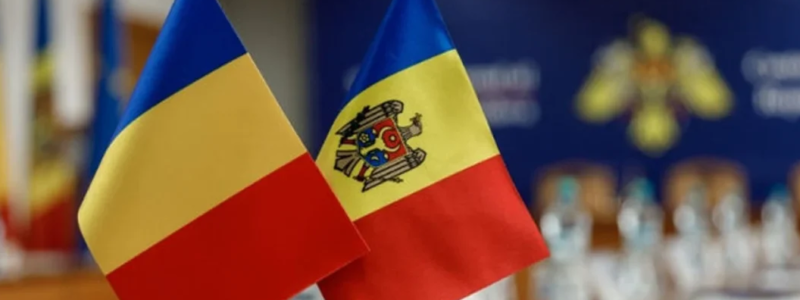
The bill on the unification of Romania and Moldova automatically passed the Chamber of Deputies of the Romanian Parliament after the deadline for consideration expired without debate or a final vote; however, the initiative received negative opinions from the government and relevant committees and must now be considered by the Senate.
The bill was introduced by deputies from the far-right S.O.S. România party. According to procedure, if the lower house does not consider an initiative within the established timeframe, it is deemed to have been tacitly adopted and is forwarded to the next chamber of parliament. In this case, the final decision must be made by the Romanian Senate.
The mere fact that the bill passed the Chamber of Deputies does not mean that the unification of Romania and Moldova has received political support from the majority. On the contrary, the initiative has already been met with negative assessments from the Romanian government, the Chamber of Deputies’ Legal Committee, and its Human Rights Committee.
The bill is primarily of a political and symbolic nature. The topic of the unification of Romania and Moldova regularly comes up in public discourse; however, Chisinau’s official position today is focused not on immediate unification but on Moldova’s accession to the European Union. Moldovan President Maia Sandu has previously stated that she would personally support unification in a referendum, but she also acknowledged that the majority of Moldovan citizens do not currently support such a scenario, and that European integration remains a more realistic goal.
For Romania, the issue of unification is also a sensitive one. On the one hand, Bucharest remains Chisinau’s main European partner, providing Moldova with political, economic, and infrastructure support, and a significant portion of Moldova’s citizens already hold Romanian citizenship. On the other hand, formal unification would raise issues regarding borders, security, the budget, the status of Transnistria, and relations with the EU, NATO, and Russia.
In theory, the potential of such a union for the region would be significant. It could accelerate Moldova’s institutional integration into the European space, expand the common labor market, strengthen transportation and energy links between the Black Sea, the Danube, and Eastern Europe, and bolster security on the eastern flank of the EU and NATO.
Economically, the union could provide Moldova with faster access to the infrastructure, financial instruments, and administrative system of an EU member state. For Romania, this would mean expanding its domestic market, deepening its influence in the region, and strengthening Bucharest’s role as a key partner of Chisinau.
However, the practical implementation of such a scenario remains extremely challenging. The main constraints are the lack of a stable majority in Moldova in favor of integration, the risks of internal polarization, the unresolved issue of Transnistria, Russia’s potential reaction, and the need to coordinate such a process with European and Euro-Atlantic partners.
Therefore, at this stage, the bill should be viewed more as a political signal and an element of intra-parliamentary struggle in Romania rather than as the beginning of an actual unification process. A more likely scenario for the region remains the gradual rapprochement between Romania and Moldova through infrastructure projects, energy integration, trade, citizenship, education, and support for Moldova’s European integration.