

The ban on the export of wheat, barley, rapeseed and sunflower seeds from Ukraine to Poland, Hungary, Slovakia, Romania and Bulgaria, imposed on May 2 for the period until June 5, will be extended until September 15, the Polish Minister of Agriculture and Rural Development Robert Telusz said.
“It (the relevant regulation) has not yet been approved or published, but we have information that the European Commission has extended the ban on imports of wheat, corn, rapeseed and sunflower from Ukraine until mid-September 2023,” the minister was quoted by the press service of the Polish agency on Monday evening.
According to Telusz, if the information about the ban on imports is confirmed, as of tomorrow, Poland will not be able to receive grain on contracts concluded before May 2, 2023.
Polish minister also said that negotiations with the so-called Eastern European border countries and the European Commission will continue. They will discuss the prospect of further extending the ban on the import of Ukrainian grain to these countries after September 15, 2023.
The Polish Agriculture Ministry said that the ban can be made more flexible taking into account the specifics of individual countries.
Speaking about grain exports, Telusz said 1.054 million tons of grain were exported from Poland in March, 1.152 million tons in April and the same amount was exported in May.
“That brings the total to more than 3 million tons of grains exported from Poland. At the same time, imports are falling. In February it was 270 thousand tons, in March 260 thousand tons, and in April only 49 thousand tons,” summarized the minister.
As reported, on Monday morning Telush reported receiving from the EU a new draft regulation to extend the ban on imports of four types of grains and oilseeds from Ukraine to five countries until September 15, 2023 and expressed hope that it will be introduced as early as June 6.
The European Commission’s speaker for agriculture and trade, Miriam Garcia Ferrer, clarified at a briefing at noon that no decision has been made at this stage, discussions are ongoing.
The EU ban on imports of wheat, corn, rapeseed and sunflower from Ukraine came into force on May 2 and replaced unilateral import bans imposed by countries bordering Ukraine, particularly Poland, Bulgaria, Hungary and Slovakia, in violation of the Association Agreement and EU internal regulations as of April 28.
As noted by the EU, Bulgaria, Hungary, Poland and Slovakia undertook to cancel unilateral measures on these and all other goods originating from Ukraine and to allow free transit.

Danube ports in May handled a record volume of cargo – more than 3 million tons, the Administration of Sea Ports (AMPU) reported on Facebook.
“According to operational data, more than 3 million tons were transshipped by Danube ports in May. This is an absolute record for the ports of this region,” stated in AMPU.
Such result, as the report says with reference to the head of AMPU Yuriy Litvin, was achieved due to responsible and coordinated actions of business, the team of AMPU and the Ministry of Development of Communities, Territories and Infrastructure.
“Development of the Danube cluster is one of the priority tasks of our company. Already now well-known world companies are investing in the development of port facilities and fleet on the Danube, which allows us to constantly increase the volume of exports and imports. This month, public and private stevedoring companies have renewed their historical records,” he said.
Development of the ports of the Danube cluster, the report points out, is a priority for the European partners. The European Commission and the Danube Commission for Cooperation with the Lower Danube Administration and the Romanian Ministry of Transport are working on increasing the throughput capacity of the Sulina channel, as the productive work of the Danube ports depends on it.
It is expected that by the end of 2023, the volume of cargo handled in the Danube ports could grow to 20 million tons, compared to 16 million tons in 2022, which is three times higher than before the war.

Oil prices strengthened their rebound Monday afternoon as investors assessed the outcome of last weekend’s OPEC+ meeting.
Futures on Brent crude oil for August at London’s ICE Futures Exchange rose by $1.37 (1.8%) to $77.5 per barrel by 2:24 pm.
WTI July futures traded on the NYMEX rose by $1.37 (1.91%) to $73.11 per barrel by that time.
Last Friday, Brent gained 2.5% and WTI gained 2.3%.
OPEC+ countries at a meeting in Vienna on June 4 decided to reduce oil production quotas by another 1.4 mln bpd – to 40.46 mln bpd. The states voluntarily reducing production since May by 1.66 million bpd will extend the cuts for the entire year 2024.
Meanwhile, Saudi Arabia will reduce production by an additional 1 million b/d as early as this year and will think about a possible extension of such measure every month depending on the market situation to stabilize it.
“Saudi Arabia is more active than most other OPEC members in seeking to maintain oil prices above the $80 a barrel mark because it is important to the country’s budget balance for this year,” DBS Bank analyst Survo Sarkar wrote.
Rystad Energy, a consultancy, estimates that additional production cuts by the kingdom will increase the global market deficit to 3 million bpd in July, which will support prices in the coming weeks.
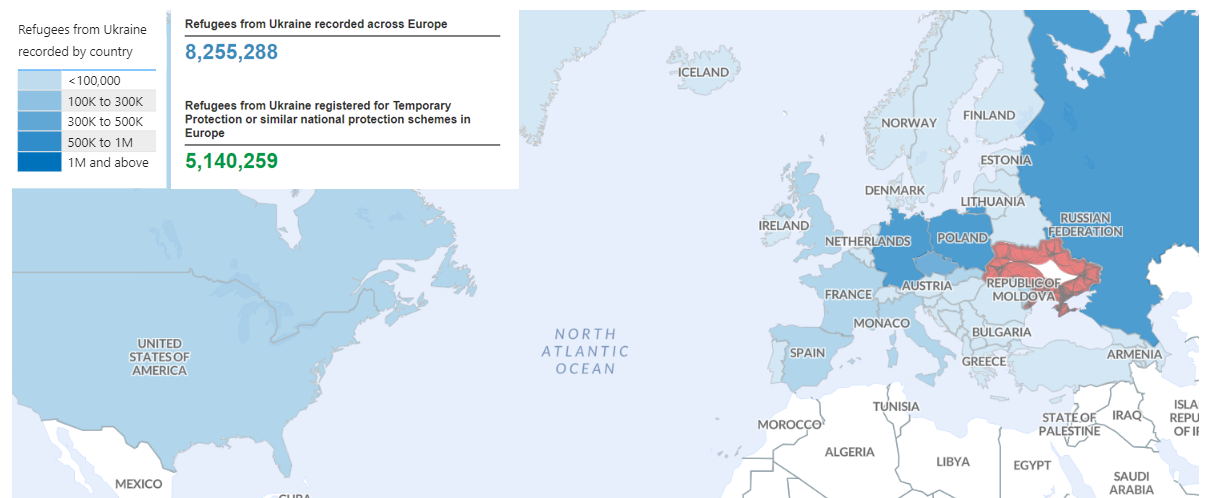
Number of refugees from Ukraine in selected countries as of 23.05.2023
Source: Open4Business.com.ua and experts.news

The European Union has extended by another year the cancellation of import duties on Ukrainian exports. This decision will become effective from 6 June 2023 and will be effective until 5 June 2024, inclusive.
The regulation of the European Parliament and the European Council of May 31 on extending for another year the abolition of import duties on Ukrainian exports was published in the EU official Journal on Monday.
The moratorium on duties imposed in 2022 will expire on June 5, 2023.
In order to prevent fraud in the preferential mechanisms established by the regulation, Ukraine must comply with a number of rules, including refraining from introducing new duties or charges and new quantitative restrictions or measures with equivalent effect, from increasing existing duties and charges, and from imposing any other restrictions in trade with the EU, unless clearly justified, the document says.
According to the regulation, if Ukraine fails to comply with any of these conditions, the EU may suspend the preferential mechanisms.

Registrations in Ukraine in May of new commercial vehicles (trucks and special) amounted to 955 units, which is 2.6% more than in April this year and twice as much as in May 2022, “Ukravtoprom” informs in Telegram-channel.
“This is the best result in the last 15 months,” the report states.
At the same time, compared with the pre-war May 2021 registrations of commercial cars decreased by 11%.
Leadership remains Renault with 327 registered cars in May, the second place by a wide margin with Volkswagen (81 units), which in April was the fifth in the ranking, the third – with Mercedes-Benz (66 units), the same number of cars registered brand Citroen. Peugeot (52 cars) is in the end of TOP-5.
According to Ukravtoprom in January-May, Ukrainian park of trucks and special-purpose vehicles was added with 4122 new cars, which is 1.5 times more than during the same period last year.
As was reported with reference to Ukravtoprom, 6.9 thousand new cars will fill in the market of new commercial vehicles in 2022, which is 2.3 times less than in 2021.
At that, in May – 2022 there were 461 registered cars (57% less than in May – 2021), and the leaders were Renault (109 units), Citroen (91 units) and MAN (54 units).



