
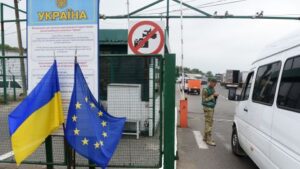
Net outflow from Ukraine this week increased to 16 thousand people from 8 thousand a week earlier, the State Border Service reported on Facebook.
According to the Ministry, the flow on the way out of Ukraine from February 11 to 17 increased from 219 thousand to 225 thousand people, while on the way in – 211 thousand people.
The number of cars, according to the department, crossed the western border of Ukraine, also remained at the level of 118 thousand, whereas the number of vehicles with humanitarian cargos decreased from 464 to 452.
Polish State Border Service also fixed increase of the net outflow from Ukraine for the last seven days – up to 12 thousand people from 7 thousand people a week before.
According to the Polish Ministry, the weekly flow from Ukraine to Poland increased from 138 thousand people to 146 thousand, whereas the return flow from Poland to Ukraine – from 131 thousand to 134 thousand people.
In total, since the beginning of the war 9.899 million people arrived in Poland from the Ukraine, while 8.021 million people went in the opposite direction.
It was reported that since May 10, the flow into Ukraine through its western border every day for almost a month steadily exceeded the flow out. The net inflow during this time was 188 thousand people. In subsequent weeks there was no such unambiguous trend, except for the week of the new academic year, when net inflow was a record 47 thousand people.
In general, statistics showed a gradual return of Ukrainians to their homes: the net influx for the period from May 10 to September 23 was 409 thousand people.
For the first time since May 10, the number of those who left Ukraine in a week exceeded the number of those who entered at the end of September. At that time, the net outflow was 28 thousand people at once, and one of the possible reasons was a reaction to mobilization in Russia and “pseudo-referendums” in the occupied territories, and then the probable reason was massive shelling of the energy infrastructure. The outflow temporarily stopped in the second half of December and early January for the period of holidays, but from the second week of January it resumed, reaching a total of 193,000 since late September.
According to UNHCR data as of February 14, a total of 18.607 million people left Ukraine since the beginning of the war (not including the flow of people into the country), of which 9.604 million left for Poland, 2.852 million for Russia (data as of October 3), 2.216 million for Hungary, 1.967 million for Romania, 1.163 million for Slovakia, 770.3 thousand for Moldova and 16.7 thousand for Belarus.
At the same time, according to the UN data, 10.297 million people arrived in Ukraine from February 28, 2022 to February 14, 2023 (not including data of Hungary, Russia and Belarus).
Passenger traffic through the western border of Ukraine, thousand.
Date from Ukraine incl. to Poland to Ukraine incl. Ukrainians number of cars of humanitarian trucks, pcs.
17.Feb 34 21 31 28 17 46
16.Feb 35 21 29 26 18 48
15.Feb 31 18 28 24 17 65
14.Feb 31 19 28 25 17 67
13.Feb 31 19 30 27 16 97
12.Feb 33 20 33 30 16 61
11.Feb 30 17 32 28 17 68
10.Feb 34 21 30 27 18 78
09.Feb 32 20 28 25 17 51
08.Feb 31 18 29 25 17 82
07.Feb 29 17 27 24 17 79
06.Feb 27 16 29 27 15 65
05.Feb 31 21 33 30 16 55
04.Feb 35 22 35 31 18 54
Data: State Border Service
International Monetary Fund (IMF) staff and Ukraine’s official authorities reached a staff-level agreement (SLA – staff-level agreement) on the first and final review under the Monitoring Program with Board of Directors (PMB).
“This agreement, which is subject to IMF management approval, paves the way for the start of discussions on a full-fledged program supported by the Fund,” the IMF said in a statement Friday evening following the mission.
As reported, Ukraine, amid the IMF’s reluctance to immediately allocate significant funding last fall, requested a four-month PMB Monitoring Program from the Fund, which the Fund approved on December 20. Kiev hopes that this program, which does not involve financing, will be replaced by the Extended Funding Facility (EFF) at the beginning of the second quarter of 2023, which may partially cover the gap in covering the $38 billion deficit in the state budget 2023, which now amounts to about $10 billion.
The IMF mission on the first revision of the program worked in Warsaw on February 13-17. It discussed medium-term macroeconomic indicators, fiscal policy, the structure of financing, financial sector policies, and governance.
“Thanks to the joint efforts of the government and the National Bank of Ukraine, all the quantitative and indicative indicators for the end of December, as well as all five structural benchmarks for the end of January were fulfilled. They included the government’s submission of a package of tax bills, the adoption of measures by the Ministry of Finance on the settlement of overdue debts, the development of a conceptual plan for the social protection system, the creation of the Naftogaz NAB and the agreement of key elements of the banking sector diagnosis,” said Gavin Gray, IMF mission chief.
According to him, the timely provision of significant external support is critical to macroeconomic stability and large-scale disbursements will remain necessary in 2023 and beyond to cover financing needs and ensure stability.
Gray also said that efforts to expand issuance in the domestic bond market should continue to help ensure a stable financing structure and eliminate reliance on monetary financing.
The IMF expects the public sector to play an important role in the recovery, and measures to improve the efficiency and transparency of public finance and governance will be critical.
The Fund also pointed out that the economy contracted by 30% in 2022, less than previously expected, and inflation has begun to slow. At the same time, the short-term outlook has worsened since the PMB approval in December, including due to attacks on critical infrastructure. Nevertheless, the economy is adjusting, and a gradual recovery is expected over the course of the year.
“Fiscal policy in 2023 should take into account higher spending needs. Strengthening tax revenues, including by improving revenue management and restoring tax policy to its prewar state, remains a priority. In addition, Ukraine faces the enormous task of creating fiscal space for war-related recovery and a stronger social safety net, leaving no room for measures that undermine tax revenues,” the Fund noted.
According to the IMF, the NBU has reacted prudently to excess liquidity in the banking system, including by raising reserve requirements and increasing the attractiveness of local currency assets to ensure price and external stability.
“With the outbreak of war, the far-reaching emergency measures imposed under martial law helped maintain financial stability. Now preparations are underway for the gradual lifting of emergency measures in order to bring norms in line with international standards. The NBU is prioritizing updating its financial sector strategy, a key element of which will be an independent assessment of banks’ assets when conditions allow,” the Fund pointed out.
According to his staff, a full-fledged program with the IMF would support the Ukrainian government’s efforts to join the EU. In particular, reform initiatives aimed at improving private sector productivity and competitiveness should be advanced to help lay the groundwork for sustainable post-war growth amid moves toward EU accession.
“The authorities are making progress on reforms to strengthen governance, fight corruption and the rule of law, and lay the foundations for post-war growth, although the reform agenda in these areas remains significant… The private sector is also expected to contribute to recovery efforts,” the release also noted.

Metinvest in 2022 reduced steel production by 69% year-on-year to 2.918 mln t, parent company Metinvest B.V. said in a press release.
According to it, the production of pig iron declined by 72% to 2.743 million tons, coke – by 64% to 1.653 million tons, including merchant coke – by 49% to 811 thousand tons.
At the same time, it is specified that in connection with the beginning of a large-scale military aggression of the Russian Federation against Ukraine, since 24 February 2022, Metinvest decided to suspend the production activities of a number of its enterprises in Mariupol, Avdiivka and Zaporizhia, including Azovstal, Illich Iron and Steel, Avdiivka Coke and Zaporizka Coke. Later, the group’s Zaporizhia companies resumed production. However, the company’s enterprises in Mariupol and Avdeevka suffered as a result of hostilities, while Mariupol is currently temporarily occupied.
It is also noted that Ukrainian enterprises of the group, except those located in Mariupol and Avdeevka, continue to operate at different levels of utilization, taking into account security factors, availability of electricity supply, as well as logistical and economic factors.
In 2022, production of commercial semi-finished products decreased by 70% to 1.022 mln tons, due to a significant decrease in the production of liquid pig iron. This was partially offset by the consolidation of commercial billet production volumes at Kametstal’s facilities.
In 2022, production of finished products decreased by 62% to 2.777 million tonnes. The production of flat products decreased by 4.247 million tonnes to 1.731 million tonnes due to the stoppage at the Mariupol mills, and the lack of a stable supply of slabs for Italian rolling mills in the first half of the reporting year. Production of long products decreased by 71,000 tonnes, to 1.018 million tonnes, due to stoppages at Azovstal from the end of February 2022 and lower production at Promet Steel due to irregular intragroup supplies of billets.
This, in turn, was partially offset by consolidation of production volumes at Kametstal’s facilities. At the same time, production of rails and pipes decreased by 38 and 100 thousand tons to 10 and 18 thousand tons, respectively, as the products were produced at Mariupol.
In 2022, coke output decreased by 64% to 1.653 mln tons.
“Last year, Metinvest also reduced the production of total iron ore concentrate (iron ore concentrate) by 66% year-on-year to 10.712 million tons, the output of marketable iron ore products decreased by 55% to 7.903 million tons, including the volume of marketable concentrate – by 60% to 4.718 million tons, and the volume of marketable pellets – by 45% to 3.185 million tons.
In 2022, the production of coal concentrate by the group decreased by 11% to 4.959 million tons, mainly due to the lack of qualified personnel at its coal assets and deteriorating geological conditions at United Coal Company (USA) mines.
As reported, Metinvest in 2021 increased the steel output by 15% compared to 2020 – up to 9.533 million tons, iron – also by 15%, to 9.709 million tons, but reduced the total production of coke by 5% to 4.551 million tons. In 2021, the Group increased the total production of iron ore concentrate by 3% to 31.341 million tons, the production of pellets by 18% to 5.811 million tons and the total production of coking coal concentrate by 92% to 5.542 million tons.
“Metinvest consists of mining and metallurgical enterprises located in Ukraine, Europe and the USA.
The major shareholders of Metinvest are SCM Group (71.24%) and Smart Holding (23.76%) that jointly manage the company.
Metinvest Holding LLC is the management company of Metinvest group.

Online travel service TripAdvisor Inc. increased revenue 1.5 times in the fourth quarter of 2022 thanks to increased activity in the travel sector.
The company said in a press release that its October-December revenue rose to $354 million, up from $241 million in the same period a year earlier. Experts polled by FactSet forecasted an average of $344.2 million.
Revenue from TripAdvisor’s core business jumped 34% to $217 million, revenue from restaurant reservation platform The Fork jumped 10% to $33 billion and online marketplace Viator soared 2.2 times to $127 million.
“The improved performance is mainly due to increased consumer demand for tourism-related services, given the easing of quarantine restrictions and the ongoing recovery of the industry,” the company said.
At the same time, a stronger U.S. dollar negatively impacted TripAdvisor’s results, taking about 8 percentage points off its revenue growth rate in the fourth quarter and 10% for the full year 2022.
The company recorded a net loss of $3 million, or $0.02 per share, last quarter, compared with a loss of $29 million, or $0.21 per share, a year earlier.
Earnings excluding one-time factors were $0.16 per share, well above analysts’ consensus forecast of $0.04 per share.
For all of 2022, TripAdvisor’s revenue rose 1.7 times to $1.49 billion, with net income of $20 million versus a loss of $148 million in 2021.
The company expects its growth to continue in 2023, the press release noted.
TripAdvisor stock is adding 9.4% in premarket trading Wednesday. Over the past 12 months, their value has declined 14%.

Thailand’s government on Tuesday approved a decision that all foreign tourists entering the country will be charged a fee of 150,300 baht – landing tax, local media reported.
“Thailand’s Cabinet has approved a decision to charge a tourist fee upon entering the country. The fee will range from 150 baht for those arriving at land borders to 300 baht 650 baht for those arriving at airports,” the newspaper said.
The tentative date for the fee is June 1, 2023.
It will not be paid by those entering Thailand on diplomatic passports and work permits. The fee will also not be charged for children under the age of two years and transit passengers who spend less than a day in the country.
The government has also instructed the Bureau of Immigration to introduce a rule whereby tourists will be able to use receipts for tourist fees from a previous trip when applying for a re-entry permit.
Minister of Tourism and Sports Phiphat Ratchakitprakarn, speaking to reporters after the Cabinet meeting, explained that the fee will be used to promote domestic tourism and insurance while tourists are in Thailand.
This is not the first time the Thai authorities have announced plans to introduce a levy on foreign tourists. In January 2022 they announced their intention to introduce a fee in April of that year. Its size was also supposed to be 300 baht. Then the fee was postponed to January 1, 2023, but was again postponed, as opposed by representatives of the tourism business, fearing that its introduction will slow the recovery of foreign tourist traffic after the pandemic coronavirus.
The simplified registration procedure for medicines registered in countries with a strict regulatory system stipulated by the Ministry of Health’s order No. 1245 of 2016 is not effective, according to the Indian Pharmaceutical Manufacturers Association (IPMA).
“The simplified procedure stipulated for registration of drugs registered in countries with strict regulatory systems has recently been ineffective, and applicants have had rejections on formal grounds,” the IPMA said.
According to the association, in particular, based on the conclusion of the State Expert Center (SEC), the Ministry of Health appointed a meeting of the Commission on Problematic Issues, where a collegial decision regarding registration was taken, but since February 2022, there was no commission. At the end of 2022, orders were still signed on state registration of medicines registered by the competent authorities of the USA, Switzerland, Australia, Canada, and the EU. At the same time, on February 10, 2023, the Ministry of Health signed an order to refuse state registration of 34 foreign-made drugs.
“We believe that a simplified procedure would work more effectively if the work of the Ministry of Health Commission on Problematic Issues was resumed. The refusal to register 34 medicines of leading foreign manufacturers due to problems in the interpretation of the legislation and on formal grounds is discriminatory and harms the welfare and health of the Ukrainian people in wartime”, the IPMA noted.
The association believes that the order of February 10, 2023, which denied registration of 34 medicinal products registered in countries with strict regulatory systems, should be canceled, and the applicants that were denied registration should have the opportunity to justify the grounds for registration and confirm compliance with legislation.
The IPMA noted that the reason for refusing to register medicinal products, whose applicants are IPMA member companies, could be inconsistencies caused in part by legal requirements and peculiarities of registration in Ukraine.
“We are talking about the first registration of Indian medicinal products whose applicants are members of our Association. These are new high quality medicinal products that have already been evaluated by the competent authorities of the USA, Switzerland, Japan, Australia and Canada and according to the centralized procedure registered by the EU competent authority”, – the IPMA informed.
The association notes that not all analogs of drugs whose registration was denied are currently on the market, but there are new drugs on the list.
“For example, the medicines of one applicant (Zandra Life Sciences Private Limited) submitted for registration under this procedure are new generic medicines that have no analogues in Ukraine, but have already been successfully registered and used in the USA. Their registration in Ukraine will allow Ukrainian patients to use them for treatment”, the IPMA noted.
Earlier Teva-Ukraine also said that the procedure for simplified registration of drugs registered in countries with a strict regulatory system was not perfect initially, but since the beginning of the armed aggression its shortcomings have deepened. According to her data, from 2016 to 2022, the company registered 10 drugs in Ukraine under the simplified procedure and received two refusals, and the last such registration in 2022 lasted 203 days while the standard procedure required 210 days.
As reported, on February 10, the Ministry of Health of Ukraine refused to register 19 foreign medicinal products under the simplified procedure. These drugs were registered in the countries by the competent authorities of the USA, Switzerland, Japan, Australia, Canada and the EU competent authority. In particular, the Ministry of Healthcare refused to register five drugs produced by Teva-Ukraine, nine drugs produced in India, in particular by Glenmark Pharmaceuticals, McLeods Pharmaceuticals and Zandra Life, five drugs from the Turkish company DEVA, as well as drugs from the British company Reckitt Benckiser Healthcare and Pfizer.
The simplified procedure was approved by Order No. 1245 of the Ministry of Health in November 2016. According to which drugs registered in countries with strict regulatory policies – Japan, Switzerland, USA, Canada, Australia, EU countries can be registered in Ukraine under a shortened procedure within 10, 17 or 45 days – depending on the category of registered drugs.
In May 2018, the Ministry of Health initiated the expansion of the list of documents that are provided for the examination of the authenticity of registration materials for drugs (registered in other countries), which are submitted in Ukraine for state registration for the purpose of their procurement by international organizations.



