
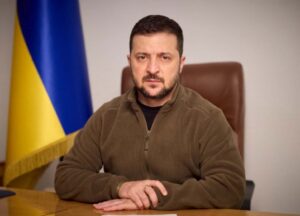
Ukrainian President Volodymyr Zelensky at the beginning of his visit to Great Britain noted his gratitude to the British people for the support provided to Ukraine.
“Great Britain was one of the first to come to the aid of Ukraine. And today I’m in London to personally thank the British people for their support and Prime Minister Rishi Sunak for his leadership,” Zelensky wrote on his Telegram Channel Wednesday.
Earlier, Zelensky landed at Stansted Airport on a Royal Air Force plane. He is scheduled to meet with Britain’s King Charles III, Prime Minister Rishi Sunak and the Ukrainian military.

Steelmakers in Ukraine last December have reduced steel production in 16.4 times, or 93.9%, compared to the same period in 2021 – up to 106 thousand tons, ranking 38th in the ranking of 64 countries-major global producers of these products, according to the Worldsteel Association (Worldsteel).
According to Worldsteel, in December-2022 there was a decline in steel production against December-2021 in most of the top ten countries, except India and Iran.
The top ten steel-producing countries in December are as follows: China (77.890 million tons, down 9.8% from December-2021), India (10.569 million tons, up 0.8%), Japan (6.899 million tons, “minus” 13.1%), USA (6.510 million tons, down 8.3%), Russia (5.5 million tons, “minus” 11.3%) South Korea (5.249 mt, minus 11.6%), Germany (2.693 mt, minus 14.6%), Iran (2.650 mt, up 3.3%), Turkey (2.659 mt, minus 20%) and Brazil (2.505 mt, minus 5.2%).
Ukraine in December, is on the 38th position with 106 thousand tons of steel (down 93.9% against December 2021). The country produced 313 thousand tons of steel in November 2022, in October – 318 thousand tons, in September – 340 thousand tons, August – 366 thousand tons of steel, July – 281 thousand tons, June – 295 thousand tons, May – 308 thousand tons, April – 281 thousand tons, March – 200 thousand tons, February – 1.374 million tons, January – 1.851 million tons.
Overall, in December 2022, global steel production decreased by 10.8% over the same period in 2021 – to 140.695 million tons.
For the 12 months of 2022, the top ten steel producing countries are as follows: China (1.013 billion tons, down 2.1%), India (124.720 million tons, up 5.5%), Japan (89.235 million tons, down 7.4%), USA (80.715 million tons, “minus” 5.9%), Russia (71.5 million tons, down 7.2%), South Korea (65.865 mt, minus 6.5%), Germany (36.849 mt, minus 8.4%), Turkey (35.134 mt, down 12.9%), Brazil (33.972 mt, down 5.8%) and Iran (30.593 mt, up 8%).
Ukraine in 12 months of 2022 is in 23rd place with the melting of 6.263 million tons of steel (“minus” 70.7%).
In total, 64 countries produced 1 billion 831.467 million tons of steel in 2022, which is 4.3% less than in 2021.
As reported, for 2021, the top ten steel producing countries were as follows: China (1 billion 32.790 million tons, down 3%), India (118.134 million tons, up 17.8%), Japan (96.334 million tons, +14.9%), USA (86.012 million tons, +18.3%), Russia (75.970 million tons, +6, 1%), South Korea (70,556 million tons, +5.2%), Turkey (40,360 million tons, +12.7%), Germany (40,066 million tons, +12.3%), Brazil (36,039 million tons, +14.7%) and Iran (28,460 million tons, -1.8%).
They were followed by Italy (24.4 million tons, up 19.7%), Vietnam (23.560 million tons, +4.8%), Taiwan (PRC, 23.250 million tons, +10.9%), Ukraine (21.366 million tons, +3.6%) and Mexico (18.4 million tons, +9.5%).
Overall, 64 countries produced 1 billion 911.945 million tons of steel in 2021, an increase of 3.6% over 2020.

The German government has approved the supply of Leopard 1 main battle tanks to Ukraine. A total of 88 tanks from the Rheinmetall Group and 99 tanks from Flensburger Fahrzeugbau Gesellschaft have been approved for export, Business Insider reported.
It is noted that the official figures will be released on Tuesday.
At the same time, the publication’s sources in the German government say, funding for tank repairs has not yet been secured. It should be definitively clarified only in the next few weeks.
In addition, the first tanks are not expected to be delivered until the middle of this year. The exact number of them has not yet been established, insiders say, it also depends on funding. It is also unclear whether all 187 Leopard 1s will eventually be combat-ready, or whether many of the tanks will have to be used as spare parts depots.
Furthermore, private conversations within the government also point out that the military and strategic significance of tank delivery is not so much in the vehicles themselves, but in the change in the ammunition used. The Leopard tanks use the NATO standard 105mm caliber, which means a much better supply of ammunition for Ukraine, as it cannot produce ammunition for its old Soviet tanks itself. In the long run, this could increase the resilience of the Ukrainian army.
Benchmark crude oil is moderately expensive Wednesday morning after rising to weekly peaks the day before, driven by hopes for a recovery in demand in China and fears of supply disruptions due to an earthquake in Turkey.
The price of April futures for Brent on London’s ICE Futures Exchange stood at $83.78 a barrel by 7:20 a.m., $0.09 (0.11%) higher than at the close of the previous session. Those contracts rose by $2.7 (3.3%) to $83.69 a barrel at the close of trading on Tuesday.
The price of WTI futures for March at electronic trades of the New York Mercantile Exchange (NYMEX) is $77.35 per barrel by that time, which is $0.21 (0.27%) above the final value of the previous session. The contract rose by $3.03 (4.1%) to $77.14 a barrel, the highest since January 31.
As earlier reported, the work of Turkish Ceyhan oil terminal was suspended after the earthquake that killed over 7,000 people in Turkey and Syria.
In addition, the market continues to assess the words of the head of the International Energy Agency (IEA) Fatih Birol that China’s economic recovery may proceed at a faster pace than expected, which in turn will lead to a global increase in demand for oil and LNG.
Meanwhile, American Petroleum Institute (API) data released on Tuesday night showed a 2.18 million barrel decline in U.S. inventories for the week ended February 3.
The official report on U.S. energy reserves will be released Wednesday at 5:30 p.m. Analysts polled by Trading Economics expect an average increase of about 2.5 million barrels of oil reserves.
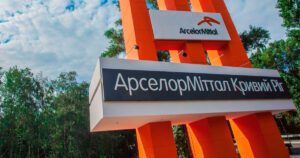
ArcelorMittal Krivoy Rog PJSC (AMKR) Krivoy Rog Mining and Metallurgical Plant is hoping for an improvement in the power supply situation in the first half of this year and an increase in production from the current 25% to 50% of the plant’s capacity, the plant’s CEO Mauro Longobardo said.
“We can’t produce more than 25 percent because we don’t have enough energy. Once we have stable energy, we can increase production … and get to 50%,” he said on the sidelines of a business forum on the rapid recovery of Ukraine in Luxembourg, organized by the Ukrainian-Luxembourg Business Club.
Longobardo clarified that the company is currently operating at 25 percent for both ore and steel production, and consumes about 125 MW, compared to the pre-war normal consumption of about 450 MW.
The CEO also added that AMKR started importing electricity after the government’s recent decision and is now happy with the result, although the price of imports adds to the negative impact on the cost of production.
According to him, despite the low utilization rate, the entire team of 26,000 employees is retained, of which about 10,000 to 12,000 are employed in production depending on the day, but assistance is also provided to others. “We are investing in keeping all of our people during this year,” the general manager said.
He said that with an adequate power supply, a further 50 percent capacity limitation is already due to logistical problems. As Longobardo pointed out, AMKR is actively developing new routes alternative to the pre-war sea routes, but tentatively the new destinations to Poland and southern Ukraine will only allow for 50 percent production.
“We just need to test them when we have 50 percent available,” the general manager added.
According to him, without the resumption of work of the main ports of Ukraine, the combine will not be able to export products or provide imports of coal. Longobardo clarified that now AMKR works entirely on Ukrainian coal, as the work of the route of traditional coal imports from Kazakhstan from another “subsidiary” ArcelorMittal is currently interrupted.
At the same time, he stressed that there are other obstacles on the way to increasing production to 50%. First, Longobardo explained, the power supply must be reliable, since the plant has three blast furnaces, of which one is still operating. Going to 50% would mean working with two blast furnaces, since the third one is the largest, and a sudden stoppage of the furnace in case of power supply problems is fraught with damage.
The second major problem the general manager cited was rising production costs and logistics. “Cost is already killed. When I tell you logistics are possible, it’s true. But it’s $100 per ton more expensive than what I was paying before,” Longobardo noted.
He clarified that previously the transport shoulder to the port of Nikolaev was 250 km, there were also river deliveries, whereas now it is 1500 km to Gdansk and more costs for transshipment due to the different gauge in Ukraine and Europe.
“ArcelorMittal Kryvyi Rih is the largest producer of rolled steel in Ukraine. It specializes in the production of long products, particularly rebar and wire rod.
As previously reported, in 2022, the plant reduced the output of rolled steel by 77% compared with the previous year – up to 1.1 million tons, steel – by 76.3% to 1.2 million tons, iron – by 71% to 1.6 million tons.
Iron ore production fell last year by 56%, to 11.6 million tons, and concentrate production fell by 57.2%, to 4.2 million tons.
The Cabinet of Ministers has appointed two new Deputy Ministers for the Development of Communities, Territories and Infrastructure of Ukraine.
As the representative of the Cabinet of Ministers in the Verkhovna Rada Taras Melnichuk said in Telegram, the corresponding decision was made at a government meeting on Tuesday.
In particular, Oleksandr Butenko and Serhiy Derkach have been appointed Deputy Ministers for the Development of Communities, Territories and Infrastructure of Ukraine.



