

The Japanese government has allocated $95 million for government work and reconstruction of Ukraine, the Ministry of Community Development, Territories and Infrastructure said.
The document was signed by Ambassador Extraordinary and Plenipotentiary of Japan to Ukraine Kuninor Matsuda and UNDP Assistant Administrator, Director of UNDP Regional Bureau for Europe and CIS Ivana Zhivkovich with participation of Deputy Prime Minister for Reconstruction of Ukraine Oleksandr Kubrakov.
The funds will be sent to the United Nations Development Program (UNDP) as part of a partnership agreement.
“While the Armed Forces of Ukraine are liberating territories from occupiers, the government is working with international partners to implement ‘survival projects’: restoring transport links to the liberated regions, creating conditions for citizens to return to their homes, maintaining the economy in the regions,” the Ministry of Community, Territory and Infrastructure Development said in a statement.
Ukraine’s aid program focuses on five key areas:
Strengthening the government’s ability to respond to and manage the crisis;
supporting public services so they can continue their work;
rebuilding critical infrastructure so people can return home safely;
Supporting private businesses so they can continue to operate, thereby supporting communities;
Strengthening civil society and social ties.
Earlier, in April 2022, Japan had already allocated $4.5 million for emergency explosive ordnance clearance and debris removal.
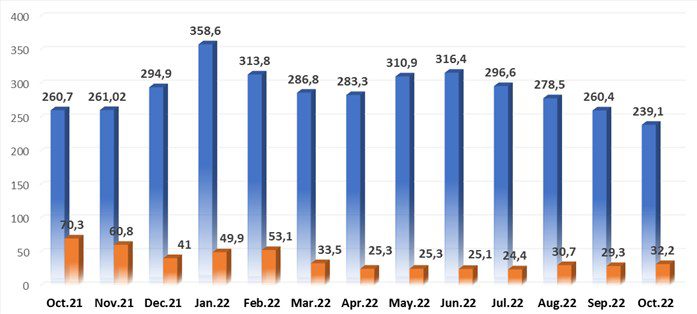
Number of unemployed in Ukraine and job opportunities, Sep 21 – Nov 22
Source: Open4Business.com.ua and experts.news

Ghana intends to implement new logistics projects to increase and make more predictable the exports of agricultural products from Ukraine, a similar intention previously announced by Nigeria and Senegal.
According to the website of the Ministry of Agrarian Policy and Food of Ukraine on Friday, the deepening of cooperation in agriculture and trade relations was discussed by Ukrainian Minister of Agrarian Policy Nikolay Solsky and Ghanaian Minister of Food and Agriculture Owusa Afriy Akoto.
It is specified that the parties considered the issue of creation of a joint project – a logistics hub for food storage, which will allow to store high-quality grain, promote the predictability of sales and stabilization of world food prices.
The Ministry of Agrarian Policy recalled that the Republic of Ghana was the third country visited by a delegation of the Ministry of Agrarian Policy during its official visit to African countries, each of which expressed its desire to create a logistics hub for the export of Ukrainian grain.

Stock indices of most major Asia-Pacific countries are rising on Friday, the exception is the Japanese market.
Japan’s Nikkei 225 index was down 1.2% by 7:32 am KC.
One of the reasons was the 7.4% drop of Fast Retailing stocks. A day earlier Asia’s largest apparel retailer, which owns the Uniqlo brand, released its September-November reporting, which failed to meet analysts’ expectations.
Fast Retailing increased its revenue in the first quarter by 14%, but it was below the forecasts. At the same time, net income fell 9 percent, mainly due to weak performance in China, where strict quarantine restrictions were in effect.
In addition, shares of automakers Mitsubishi Motors Corp. (-4.3%), Mazda Motor Corp. (-4.2%) and Subaru Corp. (-2.6%) became cheaper on Friday.
Meanwhile, financial sector stocks including Mitsubishi UFJ Financial Group Inc. (+3.5%), Chiba Bank Ltd. (+5.2%), Concordia Financial Group (+6.4%), Fukuoka Financial Group Inc. (+6.4%) rose.
China’s Shanghai Composite was up 0.5 percent by 7:37 a.m. ET, Hong Kong’s Hang Seng gained 0.1 percent.
Shares of game developer Netease Inc. surged 2.9 percent on Hong Kong Stock Exchange, oil producers PetroChina Co. and CNOOC gained 2.9 percent and 1.9 percent, respectively, while Chow Tai Fook Jewellery Group gained 3.1 percent and retailer Alibaba rose 0.6 percent.
China’s foreign trade surplus in 2022 increased by 29.7% to a record $877.6 billion, China’s General Administration of Customs reported on Friday. At the same time, exports increased by 7% and imports increased by 1.1%. The growth rates were lower than in 2021, when they were 29.9% and 30.1%, respectively.
Meanwhile, China’s exports fell 9.9% in December and imports fell 7.5%. The decline in both indicators was recorded for the third month in a row.
The value of South Korea’s Kospi was up 0.85% by 7:32 a.m. ET. The index has been rising for the eighth consecutive trading session and is at its highest level in the past month.
Stocks of one of the world’s biggest chip and electronics makers Samsung Electronics Co. rose 0.7%, automaker Hyundai Motor rose 1.5% and steelmaker Posco gained 4.6%.
Australian S&P/ASX 200 index added 0.7% over the day.
Shares of the world’s largest mining companies BHP and Rio Tinto gained 0.5% and 0.9% respectively.
The value of the country’s leading wine producer Treasury Wine Estates Ltd. rose 2.1%.

The U.S. dollar is getting stronger against the euro and the pound sterling after declining in the previous session, but it keeps getting cheaper in pair with the yen.
The ICE index showing the dollar’s movement against six currencies (euro, Swiss franc, yen, Canadian dollar, pound and Swedish krone) is gaining 0.16%, while the broader WSJ Dollar Index is 0.12%.
The ICE dollar index fell sharply Thursday after the release of U.S. inflation data, near its lowest level in seven months.
U.S. consumer prices (CPI) rose 6.5% in December compared to the same month last year, the nation’s Labor Department said Thursday. Thus, inflation slowed from 7.1% in November to its lowest level since October 2021. Consumer prices fell 0.1% from the previous month, the first month-over-month decline since 2020.
Traders believe the Federal Reserve (Fed) may slow the pace of prime rate hikes to 25 basis points at its next meeting due to slowing inflation, Trading Economics noted.
The euro/dollar pair is trading at $1.0840 as of 8:00 a.m., up from $1.0854 at the close of the previous session. The pound/dollar exchange rate dipped to $1.2182 during trading on Friday from $1.2212 the day before.
On Thursday, the dollar depreciated by 0.9% against the euro and by 0.5% against the pound.
The value of the American currency in pair with the yen continued to decline on Friday after a 2% decline the day before.
The exchange rate of the dollar fell to 129.19 yen during the trading session, compared to 129.3 yen at the close of the previous one.
JPY was supported by the report of the Japanese newspaper Yomiuri Shimbun that the leaders of the Bank of Japan plan to discuss the unintended consequences of their approach to the monetary-credit policy at the meeting that will be held on January 17-18.
According to the newspaper, the Japanese Central Bank will consider adjustments to monetary policy, including by changing the conditions of the bond purchase program to “reduce its negative impact.
Experts interrogated by Bloomberg expect that the Japanese Central Bank will pass to toughening of monetary policy earlier than it was supposed before.
Almost all respondents of the agency forecast that the Bank of Japan won’t change the main parameters of its policy next week. At the same time 38% of respondents expect its adjustment either in April or in June.

Oil prices are down on Friday, but finished the week with a strong increase due to signals of increased demand in China.
Chinese authorities significantly raised oil import quotas for local companies, which suggests that refineries are about to increase production.
Investor optimism about the prospects for the U.S. economy provides additional support to the market, notes Bloomberg. Statistics data published the day before showed a slowdown in inflation in the U.S., which reinforced expectations of an imminent end to the cycle of base interest rate increases in the country.
The cost of March futures for Brent crude oil on London’s ICE Futures exchange was $83.67 a barrel by 7:15 a.m. on Friday, down $0.36 (0.43%) from the previous session’s closing price. Those contracts rose $1.36 (1.7%) to $84.03 a barrel at the close of trading on Thursday.
The price of WTI futures for February crude oil at electronic trades of NYMEX fell by $0.22 (0.28%) by that time to $78.17 per barrel. By closing of previous trades these contracts grew by $0.98 (1.3%) to $78.39 per barrel.
U.S. consumer prices (CPI) rose 6.5% in December from a year earlier, the Labor Department said Thursday. Thus, inflation slowed from 7.1% in November, the lowest since October 2021. Consumer prices fell 0.1% from the previous month, the first month-over-month decline since 2020.
“The inflation data show that the Fed is probably almost done with the rate hike and the U.S. economy will be able to avoid a recession,” notes OANDA chief analyst Edward Moya, quoted by Market Watch.



