The EIMA International 2026 agricultural machinery trade show, held November 10–14 in Bologna, Italy, showcased new technologies for precision application of crop protection products, automated irrigation, mechanization of horticulture, and the use of artificial intelligence in agricultural production. Some innovations can reduce the use of agrochemicals by up to 95% and cut the costs of certain vineyard pruning operations by up to 75%, according to the international information and analytical platform EastFruit.
Approximately 1,800 companies participated in the 47th EIMA International exhibition, including 690 foreign exhibitors from 45 countries. Manufacturers presented about 60,000 models of agricultural machinery, equipment, and components. According to the organizer, FederUnacoma, the exhibition was attended by approximately 370,000 people, which is 7% more than in 2024.
One of the most promising areas was the technology for targeted application of plant protection products. The Swiss company Ecorobotix presented an expanded lineup of ARA smart sprayers, including the ARA200, ARA900, and ARA1200 models.
The equipment uses Plant-by-Plant AI technology, based on computer vision and artificial intelligence algorithms. The system recognizes plants and ensures localized application of pesticides instead of blanket treatment of the field.
According to the manufacturer, this technology can reduce pesticide consumption by up to 95%. However, actual savings depend on the crop being grown, the degree of weed growth on the plot, operating conditions, and equipment settings.
Kateryna Zvereva, Director of Development at the Ukrainian Fruit and Vegetable Association and head of the EastFruit website, notes that when implementing smart sprayers, farmers need to evaluate not only the reduction in pesticide use but also the cost of the equipment, productivity, maintenance costs, and the impact of treatment on crop yields.
Another focus of the exhibition was digital irrigation control systems. The Italian company Farmfront presented the Digital Irrigation IA Next Gen platform, which uses artificial intelligence to remotely control irrigation machines.
The Clear Drop Tech Irrigation Brainbox analyzes data from thermal and multispectral cameras and can control the movement of the sprinkler system and water delivery modes.
CET Electronics introduced the Irrivision system, which combines imagery of vegetation cover with climate data to assess the water status of grapes and kiwifruit. The technology underwent field testing as part of European research projects.
Such solutions make it possible to transition from irrigation based on a pre-set schedule to water management based on the actual condition of plants, weather conditions, and moisture levels.
In the horticulture and viticulture sector, technologies for mechanizing labor-intensive operations attracted particular attention. The German company ERO presented the Asymmetric Taille Rase system for preliminary pruning of grapevines. The equipment uses optical sensors to determine the position of shoots and automatically adjust the cutting height.
According to the manufacturer’s estimates, the cost of this operation can be reduced by approximately 75% compared to manual pruning of vineyards trained using the Guyot system. Actual savings depend on the layout of the vineyards, labor costs, and the need for subsequent manual processing.
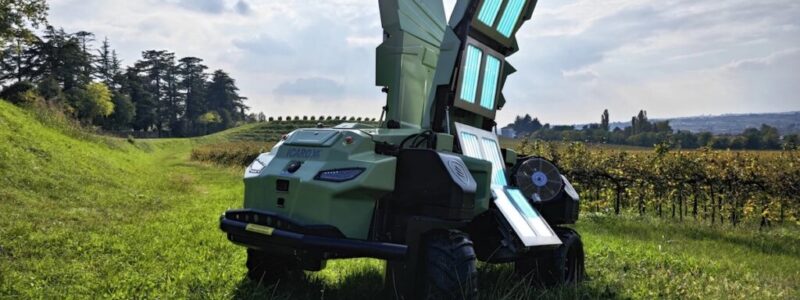
In addition, robotic orchard protection systems were showcased at the exhibition. As part of the LIFE APOLLO project, an autonomous platform equipped with UV-C lamps is being developed to combat diseases in apple orchards and olive groves. The project is scheduled to run through November 2027 and is currently in the testing phase.
Advances in automation have also extended to specialized agricultural machinery. In particular, the New Holland T4F e-Source hybrid solution, equipped with Nobili and Tecnovict electric implements, offers potential fuel savings of up to 50% and an approximately 8% increase in productivity compared to traditional methods of performing these operations.
Crop protection and agrotextile production technologies formed a separate category. The Greek company Thrace Group showcased coverings for greenhouses, berry farms, and nurseries, including materials for weed suppression, protecting plants from adverse temperatures, and regulating the microclimate.
The company is also developing technologies for the reuse and recycling of polymers, which meets the agricultural sector’s growing demand for materials with a long service life and the potential for further recycling.
Post-harvest processing technologies were presented by the University of Fuji, which demonstrated the potential applications of spectroscopic and hyperspectral sensors, computer vision, and artificial intelligence for assessing the quality of fruits and vegetables.
As noted by EastFruit, for fruit and vegetable farms—particularly Ukrainian producers—the primary economic benefit of such developments lies in the potential reduction of costs for labor, water, fuel, and agrochemicals, as well as in improved product quality.
At the same time, the implementation of digital technologies requires an individual assessment of return on investment. Producers must consider the cost of equipment, the availability of maintenance services, productivity per hectare, resource consumption, and the ability to use the equipment over several growing seasons.
According to FederUnacoma’s estimates, the production value of the Italian agricultural machinery industry could decline by 4.3% in 2026, to 13.7 billion euros. From January through October, tractor sales in Italy fell by 5.4% to 13,592 units.
Under these conditions, agricultural machinery manufacturers are increasingly focusing on solutions that allow agricultural enterprises to justify investments with concrete savings in production resources.
EIMA International is one of the largest international exhibitions of agricultural and horticultural equipment. The event is held in Bologna every two years under the auspices of FederUnacoma, the Italian association of agricultural machinery manufacturers. The next exhibition is scheduled for November 14–18, 2028.
Source: EastFruit, analytical report dated November 13, 2026, “Agri-Food Industry Trends at EIMA 2026: Precision Fertilization, Digital Irrigation, and Orchard Mechanization”. Additional attendance data: FederUnacoma.
AGRICULTURAL MACHINERY, agricultural technology, Automation, HORTICULTURE, INVESTMENTS