On the occasion of the 40th anniversary of the accident at the Chornobyl Nuclear Power Plant, the art and technology exhibition “Chornobyl. 40 Years Later. A History That Obligates” was held in Kyiv. The exhibition was organized by the State Agency of Ukraine on Exclusion Zone Management with the financial support of the European Union.
One of the thematic areas of the exhibition was the evolution of approaches to nuclear safety after the accidents at the Chornobyl NPP and the Fukushima Daiichi NPP — from safety culture to modern severe accident management systems and post-Fukushima modernization of power units.
Specially for the exhibition, the engineering company Energy Safety Group provided expert support in preparing a separate information and technology stand titled “Lessons of Severe Accidents for a Safe Future”, dedicated to how modern engineering responds to severe accident development scenarios and what technical solutions today form a multi-level protection system for modern nuclear power plants.
Forty years after the accident at the Chornobyl NPP and fifteen years after the accident at the Fukushima Daiichi NPP make it possible to look particularly clearly at the development of the industry through the prism of the lessons learned.
After the accident at the Chornobyl NPP, the global nuclear energy sector deeply reconsidered the importance of safety culture. At the practical level, this meant a very simple but fundamental thing: for any deviation of parameters from the norm, there must be defined instructions, trained personnel, and practiced action scenarios. Twenty-five years later, the accident at the Fukushima Daiichi NPP again forced the world to review approaches to the resilience of power units — this time under conditions of loss of external power supply, cooling, and the development of severe accidents.
After the accident at the Chornobyl NPP, the international nuclear community came to an important conclusion: safety must be determined not only by technologies, but also by how people think, make decisions, and respond to risks. Thus, in 1986, the concept of “safety culture” appeared. Its essence is that:
“Safety culture” became the main lesson of Chornobyl for the whole world.
The lessons of the accidents at the Chornobyl NPP and the Fukushima Daiichi NPP changed not only approaches to risk management, but also the very logic of modern nuclear safety. It became obvious: even after a reactor shutdown, safety depends on the ability of systems to remove residual heat for a long time, maintain power supply for critical functions, and keep possible consequences within protective barriers.
That is why, after the accident at the Fukushima Daiichi NPP in 2011, large-scale stress tests of nuclear power plants were conducted in Europe and around the world — in-depth inspections that assessed the resilience of power units to extreme external events, complete blackout, loss of cooling sources, and the development of severe accidents. These inspections made it possible to assess the real safety margin beyond the design operating conditions and to determine which technical solutions were necessary to further strengthen the resilience of plants.
Today, the safety of nuclear energy is based on a multi-level principle of protection, where each subsequent level compensates for the loss of the function of the previous one and ensures the resilience of the plant even in the most complex emergency scenarios.

Source: prepared on the basis of data from SSTC NRS
In Ukraine*, in response to the accident at the Fukushima Daiichi NPP, an extraordinary in-depth safety assessment of NPP power units, including facilities of the Chornobyl NPP, was initiated by a decision of the National Security and Defense Council enacted by a Decree of the President. In implementation of this decision, the State Nuclear Regulatory Inspectorate, in cooperation with the State Technogenic Safety Service and the operating organizations of the nuclear industry, developed an Action Plan, while NPP operators conducted targeted stress tests at all sites. Based on their results, the C(C)SUP — the Comprehensive (Consolidated) Safety Upgrade Program for NPP Power Units of Ukraine — was reviewed and supplemented. The responsible executor of this program is the NPP operator, NNEGC “Energoatom”.
Source: prepared on the basis of data from SSTC NRS
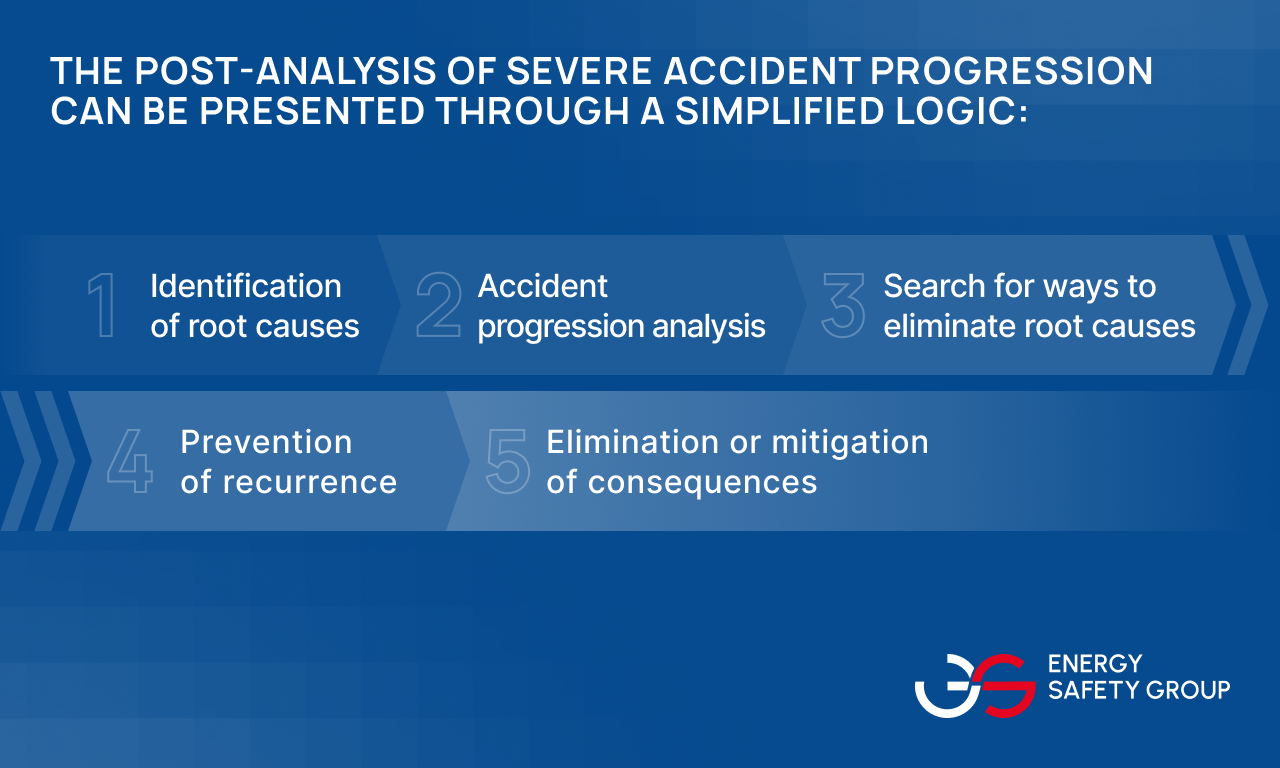
The lessons of severe accidents gave impetus to the continuous improvement of safety systems and other beyond-design-basis equipment in nuclear energy. By implementing post-Fukushima modernizations, Ukraine consistently demonstrates its commitment to the principle of continuous improvement of the safety of power units at operating NPPs. The result of this evolution has been reliable engineering solutions for all key challenges associated with severe accidents, which today are already a standard for the newest Generation III+ reactors.
To show how modern engineering responds to specific scenarios of severe accident development, the main challenges and the corresponding safety systems and beyond-design-basis equipment are presented below.
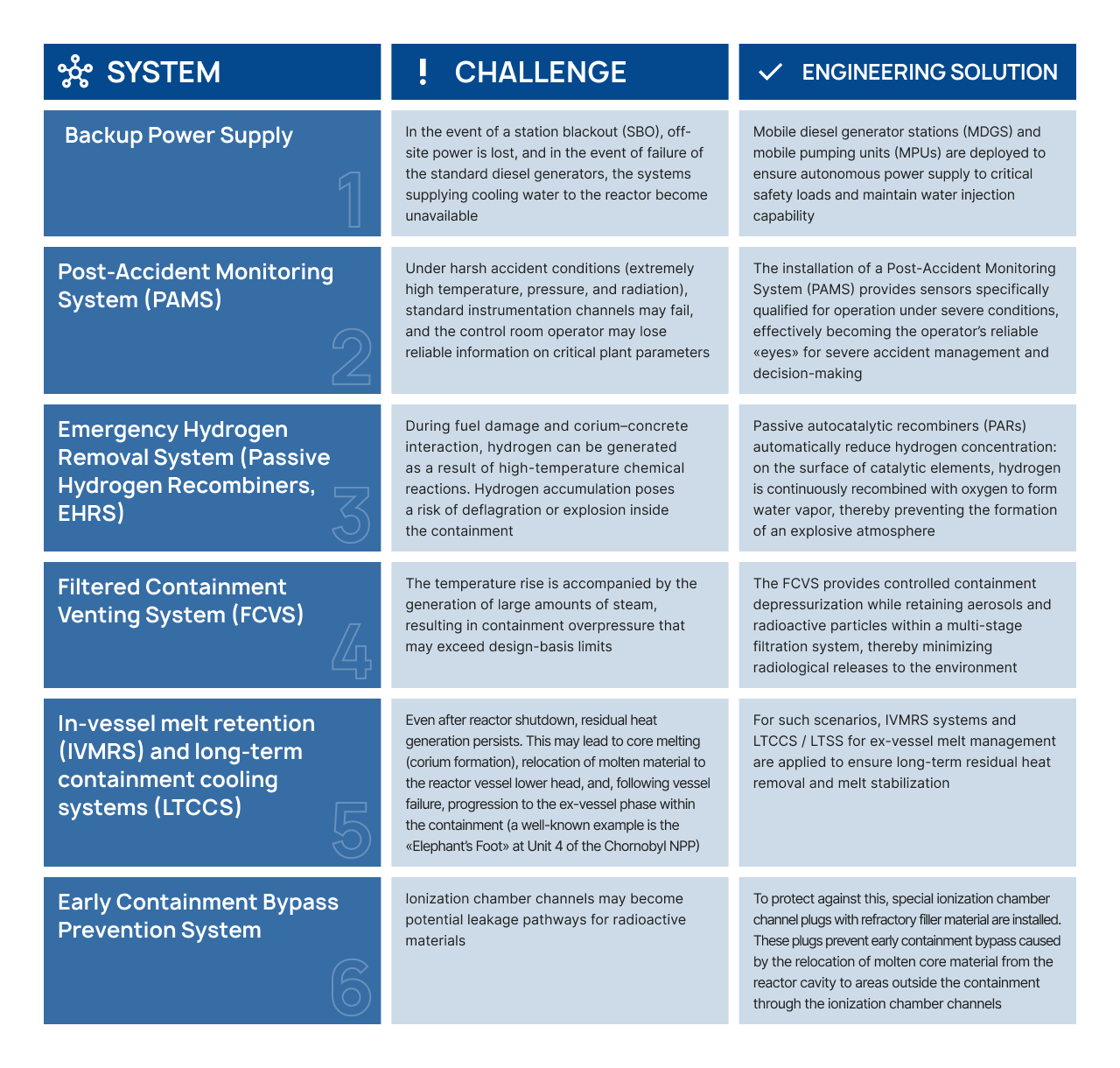
The development of nuclear safety largely takes place through the analysis of severe accidents, the review of potential scenarios, and the search for technical solutions to contain them or minimize their consequences. A significant part of the systems that were previously considered additional or beyond-design-basis, after the accident at the Fukushima Daiichi NPP, effectively became a new standard for modern power units.
For specialists in the nuclear industry, this means constant work on risk assessment, resilience of safety systems, post-accident management, and adaptation of international experience to the real operating conditions of nuclear power plants. Greater attention is paid to the modernization of safety systems, analysis of scenarios for the development of severe accidents, and the development of solutions capable of ensuring the resilience of power units under beyond-design-basis operating conditions.
It is precisely these areas that today are associated with the work of companies operating in the field of nuclear engineering and modernization of safety systems at nuclear power plants, including Energy Safety Group, which participates in the implementation of projects for nuclear facilities in Ukraine and other European countries.