
The Ministry of Energy of Ukraine has purchased domestic government bonds (OVDP) using funds from the financial reserve for the first time in nearly 20 years, the ministry announced on Wednesday.
“Nearly 400 million hryvnias have already been invested in government securities, and the total volume of such investments in 2026 will amount to approximately 785 million hryvnias,” the Ministry of Energy noted.
In the future, these funds will be used to finance the decommissioning of nuclear facilities.
As explained by the ministry, the purchase of OVDPs was the first step in implementing the mechanism for managing the financial reserve funds as provided for by law.
The financial reserve is formed through regular contributions from JSC “NAEK Energoatom,” which transfers 65.4 million UAH monthly to a special fund to ensure the future decommissioning of nuclear facilities. At the same time, for a long time, the reserve’s funds were not actually invested in financial instruments designed to preserve their value. As a result of inflation, the funds accumulated by 2025 have significantly lost their real value, the Ministry of Energy noted.
Investing the financial reserve in domestic government bonds will protect the funds from inflation, preserve their purchasing power, and ensure additional replenishment of the reserve through income from government securities.
“Ukraine is consistently developing a system of financial support for the future decommissioning of nuclear facilities in accordance with international obligations and global best practices,” the ministry emphasized.
Investing the financial reserve’s funds in OVDPs is a reliable and effective tool for managing state resources. This will help strengthen the financial stability of Ukraine’s nuclear safety system and enhance the state’s ability to fulfill its obligations in the field of nuclear and radiation safety, according to the Ministry of Energy.
ENERGOATOM, financial reserve, GOVERNMENT BONDS, MINISTRY OF ENERGY, nuclear safety

Norway is allocating over €9 million to repair the protective sarcophagus covering the Chernobyl Nuclear Power Plant following damage caused by a Russian drone, the Norwegian Embassy in Ukraine reported.
“Norway is allocating 100 million kroner (approximately 9.1 million euros – IF-U) for the repair of the protective structure covering the No. 4 reactor at the decommissioned nuclear power plant in Chernobyl. The structure was damaged as a result of a Russian drone strike in February 2025.”
The aid will be provided through the European Bank for Reconstruction and Development (EBRD) fund, the International Chornobyl Cooperation Account (ICCA).
State Secretary Eivind Vad Petersen announced the support during a visit to Kyiv, also mentioning the incident on June 7, when a spent nuclear fuel storage facility in the Chernobyl zone was hit by a Russian strike.
“These attacks also pose a threat to European and international security. Norway will make efforts to reduce the risk of radioactive emissions and ensure that the Chernobyl NPP continues to operate safely,” Petersen said.
In April, the U.S. expressed its readiness to provide up to $100 million as part of the Group of Seven’s joint efforts to repair the new sarcophagus over the Chernobyl NPP. Ahead of the 40th anniversary of the Chernobyl accident, the EU called on Russia to stop attacks on nuclear facilities in Ukraine.
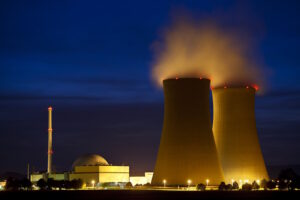
On the occasion of the 40th anniversary of the accident at the Chornobyl Nuclear Power Plant, the art and technology exhibition “Chornobyl. 40 Years Later. A History That Obligates” was held in Kyiv. The exhibition was organized by the State Agency of Ukraine on Exclusion Zone Management with the financial support of the European Union.
One of the thematic areas of the exhibition was the evolution of approaches to nuclear safety after the accidents at the Chornobyl NPP and the Fukushima Daiichi NPP — from safety culture to modern severe accident management systems and post-Fukushima modernization of power units.
Specially for the exhibition, the engineering company Energy Safety Group provided expert support in preparing a separate information and technology stand titled “Lessons of Severe Accidents for a Safe Future”, dedicated to how modern engineering responds to severe accident development scenarios and what technical solutions today form a multi-level protection system for modern nuclear power plants.
Forty years after the accident at the Chornobyl NPP and fifteen years after the accident at the Fukushima Daiichi NPP make it possible to look particularly clearly at the development of the industry through the prism of the lessons learned.
After the accident at the Chornobyl NPP, the global nuclear energy sector deeply reconsidered the importance of safety culture. At the practical level, this meant a very simple but fundamental thing: for any deviation of parameters from the norm, there must be defined instructions, trained personnel, and practiced action scenarios. Twenty-five years later, the accident at the Fukushima Daiichi NPP again forced the world to review approaches to the resilience of power units — this time under conditions of loss of external power supply, cooling, and the development of severe accidents.
After the accident at the Chornobyl NPP, the international nuclear community came to an important conclusion: safety must be determined not only by technologies, but also by how people think, make decisions, and respond to risks. Thus, in 1986, the concept of “safety culture” appeared. Its essence is that:
“Safety culture” became the main lesson of Chornobyl for the whole world.
The lessons of the accidents at the Chornobyl NPP and the Fukushima Daiichi NPP changed not only approaches to risk management, but also the very logic of modern nuclear safety. It became obvious: even after a reactor shutdown, safety depends on the ability of systems to remove residual heat for a long time, maintain power supply for critical functions, and keep possible consequences within protective barriers.
That is why, after the accident at the Fukushima Daiichi NPP in 2011, large-scale stress tests of nuclear power plants were conducted in Europe and around the world — in-depth inspections that assessed the resilience of power units to extreme external events, complete blackout, loss of cooling sources, and the development of severe accidents. These inspections made it possible to assess the real safety margin beyond the design operating conditions and to determine which technical solutions were necessary to further strengthen the resilience of plants.
Today, the safety of nuclear energy is based on a multi-level principle of protection, where each subsequent level compensates for the loss of the function of the previous one and ensures the resilience of the plant even in the most complex emergency scenarios.

Source: prepared on the basis of data from SSTC NRS
In Ukraine*, in response to the accident at the Fukushima Daiichi NPP, an extraordinary in-depth safety assessment of NPP power units, including facilities of the Chornobyl NPP, was initiated by a decision of the National Security and Defense Council enacted by a Decree of the President. In implementation of this decision, the State Nuclear Regulatory Inspectorate, in cooperation with the State Technogenic Safety Service and the operating organizations of the nuclear industry, developed an Action Plan, while NPP operators conducted targeted stress tests at all sites. Based on their results, the C(C)SUP — the Comprehensive (Consolidated) Safety Upgrade Program for NPP Power Units of Ukraine — was reviewed and supplemented. The responsible executor of this program is the NPP operator, NNEGC “Energoatom”.
Source: prepared on the basis of data from SSTC NRS
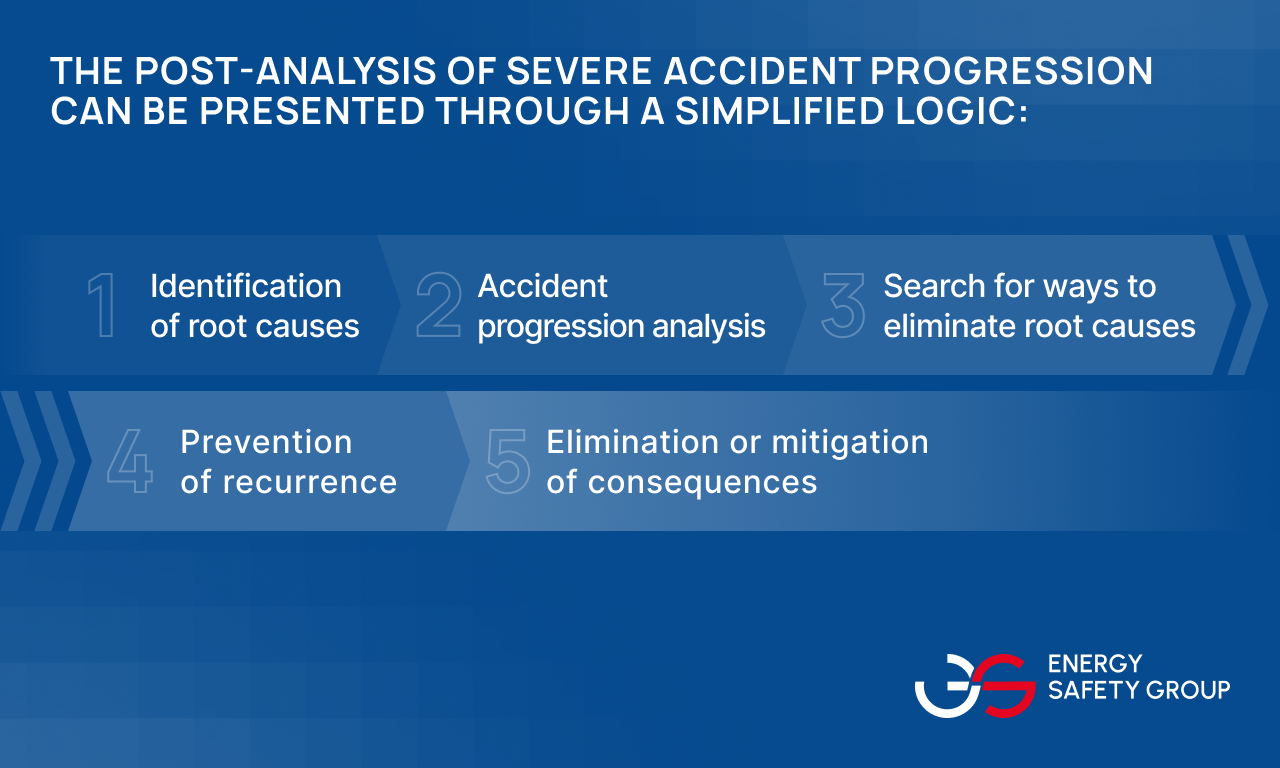
The lessons of severe accidents gave impetus to the continuous improvement of safety systems and other beyond-design-basis equipment in nuclear energy. By implementing post-Fukushima modernizations, Ukraine consistently demonstrates its commitment to the principle of continuous improvement of the safety of power units at operating NPPs. The result of this evolution has been reliable engineering solutions for all key challenges associated with severe accidents, which today are already a standard for the newest Generation III+ reactors.
To show how modern engineering responds to specific scenarios of severe accident development, the main challenges and the corresponding safety systems and beyond-design-basis equipment are presented below.
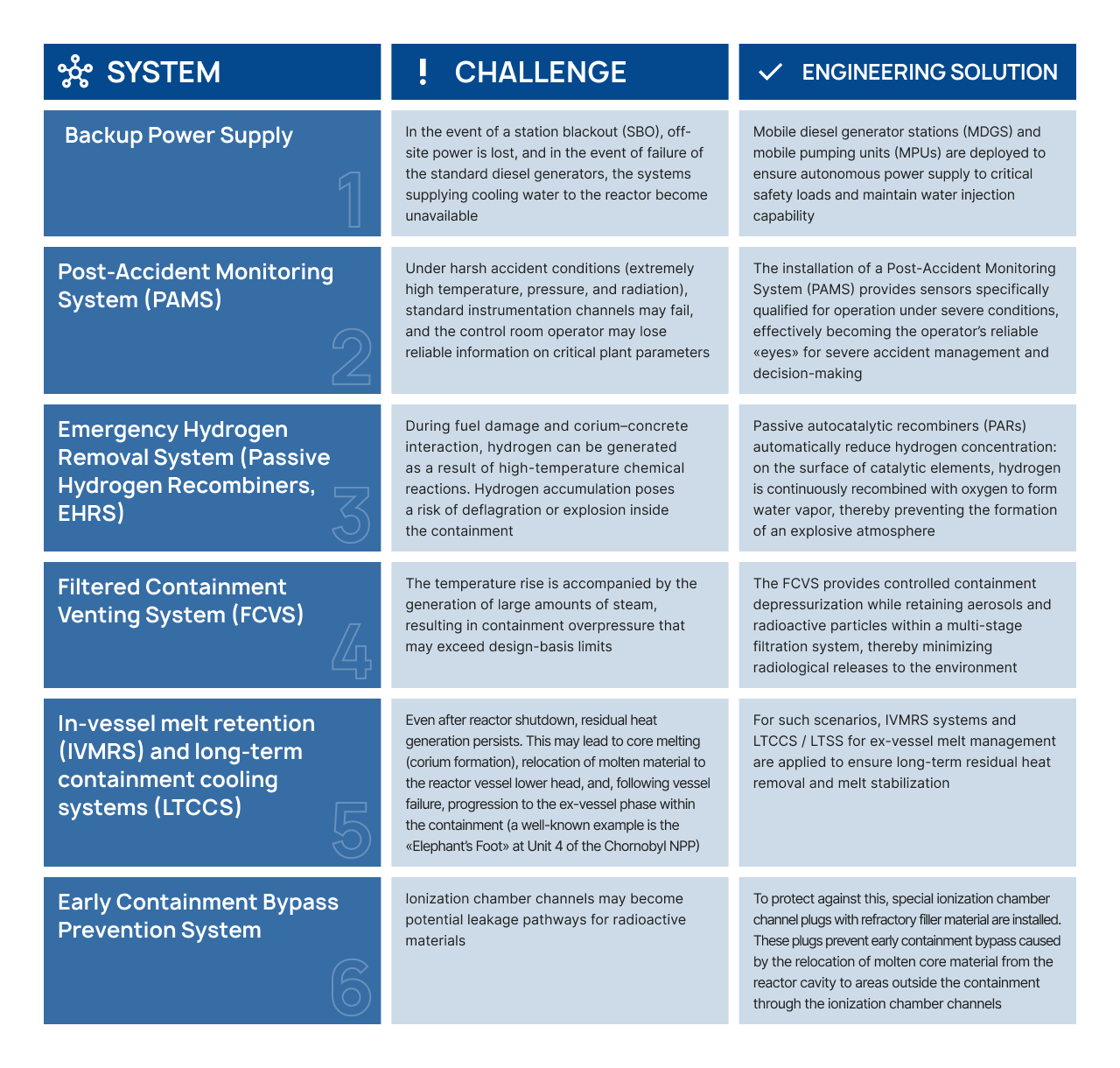
The development of nuclear safety largely takes place through the analysis of severe accidents, the review of potential scenarios, and the search for technical solutions to contain them or minimize their consequences. A significant part of the systems that were previously considered additional or beyond-design-basis, after the accident at the Fukushima Daiichi NPP, effectively became a new standard for modern power units.
For specialists in the nuclear industry, this means constant work on risk assessment, resilience of safety systems, post-accident management, and adaptation of international experience to the real operating conditions of nuclear power plants. Greater attention is paid to the modernization of safety systems, analysis of scenarios for the development of severe accidents, and the development of solutions capable of ensuring the resilience of power units under beyond-design-basis operating conditions.
It is precisely these areas that today are associated with the work of companies operating in the field of nuclear engineering and modernization of safety systems at nuclear power plants, including Energy Safety Group, which participates in the implementation of projects for nuclear facilities in Ukraine and other European countries.
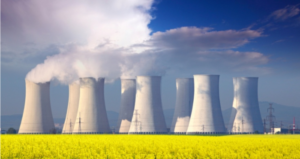
On July 25, at the office of the State Nuclear Regulatory Inspectorate of Ukraine (SNRIU), DIARU), the official transfer of permits to JSC NAEK Energoatom for the performance of organizational and administrative functions related to ensuring the nuclear and radiation safety of Ukrainian nuclear power plants, as well as the Centralized Spent Fuel Storage Facility (CSFSF), took place.
“This stage is part of the company’s reorganization – changing its form of governance from a state-owned enterprise to a joint-stock company,” the company said on Friday.
The licenses were handed over to Energoatom’s head, Petro Kotin, by the head of the State Nuclear Regulatory Inspectorate, Chief State Inspector for Nuclear and Radiation Safety, Oleg Korykov.
He noted that the SNRIU team had conducted inspections of all nuclear facilities and nuclear power plant sites and had given a positive assessment of Energoatom’s ability to comply with safety requirements, standards, and regulations, as well as the terms of the licenses.
“Obtaining licenses to operate under the new status confirms that Energoatom retains its full powers and ensures the continuous operation of nuclear power units,” emphasized the head of Energoatom.
The changes to the licenses were made in line with the law “On the Joint Stock Company National Nuclear Energy Generating Company Energoatom” and the Cabinet of Ministers’ resolution No. 1420 of December 29, 2023. “On the establishment of the joint-stock company ”National Nuclear Energy Generating Company “Energoatom.”
Currently, Energoatom operates nine power units at the South Ukraine, Rivne, and Khmelnytskyi NPPs with a total capacity of 7,880 MW. All of them are located in territory controlled by Ukraine.
The Zaporizhzhia Nuclear Power Plant, with six VVER-1000 power units with a total capacity of 6,000 MW, has not been producing electricity since September 11, 2022, following its occupation on March 3-4, 2022.
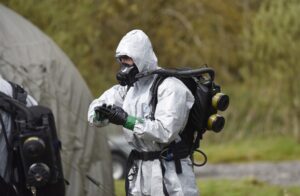
Ukraine will receive €22.6 million from European partners to ensure nuclear safety, improve radiation protection, and manage radioactive waste, according to the Ministry of Environmental Protection and Natural Resources.
The relevant draft agreement on the 2024/2025 contribution was approved during a meeting of the Supervisory Board for the Implementation of the Instrument for Nuclear Safety Cooperation in Ukraine. The meeting was held on Friday by Minister Svitlana Grynychuk together with Jan Pane, Director for Nuclear Energy, Safety and ITER at the European Commission’s Directorate-General for Energy, and Inte Stockmann, Head of the Nuclear Safety Sector at the European Commission’s DG INTPE.
The agreed contribution agreement provides for the financing of a number of projects that are important for Ukraine. These include: ensuring backup power supply for the uninterrupted operation of radioactive waste management facilities, as well as the construction of the necessary infrastructure for the proper disposal of radioactive waste; the creation of an early warning system for forest fires in the exclusion zone; equipping a modern analytical laboratory for the analysis of radioactive materials in Chernobyl; restoring the functioning of the automated radiation monitoring system in the exclusion zone damaged by Russia during the occupation of the Chernobyl NPP.
In addition, there are plans to create a national integrated automated radiation monitoring system for the entire territory of Ukraine and integrate it with the European Radiological Data Exchange Platform (EURDEP), the European Community Urgent Radiological Information Exchange System (ECURIE), the International Radiation Monitoring Information System (IRMIS) managed by the IAEA; providing personnel of enterprises in the exclusion zone with adequate modern transportation and accommodation in the exclusion zone, as well as personal protective equipment and decontamination facilities in emergency situations.
Attention will also be paid to harmonizing Ukrainian legislation with Euratom standards as one of the conditions for Ukraine’s accession to the EU.
All measures are planned to be implemented over a period of five years.



