
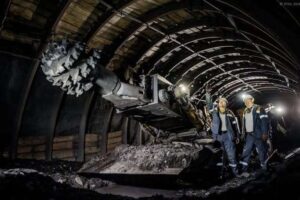
According to Interfax-Ukraine, the Ministry of Energy is working to prepare state-owned coal mining enterprises for transfer to the State Property Fund (SPF) and subsequent privatization, Deputy Minister of Energy Valentina Moskalenko said.
“The Ministry of Energy has indeed prepared our proposals for the government’s action plan, and we are indeed working to prepare all (coal) enterprises for transfer to the State Property Fund, with a view to their subsequent privatization and the search for an effective private investor for them,” Moskalenko said during an online meeting of the Verkhovna Rada’s Energy Committee on Monday.
She also added that the Ministry of Energy, together with the Ministry of Finance, has resolved the issue of compensation for wage arrears, unused vacation time, and all other payments required by law to employees of the two mines being liquidated: “Mine No. 9” (Volyn Oblast) and the “Nadiya” mine (Lviv Oblast).
“The draft plans for the liquidation of the mines are ready, funds are available to carry out the liquidation work, and everyone who wished to transfer to other enterprises has done so,” noted the deputy head of the Ministry of Energy.
At the same time, Moskalenko emphasized that the operations of the state-owned enterprise “Lvivvuhillia” have always been accompanied by debts, and this issue must be resolved.
“Lvivvuhillya has always had debts, with varying trends, and they have never gone away; now all the debts remain with the state-owned mines. We must do everything possible to restore the health of the state-owned coal mining sector,” Moskalenko emphasized.
COAL, INVESTOR, Mine, MINISTRY OF ENERGY, State Property Fund of Ukraine
The Ministry of Energy of Ukraine has purchased domestic government bonds (OVDP) using funds from the financial reserve for the first time in nearly 20 years, the ministry announced on Wednesday.
“Nearly 400 million hryvnias have already been invested in government securities, and the total volume of such investments in 2026 will amount to approximately 785 million hryvnias,” the Ministry of Energy noted.
In the future, these funds will be used to finance the decommissioning of nuclear facilities.
As explained by the ministry, the purchase of OVDPs was the first step in implementing the mechanism for managing the financial reserve funds as provided for by law.
The financial reserve is formed through regular contributions from JSC “NAEK Energoatom,” which transfers 65.4 million UAH monthly to a special fund to ensure the future decommissioning of nuclear facilities. At the same time, for a long time, the reserve’s funds were not actually invested in financial instruments designed to preserve their value. As a result of inflation, the funds accumulated by 2025 have significantly lost their real value, the Ministry of Energy noted.
Investing the financial reserve in domestic government bonds will protect the funds from inflation, preserve their purchasing power, and ensure additional replenishment of the reserve through income from government securities.
“Ukraine is consistently developing a system of financial support for the future decommissioning of nuclear facilities in accordance with international obligations and global best practices,” the ministry emphasized.
Investing the financial reserve’s funds in OVDPs is a reliable and effective tool for managing state resources. This will help strengthen the financial stability of Ukraine’s nuclear safety system and enhance the state’s ability to fulfill its obligations in the field of nuclear and radiation safety, according to the Ministry of Energy.
ENERGOATOM, financial reserve, GOVERNMENT BONDS, MINISTRY OF ENERGY, nuclear safety

The fuel market in Ukraine is functioning stably and is fully supplied with the necessary resources, according to the Ministry of Energy of Ukraine, citing Deputy Minister Mykola Kolisnyk.
“January is traditionally a period of low seasonal consumption. However, current realities, in particular the active operation of generators, are supporting demand for fuel. Despite this, thanks to the coordinated actions of the government and market operators, this demand is being steadily met,” he said.
According to Kolisnyk, the diversification of supply routes has ensured stable and regular logistics of light petroleum products for the continuous supply of consumer needs. Currently, fuel is delivered to Ukraine by road, rail, and sea transport.
“No single infrastructure facility is critical, and in the event of local restrictions, the market automatically switches to alternative routes,” he explained.
The deputy minister also noted that the current logistics situation does not create grounds for price fluctuations, shortages, or market destabilization.
“Pricing in the fuel market is determined by a complex of factors, including world prices and tax policy. Logistics does not create grounds for price fluctuations or shortages,” he stressed.
According to the Ministry of Energy, more than 344,000 tons of fuel have been imported into Ukraine since the beginning of 2026, with domestic producers continuing to play an important role.
Currently, Ukraine has a state system for monitoring fuel volumes and quality, as well as a system of minimum reserves of oil and petroleum products.
“The administrator of the electronic reporting system is JSC Market Operator. This allows the state to see the market balance in real time, control the quality of fuel, and respond quickly to any signs of crisis,” Kolisnyk emphasized.
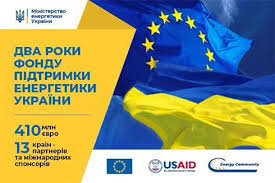
The Energy Support Fund has managed to raise over EUR410m from 13 partner countries and international organizations as of April 9.
“The remaining amount is the announced contributions, which will soon be transferred by the sponsors,” the Ukrainian Energy Ministry said on Tuesday.
As the ministry noted, the special trust of partners has been secured thanks to the system of transparent distribution of funds. In particular, the Ministry of Energy has a working group on humanitarian aid, which considers requests from Ukrainian energy companies to purchase the necessary aid with the Fund’s resources.
The Fund financed the most urgent needs of Ukrainian energy companies, in particular, the purchase of generators, power transformers, circuit breakers, spare parts, technical means, materials, special equipment, fuel, means of physical protection of energy facilities.
“Most of all funds are distributed to meet the urgent needs of energy companies from frontline regions – Kharkiv, Mykolayiv, Sumy, Zaporizhzhya, Kherson, Odessa,” the Ministry of Energy said.
There is no shortage of electricity in Ukraine, with 19 generating units of thermal power plants in reserve in the energy system, which will be used if necessary, the Energy Ministry said. According to its update in its Telegram channel on Sunday, electricity imports of 425 MWh are forecast for the current day, up a third from Saturday, and exports of 2,300 MWh are expected, down 6% from yesterday’s figure.
At the same time because of the hostilities remain without light, in particular, more than 43 thousand consumers in 75 settlements of Donetsk region, 25.8 thousand consumers in 45 settlements of Kherson region, 15.5 thousand subscribers in 63 settlements of Kharkiv region, 1119 consumers in 17 settlements of Chernihiv region. In Kherson without voltage – 12.6 thousand consumers. In addition, after shelling from the Russian border 1229 consumers in 6 settlements of Sumy region were de-energized. Repair crews will start work as soon as the security situation allows.
There are also blackouts for technological reasons: almost 5 thousand consumers were left without light in Kyiv region, where 2 overhead lines 10 kV were disconnected, more than 400 consumers – in Odessa region, where 10 kV overhead line was disconnected, and 899 consumers in Sumy region.
As noted by the Ministry of Energy, over the day the energy sector energized 10.4 thousand consumers, most of them in Donetsk region – 9.5 thousand subscribers.
Power supply was also resumed to 405 household and 41 legal consumers in five settlements of Mykolayiv region, which were disconnected due to the fall of debris from a downed UAV on an overhead power line.
As for the situation with gas supply, the Energy Ministry once again reports accidents due to improper use of the resource. Thus, in Kryvyi Rih, according to the preliminary version, due to carbon monoxide poisoning, a woman and a man died. In one of the settlements of Brovarsky district of Kyiv region, probably carbon monoxide poisoned three residents of a private house, but they are in satisfactory condition.
In Dnipro, as a result of a traffic accident, a low-pressure gas pipeline was damaged, there was a gas leak, 22 consumers were disconnected from its distribution.
In Lviv, unknown persons shut off the tap at the gas pipeline inlet to an apartment building – gas supply to 123 apartments was cut off.
As a result of shelling damaged gas distribution networks in Kharkiv region, disconnected 6 consumers.

The Ministry of Energy intends to create two industry-specific cyber centers in the electric power and oil and gas sectors on the basis of previously created cyber centers at NPC Ukrenergo and NJSC Naftogaz, Farid Safarov, Deputy Minister of Energy for Digital Development, Digital Transformation and Digitalization, said.
“The Ministry of Energy sent a draft order to the Cabinet of Ministers on the definition of two industry centers. In it, the two cyber centers created on the basis of Naftogaz and Ukrenergo were referred to as industry cyber centers. It is assumed that Ukrenergo will be responsible for the energy sector, for the oil and gas industries – Naftogaz, – Safarov said at an online briefing “Cyber threats in war: cyber attacks on Ukrainian regional energy companies” on Tuesday.
According to him, such proposals were developed as part of an agreement with the National Security and Defense Council and the Security Service of Ukraine, as well as interaction with the government’s CERT-UA computer incident response team.
The Deputy Minister explained that industry cyber centers will be built on the principle of a pyramid.
“At the first level, the enterprises themselves must carry out organizational and technical actions in order to prevent possible damage, above them there is the level of monitoring of industry centers based on Ukrenergo and Naftogaz, which, in turn, are already interacting directly with key cybersecurity stakeholders,” – Safarov explained the mechanism.
In his opinion, the creation of such industry centers will significantly enhance the cyber defense of energy facilities, which are the most vulnerable group of critical infrastructure.
“In order to simplify the work of colleagues from CERT-UA, to coordinate and make their intervention more effective precisely at critical moments, we are building this architecture,” the Deputy Minister noted.
As reported, since the beginning of the war, the number of cyber attacks on energy infrastructure facilities has almost doubled – over 200,000 cyber attacks were committed in 47 days of the war, while 900,000 of them were recorded in the entire 2021.



