

In September 2026, Ukraine imported 537,000 metric tons of diesel fuel, which is 21% less than in the same month of 2025 and 9% lower than in August, according to data from the A-95 Consulting Group.
Since the beginning of the year, diesel fuel imports have reached 4.7 million metric tons, which is 3% higher than the January–September figure from last year.
The main feature of September was unusually weak demand. A-95 attributes this, in particular, to massive attacks on industrial enterprises, as well as to problems with the export of agricultural products from the new harvest, including disruptions in maritime logistics.
“We do not yet have precise data, but there are all signs that retail sales of diesel fuel have also declined due to record prices caused by unprecedented global market rates,” note analysts at “A-95”.
The decline in demand is also confirmed by supply trends in the third quarter. During this period, approximately 1.7 million metric tons of diesel fuel were imported into Ukraine, which is about 10% less than a year earlier.
According to Serhiy Kuyun, director of the A-95 Consulting Group, the Ukrainian fuel market continues to operate amid unprecedented logistical and pricing challenges related to the war.
“The fuel market continues to face unprecedented difficulties caused by Russian attacks. Importers are actively developing new logistics channels and expanding their fleets, particularly of gasoline tankers,” the company notes.
The “A-95” consulting group specializes in research on the Ukrainian petroleum products market, price monitoring, logistics, and resource supply for the fuel market. Its director is Serhiy Kuyun.

According to Experts.news, gasoline imports to Ukraine in September 2026 totaled 145,000 metric tons, which is 5% less than in August but 3% higher than in September of last year, the A-95 Consulting Group reported based on the results of a special study.
From January through September, Ukraine imported 1.26 million metric tons of gasoline—15% more than during the same period in 2025.
“The decline in gasoline supplies in September occurred against the backdrop of a seasonal drop in consumption. Demand was also weighed down by this year’s record-high retail prices, which prompted car owners to conserve fuel,” the A-95 Consulting Group reported.
Lithuania remained the largest source of gasoline supplies in September, accounting for 46,400 metric tons, or 32% of the total volume. Compared to August, supplies fell by 10.4%.
Poland ranked second with 36,800 metric tons, or 25% of Ukraine’s imports. A month earlier, 40,100 metric tons were supplied from that country.
Thus, the combined share of Lithuania and Poland in September fell from 60% to 57%. Supplies from the largest supplier—the ORLEN Group—from these two countries decreased from 78,800 to 67,800 metric tons. Despite the decline, ORLEN accounted for about 47% of all Ukrainian gasoline imports.
At the same time, the geography of supplies changed. Imports from Germany fell by 25% compared to August—to 13,600 metric tons. Of this volume, 8,300 metric tons, or 61%, were imported by the UPG network.
At the same time, the share of southern supplies increased. Gasoline shipments from Romania rose by 29%—from 23.4 thousand to 30.1 thousand metric tons. As a result, Romania moved into third place among supplier countries and accounted for over 20% of September’s imports.
Supplies from Greece, on the other hand, fell by 28%—from 15,000 to 10,800 metric tons. Imports from Moldova more than doubled—from 1,900 to 4,100 metric tons.
Thus, despite the decline in total imports in September, shipments remain higher than last year’s level, and in the first nine months of 2026, Ukraine imported 15% more gasoline than in the same period a year earlier.
Source: A-95 Consulting Group.
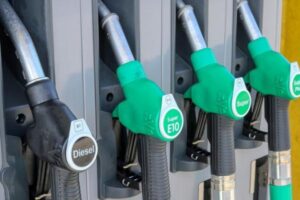
Ukrainian gas station chains are not yet fully passing on the increased costs resulting from Russian attacks to consumers, instead offsetting them by reducing their own profitability; however, the ability to keep prices in check in this way is limited, according to Serhiy Kuyun, director of the A-95 Consulting Group.
As the expert reported on his Facebook page, “A-95” specialists compared retail prices for gasoline and diesel fuel with their customs value over the past three years.
The resulting difference includes gas stations’ logistics and operating costs, as well as operators’ profits. According to “A-95” calculations, in 2026 this markup did not increase but actually decreased slightly compared to the previous year, despite a significant rise in fuel companies’ expenses.
Among the additional costs, Kuyun cites the restoration of damaged gas stations and the strengthening of their security. According to him, installing an anti-drone protective structure over a single gas station can cost about €100,000, while building a temporary shelter can cost 1–1.2 million UAH.
At the same time, personnel costs are rising. According to data from the State Tax Service cited by the expert, the official salaries of employees at the 40 largest gas station chains have increased by 20% over the past year. Additional expenses arise from the need to organize work schedules and staff rotations in frontline regions.
“In other words, the stability of the markup was achieved by reducing profits,” Kuyun noted.
According to his assessment, the most difficult economic situation has developed in the left-bank region of Ukraine. The cost of delivering fuel there is higher than in the western and southern border regions, while there is virtually no significant regional variation in retail prices.
National chains can partially offset the low profitability of such gas stations through more efficient stations in other regions. For small local operators in the east of the country, this option is often unavailable.
According to Kuyun, some local gas stations are currently operating with zero or negative profitability. The expert attributes this to why some gas stations damaged by Russian drones are not being rebuilt: investments in repairs may not pay off given the current economic situation.
A further negative factor is the decline in fuel sales. Kuyun attributes this both to the impact of attacks on Ukrainian industry and the resulting drop in consumption, as well as to the high cost of petroleum products on the global market.
According to the expert, for now, fuel retailers are effectively absorbing part of the rising costs using their own revenues, rather than passing them on entirely to the final price of gasoline and diesel fuel.
However, this situation cannot last indefinitely.
“It’s hard to say how much longer fuel retailers will be able to absorb these price increases using their own revenues. I think it won’t be long,” Kuyun noted.
Thus, future price trends at Ukrainian gas stations will depend not only on global oil and petroleum product prices and the exchange rate, but also on operators’ ability to offset rising costs related to logistics, security, infrastructure restoration, and personnel.
Source: Serhiy Kuyun — Facebook post.

It makes more sense for Ukraine to invest in creating its own network of underground fuel storage facilities than to invest in the construction of facilities for storing strategic reserves in other countries. This opinion was expressed by Serhiy Kuyun, director of the A-95 Consulting Group, according to Enkorr.
Ukrainian legislation allows for up to 50% of the minimum reserves of oil and petroleum products to be stored in countries neighboring Ukraine and up to an additional 25% in countries bordering those neighbors. This practice is common in Europe; however, finding available storage capacity in neighboring countries is complicated by the fact that EU member states themselves are required to maintain significant strategic reserves.
According to Kuyun, as a result, Ukraine may be offered the option to invest not in leasing existing facilities, but in the construction of new storage tanks abroad. Such projects will require lengthy construction periods, local permits and licenses, as well as the outflow of significant foreign currency investments from Ukraine. If a foreign partner finances the project, it may also be necessary to guarantee that the storage facilities remain filled for many years.
The expert cites another problem: the physical ability to quickly deliver strategic reserves to Ukraine in the event of a large-scale fuel crisis.
“Even if we build up reserves abroad, how would we then transport them in an emergency? The border is already strained even under normal conditions—where would we possibly fit in tens or even hundreds of thousands of additional metric tons?” Kuyun noted.
The relevance of this discussion has intensified following agreements between Naftogaz and the Hungarian company MOL. On September 20, the companies signed a memorandum to explore the possibility of storing petroleum products in Hungary near the Ukrainian border to meet the needs of the Ukrainian market. The project is still in its initial stages, and the parties must assess its technical, financial, environmental, and regulatory parameters.
According to Kuyun, a more reliable solution would be to build secure underground storage facilities directly in Ukraine. This would allow for simultaneous investment in Ukrainian infrastructure, increase the security of reserves against Russian attacks, and ensure the ability to bring fuel to market more quickly in a crisis situation.
The first government incentives for such investments have already been established. In September, the government expanded its financial support program for the fuel sector. Loan funds can be used, in particular, to bury or install underground storage tanks, pumping stations, process pipelines, and other fuel infrastructure equipment.
The maximum amount of state-backed lending is 1 billion UAH per company, including affiliated counterparties; the minimum is 100 million UAH; and for projects in combat zones, it is 30 million UAH. The state will subsidize 5.5 percentage points per annum off the bank’s base rate.
According to Kuyun, the next step should be to streamline the approval process for project documentation related to underground fuel storage facilities, as this process can currently take over a year. He noted that several private companies have already begun implementing such projects while simultaneously completing the necessary approval procedures.
“Build our own, invest in Ukraine’s infrastructure! But we need to build underground storage facilities—with a neighbor like this, we’ll always need them,” emphasized the director of “A-95.”
FUEL, INVESTMENT, petroleum product, storage facility, UKRAINE

According to Experts Club, the global oil market has entered a phase of a major fuel crisis following more than half a year of declining commercial stocks of crude oil and petroleum products, while the options for further drawing on strategic reserves are becoming increasingly limited, The Wall Street Journal reports, citing executives from the largest U.S. oil companies.
As the publication notes, U.S. oil companies have been warning for several months that prolonged restrictions on shipments through the Strait of Hormuz would ultimately lead to a fuel shortage. Now, according to their assessment, that moment has arrived.
Global commercial fuel stocks have been declining for more than six months. At the same time, governments have already been actively drawing on strategic reserves to keep prices in check, so the volume of available additional supply has dropped significantly. The WSJ emphasizes that this does not mean government reserves have physically run out, but rather that the scope for new large-scale interventions is becoming significantly narrower.
Chevron CEO Mike Wirth stated as early as September 11 that the reserves and other mechanisms that had kept oil prices from rising for several months “have largely run their course.” According to him, global commercial oil reserves were at high levels at the beginning of the year, but by September they had declined significantly.
The attack on the East-West oil pipeline in Saudi Arabia—which allows oil to be exported bypassing the Strait of Hormuz—dealt an additional blow to the market. Analysts estimate that after the pipeline was shut down, at least 2.5 million barrels of oil per day disappeared from the market.
The International Energy Agency (IEA) also confirms these supply issues. The agency describes the situation as the largest disruption to oil supplies in the history of the global market. Before the crisis, approximately 15 million barrels of crude oil and another 5 million barrels of petroleum products passed through the Strait of Hormuz daily, which together accounted for about 20% of global oil consumption.
To stabilize the market, IEA member countries agreed back in March to release 400 million barrels of oil from emergency reserves—the largest such release in the agency’s history. However, as the crisis drags on, this reserve mechanism is becoming less effective.
According to the latest available IEA data, from the start of the Middle East crisis through the end of July alone, global observed oil stocks fell by approximately 410 million barrels, or an average of 2.7 million barrels per day. Total stocks fell below 7.9 billion barrels for the first time since April 2025.
The situation is particularly tense in the diesel and jet fuel markets. The IEA notes a sharp decline in international shipments of petroleum products and a record increase in refining margins. Diesel exports from Russia, the Middle East, and Asia were approximately 1.3 million barrels per day lower than last year’s level, accounting for about one-fifth of global seaborne diesel trade.
An additional risk stems from China. In previous months, the country had cut imports and partially drawn down its own stockpiles, helping to curb global demand. However, by August, Chinese refineries were already processing more crude oil than was supplied by current imports and domestic production, prompting the country to draw down its stockpiles more aggressively.
Against this backdrop, Brent crude is once again trading above $100 per barrel. Following a new attack on Saudi infrastructure, Brent prices rose to approximately $107.5 per barrel on September 15, while WTI prices climbed above $103.
The IEA identifies the restoration of full-scale oil and petroleum product shipments through the Strait of Hormuz as the key factor capable of quickly stabilizing the market. Without this, the global economy will remain vulnerable to new disruptions, as a significant portion of the reserves that helped the world weather the first months of the crisis has already been depleted.
Source: The Wall Street Journal article “Oil Executives Say the Great Fuel Crisis Is Here” dated September 15, 2026.

Western Fuel and Energy Company (ZTEK) plans to unveil its own network of FENIX energy gas stations by the end of 2026, which is expected to consist of approximately 20 locations in the initial phase.
Oleg Chykida, CEO and co-owner of ZTEK, announced this in an exclusive interview with the news agency “Interfax-Ukraine.”
“Our initial target is up to 20 gas stations by the end of 2026. Of course, we have to take military realities into account—a shortage of contractors and personnel, as well as disruptions in the supply of materials (…) Therefore, our plan is for up to 20 stations, but the timeline also depends on external factors,” he said.
According to Chikida, less than a year ago, FENIX energy practically didn’t exist, and he, along with his business partner and ZTEK co-owner Kostyantyn Gavrilenko, worked independently on the concept, name, color scheme, and positioning of the network.
“I’m cautious about chasing quantity. We’re entering a highly competitive and long-established market, so first we need to offer a high-quality product (…), build a strong team, refine the model, and only then scale it up,” the CEO noted.
The network’s primary geographic focus will be western and central Ukraine. ZPEK does not plan to operate in Kyiv during the initial phase.
FENIX energy will be financed from several sources: its own funds, profits from the group’s operations, and bank loans.
“Our key banking partner is Ukrgasbank. Over the past three years, we’ve gone from an initial financing round of approximately $110,000 to a credit line of about $17 million. At the same time, we’re in talks with other banks regarding the FENIX energy project,” Chikida said.
As he explained, ZTEK distinguishes three main formats for gas stations. The estimated budget, depending on the facility, can range from $700,000 to $2.5 million, while certain flagship complexes will require even greater investments.
For the urban format, the company is targeting approximately $1–1.2 million. There will also be regional highway stations and complexes along major national highways.
“We don’t want to build a network that differs only in the color of the ceiling. The foundation of FENIX energy is fuel quality control from import to the pump, a uniform standard for all facilities, and comprehensive roadside service,” added the CEO.
ZTEK plans to present some of its solutions, particularly those related to self-service, separately.



