
State-owned Oschadbank and the UPG gas station chain have signed a cooperation agreement that provides for business loans on special terms for the purchase of motor fuel, according to Yuriy Voychak, director of Oschadbank’s sales department.
“We were the first among all Ukrainian banks to sign a cooperation agreement that allows all UPG customers who need it to purchase fuel using credit funds. Loan terms: 0.01% per annum, for up to 12 months, unsecured. The loan amount is up to 20 million UAH,“ Voychak said during the Energy Finance forum organized by Oschadbank in Kyiv on Wednesday.
”This means that farmers or other UPG clients can apply for financing. We have liquidity, we have sufficient funds, the interest rate is minimal, and the loan is provided without collateral—the procedure is as simple as possible,” the bank representative explained.
He noted that the bank and the network are expecting loan applications from businesses. Voychak clarified that the agreement between the bank and UPG was signed about a month ago.
In a comment to Energoreforma, he noted that the bank is negotiating with other networks to conclude similar agreements.
“WOG and OKKO have started approaching us. We are in negotiations,” said Voychak.
According to him, such an agreement creates a three-way benefit: the client has fuel, the bank has a client to lend to, and the gas station network increases its fuel sales.
UPG network owner Volodymyr Petrenko told Energoreforma that, according to his information, approximately 60 million UAH worth of fuel has already been sold under the loan agreement.
“After the rise in fuel prices, roughly twice as much money is needed to purchase it. Thanks to the loan, we can avoid using working capital for this. Our goal is to give consumers the opportunity to purchase the fuel we import from the U.S. and appreciate its high quality,” said Petrenko.
As reported, UPG (Ukrainian Petrol Group) is a Ukrainian group of companies specializing in the trade of petroleum products. UPG ranks among the top three largest operators in Ukraine by number of stations. The group has its own logistics infrastructure and conducts direct fuel supplies from leading refineries in Europe and the U.S. The founder of UPG is Volodymyr Petrenko.
Earlier, Oschadbank noted in its press release regarding a new business program with UPG—which allows entrepreneurs to purchase fuel for seasonal work or ongoing operations without straining working capital—that its main advantage is a preferential interest rate of 0.01% per annum for the first four months of the loan.
BUSINESS, FUEL, LENDING, OSCHADBANK, UPG
UKRNAFTA, Ukraine’s largest network of gas stations, doubled its fuel purchases in 2026 compared to last year to ensure stability for farmers during the planting season, the company’s CEO Bohdan Kukura told the Interfax-Ukraine news agency.
“We have received the first shipments of diesel from the United States. The government’s task was to ensure (the domestic market – IF-U) that there would be no shortage. We are fulfilling this: given the season and increased demand, we have purchased twice as much fuel as before. There will be no shortage. We are fully contracted, and we do not foresee any problems at all for April,” the company’s head emphasized.
According to him, in response to the government’s request, UKRNAFTA began using post-import financing instruments for the first time in its history. The first shipments of American fuel were purchased using credit lines from the state-owned Ukrgasbank and Oschadbank. The top manager noted that this mechanism has been in operation for only about a month but has already proven effective in ensuring energy security.
The CEO also explained that, given market volatility, UKRNAFTA has abandoned fixed-price contracts, as they are unprofitable for suppliers due to the inability to predict risks. Currently, work with clients is based exclusively on a “contract formula” tied to global Platts or Argus price indices.
Separately, Kukura commented on the sales structure: the share of retail customers (B2C) is about 50–70%, while the corporate segment (B2B cards and vouchers) accounts for 30–50%. He noted that farmers typically purchase fuel through small-scale wholesalers.
As the chairman of the UKRNAFTA board assured, thanks to strategic reserves and new logistics, there is no cause for panic. The company continues to actively work with banks, creating “effective solutions to supply the market,” so Ukrainian businesses can be confident in the availability of fuel at gas stations.
As reported, by the end of 2025, UKRNAFTA increased fuel sales in the B2B segment to 391.6 million liters, which is 61.7% more than the previous year’s figure and nearly eight times higher than the 2023 result. The number of active corporate clients during this period tripled—to 9,700 companies. Over three years, the company doubled the average daily fuel sales per gas station, and the average receipt at the network’s stores tripled—to 180 UAH.
UKRNAFTA is one of the largest gas station networks in Ukraine, comprising approximately 700 locations and ranking among the top three in terms of fuel sales volume. The network structure includes the assets of Glusko (85 gas stations) and Shell (118 gas stations). Additionally, 21 complexes of Ukrgazvydobuvannya (U.Go) operate under the UKRNAFTA brand on a franchise basis.
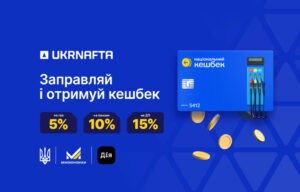
UKRNAFTA was the first to join the government’s fuel cashback support program.
Starting today, at all 660 gas stations in the network, customers will be able to receive:
15% cashback on diesel;
10% on gasoline;
5% on LPG.
Funds will be credited to a card registered in the state “National Cashback” program.
The maximum cashback amount for fuel is up to 1,000 UAH per person per month.
Accrued funds can be viewed in the Diya app. Payments are made by the end of the month following the purchase.
Fuel cashback is part of the government’s support for Ukrainians in response to rising oil prices due to hostilities in the Middle East.
The program will run until May 1.
JSC “Ukrnafta” is Ukraine’s largest oil producer and operates the country’s largest national network of gas stations—UKRNAFTA. In 2024, the company entered into an asset management agreement with Glusco. In 2025, it finalized a deal with Shell Overseas Investments BV to purchase the Shell network in Ukraine. In total, it operates 660 gas stations.
The company is implementing a comprehensive program to resume operations and modernize the format of gas stations in its network. Since February 2023, it has been issuing its own fuel vouchers and “NAFTACard” cards, which are sold to legal entities and individuals through Ukrnafta-Postach LLC.
The largest shareholder of Ukrnafta is Naftogaz of Ukraine with a stake of 50% plus one share.
In November 2022, the Supreme Commander-in-Chief of the Armed Forces of Ukraine decided to transfer to the state the share of corporate rights in the company that belonged to private owners, which is now managed by the Ministry of Defense.

The Romanian government has approved an emergency decree declaring a state of emergency in the oil and petroleum products market for the period from April 1 to June 30, 2026, and has introduced a package of measures to protect the economy and the population. The key measure involves price controls through restrictions on commercial markups. The maximum aggregate markup across the supply chain for gasoline, diesel, and certain raw materials used in their production is capped at 50%, and penalties ranging from 0.5% to 1% of a company’s annual turnover are imposed for exceeding these limits.
Romanian authorities explain that the emergency measures are being introduced amid rising global oil prices, increased insurance and logistics risks, and the country’s high dependence on imports.
As of March 27, fuel prices in Bucharest were:
gasoline: 9.19–9.23 lei per liter (about 1.85–1.86 euros);
diesel fuel: 10.26–10.36 lei per liter (about 2.06–2.08 euros).
Economist Adrian Negrescu warned that if external pressure persists, prices for premium diesel could rise to 12–13 lei per liter (about 2.4–2.6 euros).

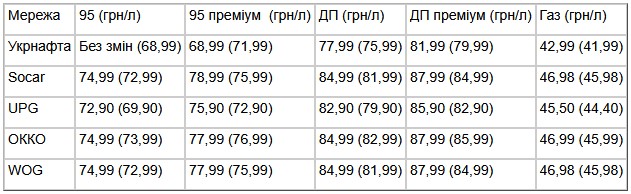
Prices for all types of fuel rose by 1–3 UAH/liter on Friday compared to Thursday; against this backdrop, PJSC “Ukrnafta” lowered the price of A-95+ by 3 UAH/liter, bringing it in line with A-95, according to data monitoring on websites and in network apps conducted by the “Energoreforma” internet portal.
According to the data, three of the surveyed gas station chains raised diesel fuel prices by 3 UAH/liter: Socar, WOG, and UPG, with the first two currently selling diesel at 84.99 UAH/liter and diesel+ at 87.99 UAH/liter. The same price applies at OKKO, which brought its prices in line with this level by raising them by 2 UAH/liter. UPG lists prices of 82.9 UAH/liter and 85.9 UAH/liter, respectively.
State-owned “Ukrnafta,” following a 2 UAH/liter increase in diesel prices, has a diesel price of 77.99 UAH/liter and diesel+ at 81.99 UAH/liter, which is the lowest among the surveyed networks.
The price of gasoline increased by 1 UAH/liter at OKKO, by 2 UAH/liter at WOG, and by 3 UAH/liter at Socar and UPG, but UPG’s price remains the lowest among private chains. Meanwhile, the state-owned “Ukrnafta” left the price of A-95 unchanged and reduced the price of A-95+ by 3 UAH/liter. For both types of fuel, it stands at 68.99 UAH/L.
Fuel prices (averages) as of March 20 compared to March 19 (based on monitoring by “Energoreforma” of network websites and apps*).
*Not all gas stations provide up-to-date prices on their websites and in their apps
As reported, at the beginning of last month, Serhiy Kuyun, director of the consulting firm A-95, predicted that diesel fuel prices would rise to 80 UAH/liter by the end of the month and noted the conditions for a further increase to 90 UAH/liter. At the same time, he indicated that he does not believe diesel fuel will reach 100 UAH/liter. According to him, since price spikes have affected many countries, the global economy cannot sustain such prices, and every effort will be made to offset the increase. He added that gasoline prices will rise only slightly.

Farmers currently have sufficient fuel reserves for the planting season, enough to cover their needs for three to six weeks, said Oleksiy Sobolev, Ukraine’s Minister of Economy, Environment, and Agriculture.
“Regarding the planting season. We now know that both diesel and fuel are secured for the planting season. We have consulted with the market—fuel reserves are sufficient for three to six weeks,” he said during “Government Hour” in the Verkhovna Rada on Friday, according to a correspondent for the Interfax-Ukraine news agency.
“We will continue to monitor the situation,” the minister added.
As reported, some experts suggested that problems with oil and petroleum product supplies to the market caused by the war between Israel and the U.S. against Iran could lead not only to a significant increase in the price of petroleum products but also to shortages in certain segments, primarily diesel fuel.



