
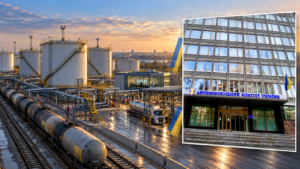
The Antimonopoly Committee of Ukraine (AMCU) has begun studying the state of competition in the markets for petroleum-product storage and related services, enkorr reported, citing a request from the committee to one of the market participants, a copy of which is in the publication’s possession.
“As part of the study, the AMCU is collecting data for 2023–2025 and the first half of 2026. In particular, operators must provide information on the volumes and cost of storing gasoline, diesel fuel and liquefied gas, storage capacity, the list of clients and related services,” enkorr noted.
The committee is also interested in the technical characteristics of oil depots: tank-farm capacity, the throughput capacity of railway and road loading racks, equipment for monitoring fuel quality and quantity, and the possibility of promptly repurposing tanks for different types of petroleum products.
A separate part of the study concerns the geographical boundaries of the market. The AMCU is requesting the distances over which fuel is transported from oil depots to clients’ filling stations, the geography of counterparties, the share of rail and water logistics, as well as a list of competing oil depots within a radius of 100 and 150 km.
“In addition, the committee will analyze pricing in the market. Operators must report storage tariffs and tariffs for related services, the practice of granting discounts to large clients, the share of the three largest customers in storage revenue, and their possible influence on tariff policy,” the publication reported.
The committee is also studying barriers to market entry and collecting information on damage to tank farms, railway infrastructure and loading systems, the cost of restoring them, and logistics problems.
Another section concerns minimum stocks of oil and petroleum products (MZNN). The AMCU is determining whether oil-depot operators plan to operate as minimum-stock operators or responsible custodians, as well as how the introduction of MZNN has affected their activities.
As part of the government-introduced experiment on underground fuel storage, the committee is also interested in whether companies have underground storage facilities and in their plans to build new capacity.
Source: https://enkorr.ua/uk/news/amku_dosldzhu_konkurencyu_na_rinku_zbergannya_palnogo/269381
ANTIMONOPOLY COMMITTEE, fuel market, PETROLEUM PRODUCTS, UKRAINE
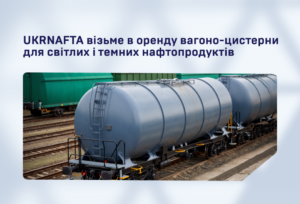
UKRNAFTA is seeking reliable logistics partners.
The company is announcing a commercial procurement for the long-term lease of rail tank cars.
We are accepting proposals for two categories:
• steam-jacketed tank cars for the transportation of dark petroleum products;
• non-steam-jacketed tank cars for the transportation of light and dark petroleum products.
The location for service provision is Ukraine.
We are accepting proposals from September 23 until 3:00 p.m. on October 14, 2026.
Let’s work together to support Ukraine’s energy resilience!
For more details, see this link.
JSC “Ukrnafta” is Ukraine’s largest oil producer and operates the country’s largest national network of gas stations—UKRNAFTA. In 2024, the company began managing Glusco’s assets. In 2025, it finalized a deal with Shell Overseas Investments BV to acquire the Shell network in Ukraine. In total, it operates nearly 700 gas stations.
The company is implementing a comprehensive program to resume operations and modernize the format of the gas stations in its network. Since February 2023, it has been issuing its own fuel vouchers and “NAFTACard” cards, which are sold to legal entities and individuals through Ukrnafta-Postach LLC.
The largest shareholder of Ukrnafta is NJSC Naftogaz of Ukraine, with a stake of 50% plus one share.
In November 2022, the Supreme Commander-in-Chief of the Armed Forces of Ukraine decided to transfer to the state the portion of the company’s corporate rights previously held by private owners; the company is now managed by the Ministry of Defense.
LOGISTICS, PETROLEUM PRODUCTS, PROCUREMENT, TANKER, UKRNAFTA
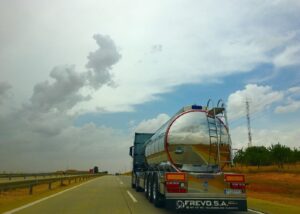
In January–August 2026, Ukraine imported 1.12 million metric tons of automotive gasoline, which is 16% more than during the same period in 2025, according to the A-95 Consulting Group, based on the results of a special market study.
However, gasoline imports in August alone totaled 152,000 metric tons, which is 7% less than in August of last year.
Lithuania and Poland remain the main suppliers of gasoline to Ukraine. In August, 51,800 metric tons of fuel were imported from Lithuania, accounting for 34% of total imports, and 40,100 metric tons from Poland, accounting for 26%.
Thus, the combined share of the two countries reached 60%, compared to 55% a year earlier.
The ORLEN Group, which owns oil refineries in Lithuania and Poland, remains the largest source of imported gasoline. In August, the group’s enterprises shipped 78.8 thousand metric tons of gasoline to Ukraine, accounting for 52% of all imports for the month.
Imports from Germany fell by 13% in August, to 18,200 metric tons. Of this volume, 11,200 metric tons, or 61.5%, came from the UPG network.
A-95 notes that the decline in August shipments is linked, in particular, to high carryover fuel stocks accumulated earlier.
After losing a significant portion of its domestic refining capacity as a result of the full-scale war, the Ukrainian petroleum products market remains heavily dependent on imports from EU countries. The bulk of gasoline and diesel fuel arrives via western and southern routes.
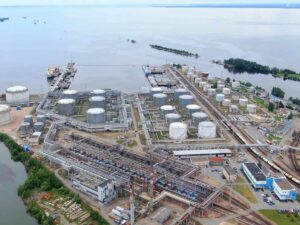
According to “Serbian Economist,” the Romanian company JT Grup Oil has received approval to build a new oil products terminal on the Danube near the port of Tisovica-Dubova, not far from Orșova in Mehedinți County, the company reported in a filing published on the Bucharest Stock Exchange.
The project involves the construction of four above-ground storage tanks for liquid fuel, as well as the engineering and logistics infrastructure necessary for the receipt, storage, and transshipment of petroleum products.
JT Grup Oil views the new facility as part of a larger regional logistics system. The Danube terminal is planned to be integrated with the company’s new terminal in the port of Constanța on the Black Sea.
According to the company, the platform being developed is intended to serve the markets of Romania, Hungary, Serbia, Austria, and Ukraine, leveraging both Black Sea logistics capabilities and the international transport corridor along the Danube.
Thus, fuel will be able to arrive via Constanta by sea and then be distributed throughout Central and Southeastern Europe using river, rail, and road transport.
For Serbia, the new facility is of particular interest due to its location on the Danube, relatively close to the Serbian border. Additional storage and transshipment capacity for petroleum products could expand fuel supply options to the Serbian market and enhance the Danube’s role in regional energy logistics.
For Ukraine, the project also creates an additional route for importing petroleum products via Romania. Since 2022, Romanian ports—primarily Constanța—have significantly increased their importance for Ukrainian trade and fuel supplies.
At the same time, JT Grup Oil is completing another major infrastructure project—the JT Terminal in the port of Constanța.
The terminal has already passed technical trials, and its commercial operation is scheduled to begin in October 2026, following the completion of all necessary procedures and the receipt of permits.
JT Grup Oil’s strategy effectively involves creating a Constanta–Danube–Central Europe logistics corridor.
The Black Sea terminal is intended to handle imported petroleum products arriving by sea, while the new facility near Orșova will bring fuel supplies closer to the markets of Serbia, Hungary, and Austria and utilize the Danube for further transportation.
“By developing the terminal in Constanta and the terminal in the Orsova area, the company aims to create an integrated logistics platform capable of effectively serving the markets of Central and Eastern Europe,” according to a statement from JT Grup Oil cited by Romanian media.
The project takes on added significance against the backdrop of the restructuring of European petroleum product supply routes and the region’s countries’ efforts to diversify their transportation infrastructure.
JT Grup Oil operates in the Romanian wholesale fuel trade and distribution market. The company’s shares are traded on the AeRO market of the Bucharest Stock Exchange under the ticker symbol JTG.
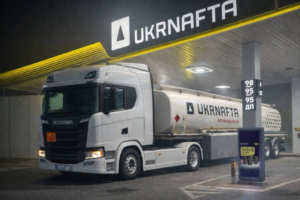
Ukrnafta JSC announces commercial procurement of road transport services for light petroleum products to meet commercial needs, the company said on Friday.
“The procurement will take place on the Zakupivli.pro platform in two stages. Offers submitted by other means will not be considered,” Ukrnafta said.
As explained by the company, Ukrnafta is accepting commercial proposals for road transportation of light petroleum products across Ukraine in connection with the expansion of its network and increased sales.
“We are waiting for commercial proposals until March 1, 2026, inclusive,” the statement said.
Ukrnafta JSC is Ukraine’s largest oil producer and operator of the largest national network of filling stations, UKRNAFTA. The company has 1,807 oil and 164 gas production wells on its balance sheet.
In 2024, the company entered into an asset management agreement with Glusco. In 2025, it completed a deal with Shell Overseas Investments BV to purchase the Shell network in Ukraine. It operates a total of 663 gas stations.
The company is implementing a comprehensive program to restore operations and update the format of its network of gas stations. Since February 2023, it has been issuing its own fuel vouchers and NAFTAKarta cards, which it sells to legal entities and individuals through Ukrnafta-Postach LLC.
The largest shareholder of Ukrnafta is Naftogaz of Ukraine with a 50%+1 share. In November 2022, the Supreme Commander-in-Chief of the Armed Forces of Ukraine decided to transfer to the state the corporate rights of the company that belonged to private owners and is now managed by the Ministry of Defense.
In January-September 2025, Ukraine increased its imports of petroleum products by 3% (166,823 thousand tons) compared to the same period last year, to 5 million 665,761 thousand tons.
According to the State Customs Service, petroleum products were imported in the amount of $4 billion 566.46 million, which is 11.1% less than in the first nine months of 2024 ($5 billion 133.869 million).
Fuel worth $695.185 million was imported from Poland (15.22% share), Greece – $595.812 million (13.05%), Lithuania – $569.152 million (12.46%), other countries – $2 billion 706.311 million (59.26%).
As reported, Ukraine imported 7 million 562.556 thousand tons of petroleum products in 2024, which is 1.1% less than in 2023 (7 million 646.537 thousand tons).



