
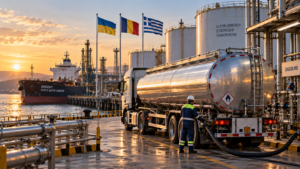
In August 2026, Ukraine significantly reduced purchases of motor gasoline from the southern direction: imports from Romania decreased by approximately one third, while those from Greece fell by 40%, according to calculations by the Experts Club analytical center and data from the A-95 Consulting Group.
Supplies of Romanian gasoline amounted to 23.4 thousand tonnes compared with 34 thousand tonnes in July.
Imports from Greece decreased to 15 thousand tonnes from 24.9 thousand tonnes a month earlier.
Thus, total supplies from the two countries decreased over the month from approximately 58.9 thousand to 38.4 thousand tonnes.
“The main reason for the significant drop in imports from the south was the price factor. In August, when the market was no longer threatened by a shortage, companies reduced purchases of more expensive fuel from Romania and Greece,” the A-95 Consulting Group reported.
A similar trend was also observed in the diesel fuel market.
At the same time, the bulk of Ukrainian gasoline imports continued to arrive from the northwestern direction. In August, Lithuania supplied 51.8 thousand tonnes of gasoline, while Poland supplied 40.1 thousand tonnes.
These two countries accounted for about 60% of total imports.
Overall, gasoline supplies from abroad in August amounted to 152 thousand tonnes, which is 7% less than a year earlier. Since the beginning of 2026, Ukraine has imported 1.12 million tonnes of gasoline — 16% more than in January-August 2025.
The decline in purchases from the southern direction shows that after supply stabilized, Ukrainian traders began more actively redistributing flows in favor of cheaper European sources.
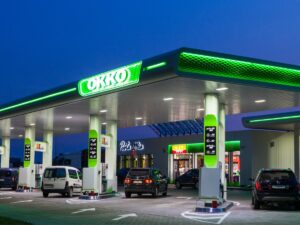
The OKKO network remains the largest importer of automotive gasoline into Ukraine: in August 2026, the company imported 46,100 metric tons of fuel, and 302,000 metric tons since the beginning of the year, according to data from the A-95 Consulting Group. OKKO accounts for about 27% of all Ukrainian gasoline imports since the beginning of the year.
The next group of largest suppliers consists of WOG, UPG, and “Ukrnafta.”
In August, WOG imported 20,200 metric tons of gasoline, UPG—20,000 metric tons, and “Ukrnafta” imported 19,400 metric tons.
Next are “BRSM-Nafta” with 7,000 metric tons, Amic with 3,400 metric tons, and “Avantage” with 3,100 metric tons.
Gaztrim and KLO each imported 2,400 metric tons, and Bars 2000 imported 2,200 metric tons.
Other market participants accounted for 26,100 metric tons.
In total, Ukraine imported 152,000 metric tons of motor gasoline in August.
The largest countries of origin for the fuel were Lithuania—51,800 metric tons—and Poland—40,100 metric tons. The ORLEN Group supplied more than half of August’s imports.
The rise in artisanal gasoline production within Ukraine was one of the factors behind the decline in official fuel imports in August 2026, according to the A-95 Consulting Group.
According to the group, imports of automotive gasoline in August totaled 152,000 metric tons, which is 7% less than a year earlier.
“In August, gasoline shipments were lower due to large carryover stocks and the growth of domestic illicit production, driven by the ability to add tax-exempt solvents,” A-95 reported.
Experts believe that government agencies—primarily the State Tax Service—need to strengthen oversight of this sector.
“This is not only a matter of losses to the state budget but also of the questionable quality of such fuel,” the group emphasized.
The use of components not subject to excise tax as motor fuel potentially allows producers to lower the cost of gasoline blends and gain an advantage over legal market participants who pay fuel taxes in full.
At the same time, there was no overall gasoline shortage on the Ukrainian market in August. Since the beginning of 2026, official import volumes have remained higher than last year’s: 1.12 million metric tons of gasoline were imported over eight months, which is 16% more than a year earlier.
The largest importers remain OKKO, WOG, UPG, and Ukrnafta, while the main supplier countries are Lithuania and Poland.
EXCISE TAX, FUEL, GASOLINE, TAX, UKRAINE
In January–August 2026, Ukraine imported 1.12 million metric tons of automotive gasoline, which is 16% more than during the same period in 2025, according to the A-95 Consulting Group, based on the results of a special market study.
However, gasoline imports in August alone totaled 152,000 metric tons, which is 7% less than in August of last year.
Lithuania and Poland remain the main suppliers of gasoline to Ukraine. In August, 51,800 metric tons of fuel were imported from Lithuania, accounting for 34% of total imports, and 40,100 metric tons from Poland, accounting for 26%.
Thus, the combined share of the two countries reached 60%, compared to 55% a year earlier.
The ORLEN Group, which owns oil refineries in Lithuania and Poland, remains the largest source of imported gasoline. In August, the group’s enterprises shipped 78.8 thousand metric tons of gasoline to Ukraine, accounting for 52% of all imports for the month.
Imports from Germany fell by 13% in August, to 18,200 metric tons. Of this volume, 11,200 metric tons, or 61.5%, came from the UPG network.
A-95 notes that the decline in August shipments is linked, in particular, to high carryover fuel stocks accumulated earlier.
After losing a significant portion of its domestic refining capacity as a result of the full-scale war, the Ukrainian petroleum products market remains heavily dependent on imports from EU countries. The bulk of gasoline and diesel fuel arrives via western and southern routes.
Over the next two weeks, domestic prices for gasoline and diesel may rise by 4.5–5 UAH per liter due to a price surge on global markets to levels close to April’s highs; specifically, the price of diesel fuel in London rising above $1,400 per metric ton, according to Serhiy Kuyun, director of the “A-95” consulting group.
“We are expecting domestic prices to rise. Currently, this increase translates to an additional 4.5–5.0 UAH per liter of gasoline and diesel fuel (their current average prices are 80 and 91 UAH per liter, respectively). This could happen within a couple of weeks if current prices stabilize at their current levels,” he wrote on Facebook on Wednesday.
According to the expert, on September 1 and 2, some Ukrainian retail chains had already raised prices by 1 UAH per liter.
“There are no fuel availability issues, neither here nor in Europe. Therefore, the issue is solely about price. The much-discussed 100 UAH per liter mark hasn’t been reached yet, but it’s starting to loom on the horizon again,” Kuyun noted.
As reported by “Energoreforma,” fuel prices in Ukraine showed both slight decreases and increases throughout August.
According to “A-95,” as of September 2, the average retail price in Ukraine for A-95 gasoline is 80.7 UAH/liter, and for diesel fuel, 91.31 UAH/liter.
According to the Experts Club analytical center, citing data from the A-95 Consulting Group, the Ukrainian gasoline market continues to be concentrated around supplies from Poland and Lithuania: in July 2026, these two countries accounted for 55% of total imports.
Ukraine received 56,100 tonnes of gasoline from Lithuania and 51,700 tonnes from Poland. Together, this amounted to around 107,800 tonnes out of total imports of approximately 196,000 tonnes.
The Polish supply route is demonstrating particularly high growth rates. Compared with July last year, the volume of supplies increased by 68% and reached its highest level since August 2025.
Imports from Lithuania increased by 16% year-on-year.
The ORLEN oil refining group plays a key role in both supply routes. The group’s facilities in Poland and Lithuania supplied around 97,000 tonnes of gasoline to the Ukrainian market.
A-95 estimates ORLEN’s share at more than half of total imports. Comparing the rounded figures of 97,000 tonnes and the total volume of 196,000 tonnes, this represents approximately half of the market.
The high level of concentration has a dual effect.
On the one hand, the large and stable refineries in Poland and Lithuania allow Ukraine to rapidly increase purchases during periods of higher demand and compensate for the loss of other suppliers.
On the other hand, more than half of the available supply comes from only two geographical routes, while a very significant share of deliveries is linked to a single refining group.
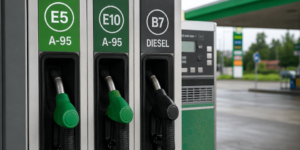
Poland’s importance increased particularly after Ukraine switched to E10 gasoline. The change in standards limited the possibility of using some traditional sources, including certain Greek refineries.
At the same time, Greece has not disappeared from the market entirely. In July, Ukraine imported around 25,000 tonnes of gasoline produced by Motor Oil.
Germany became another rapidly growing supply route. It supplied 21,000 tonnes of gasoline, 78% more than in July 2025. The UPG network imported the entire volume.
Thus, the structure of imports in July demonstrates two parallel trends: ORLEN’s growing role as a key supplier and simultaneous attempts by Ukraine’s largest fuel retail networks to diversify purchases through Germany, Romania and Greece.



