
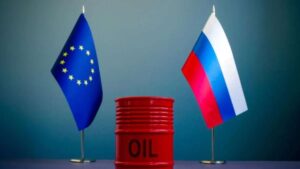
The European Union has established a legal framework allowing member states to sell Russian oil that was previously seized and confiscated in the course of cracking down on sanctions evasion.
The relevant provision is included in EU Council Regulation No. 2026/1848 of July 23, 2026, which formalized the 21st package of sanctions against Russia. The document states the need to enable national competent authorities to safely dispose of shipments of Russian oil that they seize and confiscate. Disposing of the cargo may include selling it to third parties.
However, the new provision does not grant EU authorities the automatic right to stop any tanker simply because it is transporting oil of Russian origin. First, the state must have legal grounds to detain the vessel and confiscate the cargo—for example, a violation of the sanctions regime, the absence of a valid flag, the provision of false documents, or other violations of European, national, or international law.
The new regulation primarily specifies what authorities may do with the cargo after its lawful confiscation. Once the confiscation procedure is complete, the former owner does not automatically receive the right to the proceeds from the sale of the cargo. However, the regulation does not establish a uniform procedure for distributing the proceeds across all EU countries, nor does it provide for their automatic transfer to Ukraine. Such decisions will depend on national legislation and the specific case.
According to Euractiv, the measure is primarily aimed at cargo from vessels used to circumvent EU oil sanctions. The option to sell the cargo is intended to address a practical problem: confiscated oil must be unloaded, stored, and safely sold, which entails significant costs and environmental risks.
The mechanism is part of the 21st EU sanctions package, adopted on July 23. The package also increases pressure on the Russian oil sector, traders, and the shadow fleet, and suspends the automatic review of the price cap on Russian oil until July 15, 2027.
In practice, the new rule may make it easier for EU member states to take action against vessels suspected of circumventing sanctions. However, each detention and confiscation must have a separate legal basis, and the owners of the vessels and cargo will be able to challenge such decisions in national and international courts.
The price of May Brent futures on the London ICE Futures exchange rose by $6.09 (6.62%) to $98.07 per barrel at 7:12 a.m. Earlier during the session, Brent again exceeded $100 per barrel. On Wednesday, the contract rose in price by $4.18 (4.8%) to $91.98 per barrel.
WTI crude oil futures for April delivery on the New York Mercantile Exchange (NYMEX) are currently up $5.29 (6.06%) to $92.54 per barrel. At the end of the previous session, the value of these contracts rose by $3.8 (4.6%) to $87.25 per barrel.
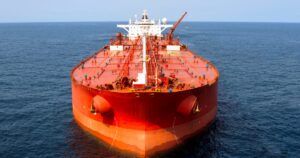
An Iranian underwater drone attacked two oil tankers in the Persian Gulf overnight, Iranian state television IRIB reported. Earlier, a source in the Iraqi security service in Basra told CNN that a ship loaded with explosives rammed into two tankers at once.
CNN specifies that the ships Zefyros, flying the Maltese flag, and Safesea Vishnu, flying the Marshall Islands flag, were on fire. The registered owner of the Safesea Vishnu is the American company Safesea Transport Inc., while the owner of the Zefyros is based in Greece.
Iraq’s oil ports have been suspended following the fire, according to Farhan al-Fartousi, head of the Iraqi Ports Authority. He said one person had died and 38 others had been rescued.
Meanwhile, Oman has ordered ships to leave the Mina al-Fahal export terminal as a precaution, Bloomberg reports, citing informed sources. According to Kpler, about 1 million barrels of oil were exported from the terminal daily.
Earlier, a representative of the Iranian armed forces said that the world should prepare for oil at $200 per barrel, as fuel prices depend on security in the region, and Israel and the US have violated this security with their actions.
“The only thing that could lead to a long-term decline in prices is the resumption of oil supplies through the Strait of Hormuz,” ING analysts wrote. “If this does not happen, we can expect new highs.”
Oil prices rose yesterday, despite the fact that OPEC member countries agreed to supply a record 400 million barrels from their strategic reserves to the world market. The timing of the release of reserves will depend on the circumstances in each individual country. The total strategic oil reserves of IEA member countries exceed 1.2 billion barrels, with another 600 million barrels in state-owned industrial reserves.
“The release of IEA oil reserves may only be a temporary solution, while supply disruptions and significant production cuts in some Middle Eastern countries could cause a long-term supply shortage,” said Tina Teng of Moomoo ANZ.
On Wednesday, it was also reported that commercial oil reserves in the US rose by 3.824 million barrels last week to a maximum of 443.1 million barrels since May 2025. Experts had forecast an average increase of 1.1 million barrels, according to Trading Economics.
Earlier, the Experts Club information and analytical center released a video dedicated to global oil production in 1900–2024 and the leading producing countries.
Brent, EXPERTS CLUB, IRAN, OIL, TANKER
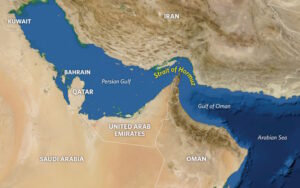
The cost of insurance for ships passing through the Strait of Hormuz has jumped 12-fold, despite US President Donald Trump’s promise to ensure uninterrupted energy supplies from the Middle East, the Financial Times reports, citing brokers.
According to the publication’s sources, the insurance rate for ships operating in high-risk areas, which include not only the strait itself but also the waters adjacent to it, is now 3% of the ship’s value, whereas before the US and Israeli military operation against Iran, it was 0.25%.
The White House chief previously wrote on Truth Social that he had ordered the US International Development Finance Corporation (DFC) to begin providing insurance and guarantees on favorable terms “for all commercial maritime traffic through the Persian Gulf, especially that related to energy resources.”
Insurers are trying to figure out how this will work and whether it will help lower prices. Several brokers admitted to the FT that they were taken aback by Trump’s statement.
“We haven’t heard anything other than this announcement on Truth Social,” said David Smith of brokerage firm McGill, adding that insurers don’t know how widely the announced support will be extended, despite the promise to insure “all” trade passing through the Persian Gulf.
Other experts question how effective the DFC’s assistance can be, given that its primary role is to promote private investment in poor countries, while the main problem for shipowners operating in the Persian Gulf is the threat of attack.
“We already have insurance,” said Ed Finley-Richardson, founder of Contango Research. The DFC announcement may have helped curb oil price rises, but it is unlikely to change anything for us, he added.
At least seven tankers have been attacked in the Strait of Hormuz and surrounding waters since Sunday. Some ships reported receiving radio warnings demanding that they stay away from the strait.
Trump said on Truth Social that the US Navy would escort tankers through the Strait of Hormuz if necessary.
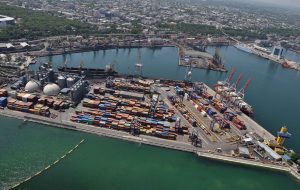
State-owned Ukrainian Sea Ports Authority (USPA) has said it eliminated pollution of the sea next to the sunken tanker Delfi in the area of Dolphin Beach. The enterprise insists on solving the problem of raising it, stressing that the ship owner must do this, USPA’s press service said on Thursday.
“The administration of the seaports of Ukraine, taking into account the active discussion of this issue by the public, emphasizes that the only legal way to solve the problem with the emergency tanker is to carry out all the work and eliminate the consequences of the incident directly and exclusively by the owner,” the statement said.
At the same time, the state-owned enterprise notes that the USPA does not have any legal grounds for independently raising the vessel. According to Article 123 of the Merchant Shipping Code, USPA will receive such a right only if a number of conditions and circumstances independent of it arise directly:
– the owner of the vessel will not ensure its recovery within the time limits established by the captain of the port (State services of sea and river transport of Ukraine). USPA will have the right to raise the vessel no earlier than July 20, 2020;
– the State Environmental Inspectorate provides an appropriate document stating that the tanker poses an immediate threat to environmental pollution;
– the owner of the vessel documents the readiness and undertakes to compensate USPA SE the cost of the work;
– the captain of the port of Odesa grants permission to raise property that has sunk within the water area of the seaport.
“If at least one of the above conditions does not occur, the right (and in this case the obligation) to raise and remove the vessel will remain solely with the owner. As of June 23, USPA received an official, clear and unambiguous refusal for compensation of expenses, and also assured of a full understanding of the responsibility and financial, organizational and technical readiness of the ship owner to raise his own ship,” USPA said.
At the same time, as noted in the message, organizationally, USPA was ready as early as April 1, 2020 (the deadline originally set by the port captain). Tender documentation was worked out and agreed and funds are provided in the financial plan.
According to the latest data from the state-owned enterprise, the work execution plan provided by the ship owner was worked out and agreed by the captain of the Odesa Sea Port and the State Environmental Inspectorate. Based on the above, the activation of the preparatory work, at the request of the ship owner, the deadline for the completion of the work on cleaning the tanker from the Odesa beach by the port captain has been extended.
Earlier, the State Environmental Inspectorate reported that according to the results of samples taken by Ukraine’s State Ecological Inspectorate, the content of oil products in the Black Sea near the Dolphin beach (Odesa) is 16.4 times higher than the permissible concentration.
As reported, in the Gulf of Odesa, the Delfi tanker under the flag of Moldova suffered a disaster – the ship broke anchor.
USPA said initially the tanker was in neutral waters and did not apply for entry into the Odesa or “South” sea ports. But later a signal was given that the ship was in distress, it was left without fuel, with an inoperative engine. In this regard, the Odesa Rescue Coordination Center, which received the signal, began to take measures to eliminate the emergency. It was agreed to tow the tanker to Ochakiv port.
On the night of November 22, Delfi managed to gain an anchor at a distance of about 1 mile from the coast near the Dolphin Beach. However, according to USPA, at 5:00, the vessel began drifting again. On the evening of the same day, rescuers managed to evacuate three crew members from the ship. They were hospitalized, doctors reported overwork and hypothermia.
The owner of the vessel had to take measures by March 31, 2020 to raise and remove the sunken tanker from the waters of Odesa Sea Port. On April 1, the prosecutor took control of the case.



