
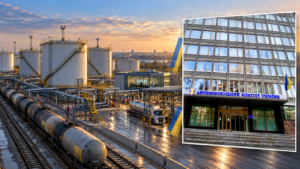
The Antimonopoly Committee of Ukraine (AMCU) has begun studying the state of competition in the markets for petroleum-product storage and related services, enkorr reported, citing a request from the committee to one of the market participants, a copy of which is in the publication’s possession.
“As part of the study, the AMCU is collecting data for 2023–2025 and the first half of 2026. In particular, operators must provide information on the volumes and cost of storing gasoline, diesel fuel and liquefied gas, storage capacity, the list of clients and related services,” enkorr noted.
The committee is also interested in the technical characteristics of oil depots: tank-farm capacity, the throughput capacity of railway and road loading racks, equipment for monitoring fuel quality and quantity, and the possibility of promptly repurposing tanks for different types of petroleum products.
A separate part of the study concerns the geographical boundaries of the market. The AMCU is requesting the distances over which fuel is transported from oil depots to clients’ filling stations, the geography of counterparties, the share of rail and water logistics, as well as a list of competing oil depots within a radius of 100 and 150 km.
“In addition, the committee will analyze pricing in the market. Operators must report storage tariffs and tariffs for related services, the practice of granting discounts to large clients, the share of the three largest customers in storage revenue, and their possible influence on tariff policy,” the publication reported.
The committee is also studying barriers to market entry and collecting information on damage to tank farms, railway infrastructure and loading systems, the cost of restoring them, and logistics problems.
Another section concerns minimum stocks of oil and petroleum products (MZNN). The AMCU is determining whether oil-depot operators plan to operate as minimum-stock operators or responsible custodians, as well as how the introduction of MZNN has affected their activities.
As part of the government-introduced experiment on underground fuel storage, the committee is also interested in whether companies have underground storage facilities and in their plans to build new capacity.
Source: https://enkorr.ua/uk/news/amku_dosldzhu_konkurencyu_na_rinku_zbergannya_palnogo/269381
ANTIMONOPOLY COMMITTEE, fuel market, PETROLEUM PRODUCTS, UKRAINE
The five largest diesel fuel importers in Ukraine accounted for approximately half of all foreign supplies in July 2026, according to data from the A-95 Consulting Group.
A total of 134 companies imported diesel fuel during the month, but the top five accounted for approximately 280,000 tonnes out of the total volume of 562,000 tonnes. Thus, their combined share amounted to approximately 49.8% of the import market.
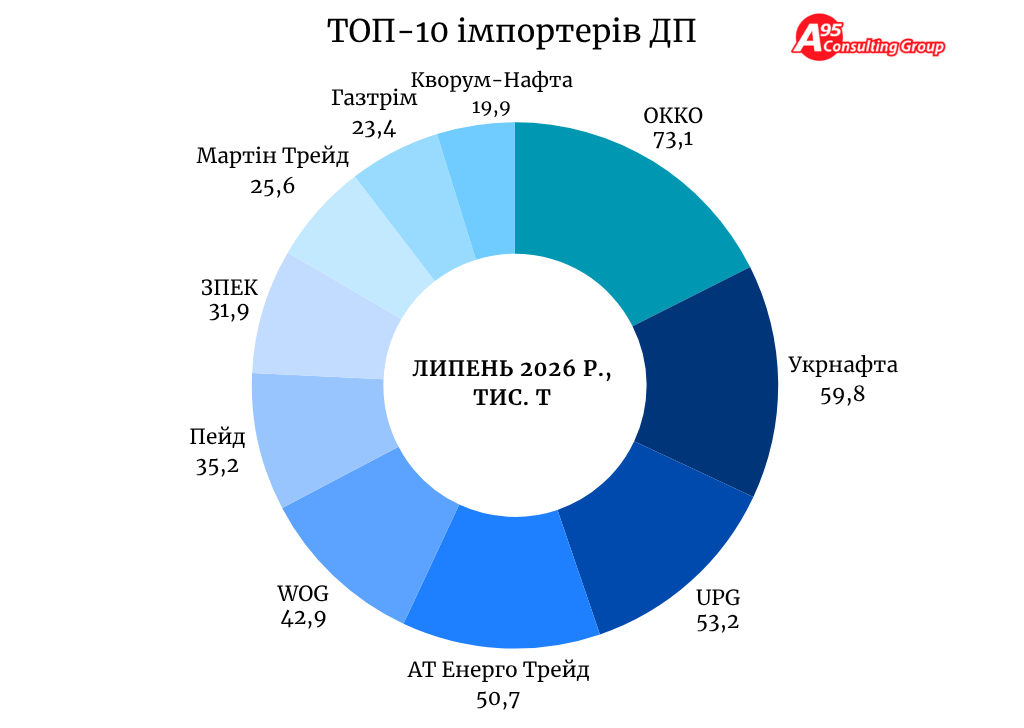
The OKKO Group was the largest importer, bringing in 73,100 tonnes of diesel fuel. Its supplies increased by 32% compared with July last year.
The state-owned Ukrnafta ranked second with 59,800 tonnes. The company demonstrated significantly stronger growth, increasing its imports 2.4-fold compared with July 2025.
UPG ranked third with a volume of 53,200 tonnes.
AT Energo Trade ranked fourth with 50,700 tonnes, while WOG placed fifth with 42,900 tonnes. These figures are presented in the A-95 infographic showing the top 10 diesel fuel importers for July.
Thus, OKKO and Ukrnafta alone accounted for almost 133,000 tonnes, or approximately 24% of total monthly imports.
At the same time, the highest growth rate among market participants was demonstrated not by a company in the top five, but by Zakhidna Palyvno-Enerhetychna Kompaniia (ZPEK). It increased its supplies 5.3-fold to 31,900 tonnes.
The ten largest importers also included companies with supply volumes ranging from approximately 20,000 to 35,000 tonnes.
The growing concentration of major suppliers is taking place against the backdrop of an overall increase in imports. In July, Ukraine imported 562,000 tonnes of diesel fuel, 5% more than a year earlier.
However, as A-95 Director Serhii Kuiun noted, even these volumes proved insufficient to meet the sharply increased demand. The market experienced a diesel fuel shortage due to a price-driven buying rush, increased activity among industrial and private buyers, and growing fuel consumption in the transport sector.
A-95 expects a more balanced situation in August as a result of increased supplies and lower global fuel prices.
Source: A-95 Consulting Group, Experts Club

The capacity of the Ukrainian gasoline market increased by 8% in 2023, LPG – by 18%, diesel fuel – by 25%, said Sergiy Yun, Director of the consulting group A-95 Sergiy Kuyun on Facebook.
“We have pushed off from the bottom-22. Preliminary growth in gasoline supplies is 8%, diesel – 25%, gas – 18%,” he wrote.
At the same time, according to the expert, this year’s gasoline balances have lost 16%, diesel – 17%, and autogas – 34% compared to 2021.
According to Kuyun, the collapse of the fuel market in Ukraine occurred in 2022 with the beginning of Russian aggression.
“In 2022, the market lost almost 2.5 million tons of diesel, almost a third of gasoline, and liquefied gas almost halved,” the expert said during a presentation of the results of the oil products market at the Ukraine-Ukrinform Media Center on December 21.
According to the preliminary data on oil product balances in Ukraine in 2021-2023, released by A-95 during the presentation, the forecast volume of the LPG market in 2023 was to be 1.283 million tons, gasoline – 2.275 million tons, and diesel fuel – 6.685 million tons.



