
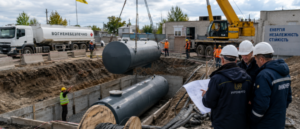
It makes more sense for Ukraine to invest in creating its own network of underground fuel storage facilities than to invest in the construction of facilities for storing strategic reserves in other countries. This opinion was expressed by Serhiy Kuyun, director of the A-95 Consulting Group, according to Enkorr.
Ukrainian legislation allows for up to 50% of the minimum reserves of oil and petroleum products to be stored in countries neighboring Ukraine and up to an additional 25% in countries bordering those neighbors. This practice is common in Europe; however, finding available storage capacity in neighboring countries is complicated by the fact that EU member states themselves are required to maintain significant strategic reserves.
According to Kuyun, as a result, Ukraine may be offered the option to invest not in leasing existing facilities, but in the construction of new storage tanks abroad. Such projects will require lengthy construction periods, local permits and licenses, as well as the outflow of significant foreign currency investments from Ukraine. If a foreign partner finances the project, it may also be necessary to guarantee that the storage facilities remain filled for many years.
The expert cites another problem: the physical ability to quickly deliver strategic reserves to Ukraine in the event of a large-scale fuel crisis.
“Even if we build up reserves abroad, how would we then transport them in an emergency? The border is already strained even under normal conditions—where would we possibly fit in tens or even hundreds of thousands of additional metric tons?” Kuyun noted.
The relevance of this discussion has intensified following agreements between Naftogaz and the Hungarian company MOL. On September 20, the companies signed a memorandum to explore the possibility of storing petroleum products in Hungary near the Ukrainian border to meet the needs of the Ukrainian market. The project is still in its initial stages, and the parties must assess its technical, financial, environmental, and regulatory parameters.
According to Kuyun, a more reliable solution would be to build secure underground storage facilities directly in Ukraine. This would allow for simultaneous investment in Ukrainian infrastructure, increase the security of reserves against Russian attacks, and ensure the ability to bring fuel to market more quickly in a crisis situation.
The first government incentives for such investments have already been established. In September, the government expanded its financial support program for the fuel sector. Loan funds can be used, in particular, to bury or install underground storage tanks, pumping stations, process pipelines, and other fuel infrastructure equipment.
The maximum amount of state-backed lending is 1 billion UAH per company, including affiliated counterparties; the minimum is 100 million UAH; and for projects in combat zones, it is 30 million UAH. The state will subsidize 5.5 percentage points per annum off the bank’s base rate.
According to Kuyun, the next step should be to streamline the approval process for project documentation related to underground fuel storage facilities, as this process can currently take over a year. He noted that several private companies have already begun implementing such projects while simultaneously completing the necessary approval procedures.
“Build our own, invest in Ukraine’s infrastructure! But we need to build underground storage facilities—with a neighbor like this, we’ll always need them,” emphasized the director of “A-95.”
FUEL, INVESTMENT, petroleum product, storage facility, UKRAINE
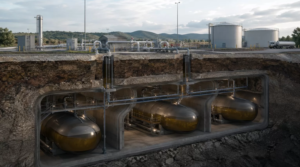
Starting in 2027, Ukraine will launch a pilot project for the underground storage of petroleum products from the minimum reserves of oil and petroleum products (MROPP), according to Cabinet of Ministers Resolution No. 1037 dated August 13, 2026, published on the government portal.
According to the resolution, the pilot project, initiated by the Ministry of Energy, is to last no more than two years.
“Starting from the beginning of the third base year (2027), market participants and operators are required to store a portion of diesel fuel—amounting to at least 20% of the total volume of this type of petroleum product—from the MRPS in underground petroleum product storage facilities,” – states the procedure for implementing the pilot project attached to the resolution.
The project provides for the creation of an extensive system of underground petroleum product storage facilities and conditions for their safe storage, as noted in the procedure.
The Ministry of Energy has been designated as the coordinator of the pilot project, and JSC “Ukrtransnafta” as the specialized responsible storage operator.
At the same time, the operation of the specialized responsible storage operator grants other market participants the right to store petroleum products in their own underground storage facilities.
The list of state-owned facilities whose property may be used as underground storage facilities is specified in the confidential section of the resolution.
The Ministry of Energy must ensure the implementation of the project in cooperation with, among others, NJSC “Naftogaz of Ukraine,” “Ukrtransnafta,” and the “Market Operator.”
Serhiy Kuyun, director of the consulting firm A-95, commented on the pilot project, noting that there are currently no underground storage facilities in the country, and that with only four months remaining before the deadline, no one will even have time to develop a project. At the same time, he pointed out that the resolution provides for the use of oil pipelines, salt caverns, depleted oil or gas fields, and other geological formations for these purposes.
Kuyun also noted that in the near future, state-owned banks, by government decision, may begin providing loans for underground petroleum product storage facility projects at 10% per annum, with the state compensating for the remaining interest. According to his information, the loan amount could range from 100 million UAH to 1 billion UAH. At the same time, Kuyun suggested that in such cases, a strict condition would be imposed requiring the storage facilities to be put into operation within a year.
However, in his opinion, a year is an unrealistic deadline, so the government needs to speed up the approval of project documentation, a process that currently takes one to one and a half years. The director of A-95 also noted that private gas station network operators have already begun construction of underground storage facilities “at their own risk,” while simultaneously seeking approval for their projects.
He also drew attention to the broader issue of MZNN storage starting in 2027.
“The law (on MZNN), although blocked by subordinate regulations, is formally in effect, and currently the MZNN quota stands at 6% (of the market—ER), or approximately 600,000 metric tons. This is a volume that physically has nowhere to be stored—neither underground nor above ground. And no one is going to store it on land, because that would be business suicide. If nothing changes, the quota will automatically increase to 9% starting in 2027,” Kuyun explained.
He added that the Ministry of Energy understands the problem and has prepared amendments to the law, which already number 300.
“The positions are as follows: everyone, without exception, understands the main point—reserves are necessary, but they must be protected. And these reserves must remain in Ukraine; fantasies about storing them abroad are quickly dispelled,” the director of A-95 concluded.
As reported, parliament passed the MZNN law on November 21, 2023.
The explanatory note to Bill No. 9024-d stated that its adoption would allow for the creation of a system of minimum reserves of crude oil and petroleum products in Ukraine and would regulate relations in the sphere of managing such minimum reserves, as well as ensure Ukraine’s compliance with its obligations regarding the implementation of Directive 2009/119/EU.
According to Vasyl Danylyak, CEO of OKKO Group, establishing minimum oil and petroleum product reserves is only feasible once Ukraine has a sufficient network of underground storage facilities.
FUEL, petroleum product, storage facility, UKRAINE, UKRTRANSNAFTA



