

Against the backdrop of shrinking fuel supply channels and the Russian Federation’s increasingly intense attacks on fuel infrastructure, Ukraine needs to build decentralized, small-scale underground storage facilities for petroleum products, according to Serhiy Kuyun, director of the consulting firm A-95.
“There is only one solution—storage in underground facilities. It appears that both the government and private players are already working on this. At the same time, building such infrastructure is at least twice as expensive as above-ground storage tanks,” he wrote on his Facebook page on Wednesday.
Meanwhile, according to the expert, there is currently no government support, not even in the form of deregulation or expedited approval of project documentation, let alone preferential lending and other incentives.
According to Kuyun, when creating underground storage facilities, the goal should not be to build large-scale facilities, as they are more vulnerable to complex missile strikes.
“But if every importer builds its own small storage facilities with a capacity of 3,000–4,000–5,000–10,000 cubic meters, this will already be a much more resilient structure. In any case, however, it’s important to understand that this won’t happen quickly—it will take one and a half to two years if we start today,” he believes.
According to the expert, it is necessary to convey to citizens, municipal institutions, and government organizations, as well as private companies, the need to build up fuel reserves. “A reserve distributed among consumers will help prevent panic buying and an excessive, sudden strain on the supply system in the event of a crisis,” noted the director of A-95.
According to him, Russia has launched new strikes on the bridge in Mayaky (the route from Reni to the “mainland”) and a “Shahed” drone strike on a tanker carrying lubricants on that same route.
“I think that when planning the strategy for securing petroleum products for the coming months, it’s best to forget about the South (…). This means that the entire burden will fall on the land border, which is already at maximum capacity. All of this indicates that the system is becoming less diversified, which carries corresponding risks,” Kuyun wrote.
As he explained, the enemy is gradually cutting off Ukraine’s southern fuel supply route, which amounts to a triple blow: a reduction in supply channels, a decrease in consumption due to the shift from “maritime” exports to “road” transport, and an increase in the burden on the border coupled with a decrease in its capacity for fuel imports.
At the same time, Russia is already attacking not only oil depots in Ukraine but also gas stations with fuel tankers.
As reported, the Ukrainian Oil and Gas Association (NAU) is urging the government to grant the fuel industry access to loans at 10% interest, which can be achieved by extending the scope of Cabinet of Ministers Resolution
No. 594 to all types of businesses for the purpose of creating underground storage tanks for petroleum products as part of the reconstruction of existing oil depots.
This was announced, in particular, by UGA President Yaroslav Starovoitenko during an online meeting with business representatives organized by the parliamentary committee on finance, tax, and customs policy earlier this week.
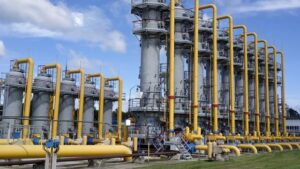
On November 1, 2024, Ukraine started the season of natural gas withdrawal from its underground gas storage facilities (UGS), according to the data of the Association of European Underground Gas Storage Operators (GSE). While on October 30 and 31 a small filling of storage facilities was recorded, on November 1 the volume of their filling decreased by 0.05%.
On October 31, the head of Naftohaz, Oleksiy Chernyshov, stated on his Facebook page that the heating season was actively starting in Ukrainian cities.
He recalled that Ukraine used about 6.7 billion cubic meters of gas from its subway gas reservoirs during the 2023/2024 heating season, and expects the same figures for the 2024/2025 season.
As reported, Ukraine entered November 2023 with 16 billion cubic meters of gas stored in UGS facilities. In general, during the heating season 2023/24, 8.5 billion cubic meters of natural gas was withdrawn from storage facilities, of which Ukraine used 6.7 billion cubic meters. The gas withdrawal season lasted a total of 145 days.
Ukraine planned to enter the heating season of 2024/25 with gas reserves in UGS at least 13 billion cubic meters. At the same time, the low activity of gas injection by non-residents forced Naftohaz to buy gas and store it in Ukraine’s UGS facilities in the “customs warehouse” (CU) mode,
Chernyshov noted in his commentary to Energoreforma in early October that as of November 1, the company’s purchase of gas in the TC mode, which is carried out as a reserve at the expense of the EBRD loan, will amount to about 0.5-0.6 billion cubic meters.
According to former Energy Minister Olga Buslavets, in general, the reserves in Ukraine’s UGS facilities as of November 1, 2024 amounted to 12.9 billion cubic meters.
natural gas withdrawal, UKRAINE, underground storage facilities



