

In 2024, the area under soybeans in Ukraine will be expanded by 10-15%, according to UkrAgroConsult, the information and analytical agency.
“During the 2023/24 marketing year (MY, July-2023 – June-2024), the price of soybeans on both domestic and export markets is quite steady, having recovered from the fall at the beginning of the season. In 2024/25 MY, Ukraine is guaranteed to receive a record soybean harvest, which cannot but put pressure on prices. Moreover, the soybean market is very sensitive to the trends in the global market not only for soybeans but also for its processed products and sunflower meal,” the analysts said.
In their opinion, even if the average yield is achieved, the soybean harvest in 2024/25 MY will reach the record level. This will allow potentially more than 60% of the crop to be exported.
In the current conditions, Ukraine’s favor is not only the demand of key buyers (EU countries, Turkey and Egypt), which will remain in the new season, but also their relative territorial proximity and the possibility of transportation outside the Red Sea, experts emphasized. At the same time, they reminded that the experience of the last two seasons clearly demonstrates the logistics, especially maritime logistics, for realizing the export potential.
“The absence of import bans by the EU countries and the functioning of a temporary sea corridor allows us to consider a rather optimistic scenario for the next season,” UkrAgroConsult predicts.
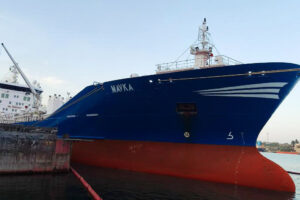
“In 2023, Kernel, one of the largest Ukrainian agro-industrial groups, strengthened its position as a port operator by acquiring a tanker, two bulk carriers and terminals for transshipment of sunflower oil in Odesa’s Pivdennyi and Chornomorsk ports and on the Danube River, said Yevhen Osypov, CEO of the agricultural holding.
“The agricultural holding has long been a port operator. We have several terminals through which we export. Over the past year, we have invested and purchased terminals for transshipment of sunflower oil. We did not have self-propelled terminals before. We used the services of partners,” he said at the Business Breakfast with Forbes Ukraine on Wednesday.
Osipov noted that the bulk of the agricultural holding’s terminals were concentrated in Mykolaiv. After losing Mykolaiv ports to the full-scale war, Kernel had to invest in new supply chains for sunflower oil to the global market and acquired terminals in Pivdennyi and Chornomorsk ports and on the Danube River to ensure exports. The agricultural holding’s SEO called the acquisition of vessels one of the elements of Kernel’s sustainable development.
“At some stage, we did not understand whether the corridor would work or not (the Black Sea Grain Initiative – IF-U), and the volumes (of agricultural products – IF-U) need to be exported. We realized that we need to invest in the fleet to ensure the possibility of export,” he said.
Mr. Osipov confirmed that Kernel currently owns one tanker and two bulk carriers, which provide the agricultural holding with 30% of sunflower oil and 20% of bulk cargo exports.
The group is currently exploring this area and has formed a new team to manage the fleet.
“These are slightly different competencies that the agricultural holding did not have before. This business is very competitive and not as simple as it seems at first glance,” admitted the SEO and added that the existing military bonus makes this business efficient.
Mr. Osipov noted that due to military risks, Kernel has not been buying new vessels and is considering investing in newer ones, although not this year – first it intends to learn how to balance with the existing fleet on the market. Currently, the agricultural holding’s fleet operates on a daily basis, delivering its agricultural products to Romania, the Mediterranean basin and Northern Europe, where it is gaining experience in shipping.
Prior to the war, Kernel was the world’s largest producer of sunflower oil (about 7% of global production) and a major exporter (about 12%). It is one of the largest producers and sellers of bottled oil in Ukraine. In addition, it is engaged in the cultivation and sale of agricultural products.
Kernel’s net profit for FY2023 amounted to $299 million, while the previous year it ended with a net loss of $41 million. The agricultural holding’s revenue for FY2023 decreased by 35% to $3.455 billion, but EBITDA increased 2.5 times to $544 million.

Transportation costs for importing goods have quadrupled compared to pre-war levels, and transport delays at the border average 20 days, said Dmytro Derevytskyi, chairman of the board of directors of the national marketplace network Allo Dmytro Derevytskyi, chairman of the board of directors of the national market chain Allo.
“In the pre-war period, a truck from Warsaw to Lviv cost about EUR1.3 thousand, then in 2022 – EUR2-2.5 thousand. Now the freight is about EUR4.8 thousand and changes daily, somewhere plus or minus EUR300,” he explained at a discussion organized by Deloitte in Kyiv on Wednesday.
He also noted that the search for alternative options (to the Polish border) is not optimal. According to him, the company has redirected its trucks to Slovakia, Hungary and Romania amid the blockade of the Polish border, but the checkpoints there do not have the capacity to quickly process the increased flow of freight traffic. Waiting times at the border from Romania, Hungary, and Slovakia range from 3 to 6 days, and taking into account the queue at the Ukrainian border for exit (14 days), trucks stand in line for about 20 days.
“The cost of funds in Ukraine is very high. Imagine which business will be able to pay for this downtime for such a long time,” Derevytsky said and called on business associations to lobby for at least a reduction in transport downtime on the Ukrainian border.
Allo LLC was established in 1998. The group’s network includes showrooms under the Allo Mah and Allo brands, Mi stores and outlets under the brands of telecom operators.
According to the Opendatabot resource, the participants of Allo LLC are PE Dniproinvest 2016 (95.19%), Dmytro Derevytskyi (3.6%), and Maksym Raskin (1.21%). Derevytskyi is listed as the ultimate beneficiary.
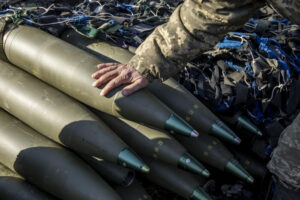
Prague has received preliminary approval to purchase an additional 200,000 shells in addition to the mandatory purchase of 300,000 artillery rounds for Ukraine, Czech News reports, citing Prime Minister Petr Fiala.
“…Petr Fiala said that in addition to the mandatory confirmed purchase of 300,000 units of artillery ammunition for Ukraine from third countries, the Czech initiative to search for ammunition has a promise of another 200,000 pieces,” the Czech News website said on Tuesday.
According to Fiala, 18 countries, including Canada, Germany, the Netherlands, and Poland, have joined the Czech initiative to purchase ammunition from third countries. “I consider this a great success. This is yet another proof that the Czech Republic is a full-fledged active player in European security policy,” the Czech Prime Minister said.
Fiala also announced that over the past two years, the Czech Republic has delivered more than a million pieces of large-caliber ammunition to Ukraine.
As reported, at the Munich Security Conference, Czech President Petr Pavel said that the Czech Republic had found up to 800,000 NATO standard-caliber shells that could be sent to Ukraine in a few weeks if funding is found.
Last week, the Czech prime minister said that enough money had been raised to purchase the first batch of 300,000 artillery shells.
Structure of foreign exchange reserves as of 30.10.2023
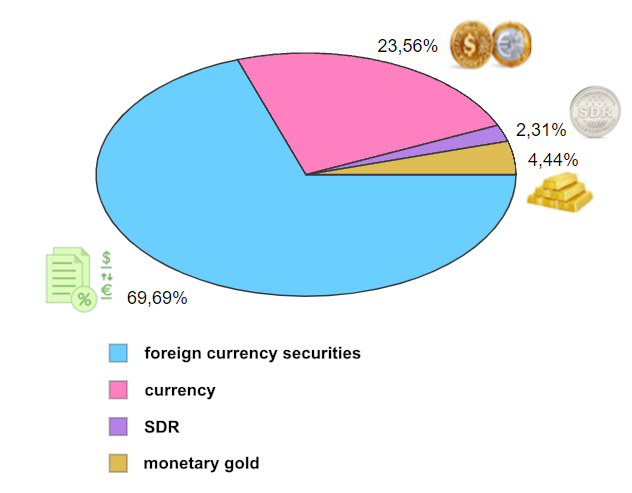
Source: Open4Business.com.ua and experts.news
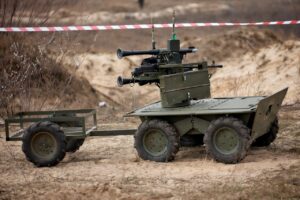
Ukraine has conducted a large-scale test of robotic ground platforms developed by the Brave1 cluster, said Mykhailo Fedorov, Vice Prime Minister for Innovation, Education, Science and Technology of Ukraine and Minister of Digital Transformation.
“Ukraine is starting mass production of robotic ground platforms. Brave1 has tested 50+ complexes at the testing ground. Kamikaze platforms, turrets, platforms that destroy Russian positions and equipment, mine, clear mines, evacuate the wounded and bring ammunition to the positions were tested,” Fedorov wrote on Telegram on Tuesday.
He emphasized that the robots have successfully proved themselves at the training ground and will be on the battlefield in a few months. Hundreds of different platforms will be purchased through UNITED24.
The main goal of ground robots is to minimize human involvement on the battlefield. This will help preserve the lives and health of Ukrainian soldiers, the Vice Prime Minister emphasized.
“Ground robotic systems will become the next game changer in this war, just like drones are already. This is an asymmetric response to the enemy’s numerical superiority,” Fedorov said.
It is reported that more than 140 robotic systems have been registered on the Brave1 platform, 96 of them have passed defense expertise, and 14 developments have been codified according to NATO standards.
Some robotic developments have already been deployed at the front, such as the ShaBla turret.
As reported, Minister of Strategic Industries Oleksandr Kamyshyn at the conference “Ukraine. The Year 2024” conference, Oleksandr Kamyshyn reminded that Ukraine has significantly increased the production of air and sea drones, which have begun to operate for strategic purposes in Russia. According to him, 2024 will be the year when we will see drones operating on the ground. According to Kamyshyn, 2024 will be the year when we will hear more about ground-based robotic systems.



