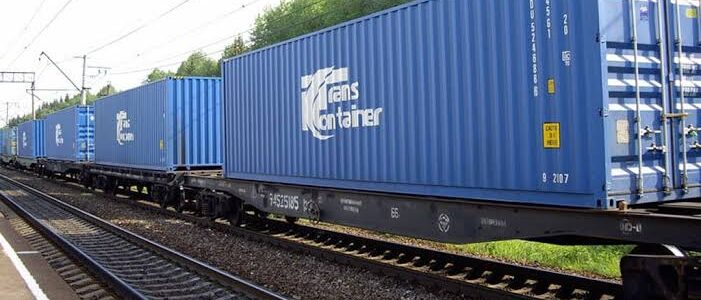
The volume of containerized freight transported by rail in January–August of this year totaled 202.73 thousand DFE (TEU), which is 33% higher than the figures for the same period in 2025, according to Valery Tkachov, deputy director of the Department of Transportation Technology and Commercial Operations at JSC “Ukrzaliznytsia,” on Facebook.
According to him, the business community considers the shortage of fitting platforms (FTPs) in Ukraine to be the main obstacle to further growth in container transportation volumes.
According to data provided by Tkachov, 27% of container traffic during the reporting period consisted of grain (26% for the first 8 months of 2025), 15% (21%) to ferrous metals, 12% (10%) to oilcake and meal, and 6% each to synthetic resins and oil (5% and 7%, respectively, last year).
The expert noted that, against the backdrop of an overall decline in shipments, the share of container traffic in the total cargo volume rose to a record high of 4.4% over the past year.
Tkachov added that the “Liski” branch of the Central Transport Service (CTS) presented a strategy for selling its own rolling stock, under which 60–80% of the FTL fleet is planned to be sold under long-term USTO contracts, and 20–40% through auctions or on general terms.
Currently, the operational fleet of the “Liski” branch of the Central Transport Service consists of 1,500 FTG units, of which 1,200 are 40-foot units, 265 are 60-foot units, and 48 are 80-foot units.
A representative of “Ukrzaliznytsia” noted that due to increased demand for fitting platforms, the branch has begun selling its scarce fleet through “Prozorro.Sales” auctions.
According to the post, business representatives raised concerns regarding the mechanisms for allocating the railcar fleet between long-term USTO contracts and auctions, suggesting that these mechanisms be revised to account for the specific nature of container transportation. To resolve the issue, meeting participants agreed to transition to long-term cooperation regarding the provision of container railcars under USTO contracts. Company representatives were asked to submit requests within a week detailing their FTT needs for 2026–2027, while “Ukrzaliznytsia” plans to conclude the relevant contracts with all interested companies as soon as possible.
“Having signed USTO contracts will allow us to plan the repair of Ukrzaliznytsia’s freight train fleet, taking into account existing repair capacities,” explained the director of Ukrzaliznytsia’s Department of Transportation Technology and Commercial Operations.
In addition, business representatives proposed considering the possibility of leasing FPTs from the non-operational fleet, assuming the costs of their repairs.
Among other issues, the business community cited incorrect preparation of accompanying documents and charges during export and import shipments at western border crossings, as well as congestion at the “Yagodin-Dorohusk” and “Mostyska-2-Medika” crossings, Tkachov reported.
CONTAINER, LOGISTICS, TRANSPORTATION, UKRAINE, UKRZALIZNYTSIA