

The Cabinet of Ministers has approved a draft agreement with the World Food Program (WFP) on the renewal of the agreement on opening a WFP Office in Ukraine.
As the representative of the Cabinet of Ministers in the Verkhovna Rada Taras Melnichuk said in the Telegram channel, the corresponding decision was made at a government meeting on Tuesday.
In particular, the project provides for: resumption of WFP representation in Ukraine; prompt response in case of emergencies, including in the field of distribution of financial assistance and assistance in kind for the affected regions; promotion of cooperation in the context of the participation of Ukrainian companies in the purchase of agricultural and food products for the needs of international humanitarian projects of the UN World Food Program.
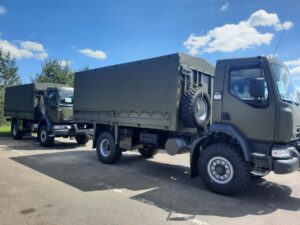
The European Union is starting to supply more than 90 off-road trucks to support the Armed Forces of Ukraine, the EU Delegation to Ukraine has reported.
“The logistics equipment is part of a wider €31 million assistance measure adopted on December 2 in support of Ukraine. The EU has begun supplying the Armed Forces with more than 90 off-road trucks as part of the European Peace Fund. The trucks are provided to support the medical, engineering and logistics units of the Armed Forces of Ukraine “, – said in a press release on the website of the representative office on Tuesday.
It is emphasized that this assistance measure will increase the overall resilience of Ukraine and help strengthen the capacity of its Armed Forces. In particular, we are talking about the provision of medical equipment, including a field hospital, engineering equipment, including demining tools, items for logistics units, including trucks and other means, and equipment to increase cyber defense capabilities.

This summer, the State Agency for Highways of Ukraine (Ukravtodor) does not introduce seasonal restrictions for trucks with a total weight of up to 40 tons during the daytime at elevated air temperatures.
According to the agency on its Facebook page on Tuesday, this decision was made primarily due to the war in the country, the reorientation of exports to the road network and significant changes in logistics.
“Before the full-scale invasion of Russia, Ukraine exported mainly by sea. Now, due to the blocking of ports, the country has redirected the flow of goods to rail and road. We understand the importance of logistics today, therefore, in order to avoid interruptions in the transportation of vital goods, seasonal restrictions are not introduced this year” , the ministry said in a statement.
At the same time, Ukravtodor reminds drivers and carriers that the movement of trucks must be carried out in compliance with weight parameters both in terms of total mass and axle load at any time of the day. According to the norms, the maximum weight of a cargo vehicle for transportation on the roads of the country is 40 tons.

President of Ukraine Volodymyr Zelensky has held a meeting in the President’s Office of Ukraine with American actor and film director Sean Penn, who is making a documentary about the Russian war in Ukraine.
“Actor and film director Sean Penn is making a documentary about the war in Ukraine. From the first day of the full-scale invasion, he was in Kyiv and saw what Russian aggression was. Soon, the whole world will be able to see the whole truth about the war thanks to his film,” Zelensky wrote on his Telegram channel.
The Head of State also thanked the actor for the support of Ukraine and Ukrainians.
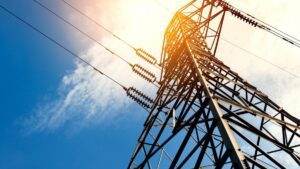
In a few days, Ukraine will start exporting electricity to the synchronous zone of Continental Europe, Volodymyr Kudrytsky, Board Chairman of NPC Ukrenergo, has said on his Facebook page on Tuesday.
“ENTSO-E confirmed on June 27 that Ukrenergo, together with TSOs [Transmission System Operators] of neighboring countries, has successfully met six technical conditions for opening the first 100 MW of electricity exports from Ukraine to Europe. Ukraine can also import this amount of European electricity if necessary,” Kudrytsky wrote.
According to him, today Ukrenergo will hold an open auction for access to the interstate section, at which all electricity producers and other participants will be able to participate.
“This decision finally breaks the ‘aquarium’ of the closed Ukrainian energy market and at the same time brings us closer to full integration into the European energy space,” the head of Ukrenergo stressed.
He noted that in terms of the timing of the opening of exports from the power system newly attached to ENTSO-E, this is an unprecedentedly quick decision. Under the 2017 synchronization agreement, commercial exports from the Ukrainian power grid were to open only one year after the trial synchronization. Ukraine has reached an agreement to open commercial electricity exchanges in three months.
Kudrytsky also saw a certain symbolic coincidence in the date of the ENTSO-E decision on Ukrainian exports.
“Exactly five years ago, Ukrenergo signed the historic agreement with ENTSO-E, thanks to which the Ukrainian energy system is now synchronized with the European one. This agreement set the conditions for future integration with the continental European energy grid, which was to take place in 2023. We achieved the result a year and a half earlier,” the head of Ukrenergo summed up.
Andriy Gerus, Chairman of the Verkhovna Rada Committee on Energy, Housing and Utility Services, said at a press conference on Tuesday that Ukraine would start exporting electricity to the synchronous zone of Continental Europe from July 1.
At the same time, Minister of Energy Herman Haluschenko specified that the export of electricity would start on June 30.
The same information was posted on its website by ENTSO-E.
“The start of commercial electricity exchange with the Ukraine/Moldova power system is scheduled for June 30 at the Ukraine-Romania connection. It is expected that electricity trading on other connections [Ukraine-Slovakia, Ukraine-Hungary and Moldova-Romania] will start later,” the network said in a release on Tuesday.
According to him, the total trading capacity at the first stage will be set at 100 MW. After this initial phase, a gradual increase in trading capacity will be regularly assessed based on grid stability and security considerations, ENTSO-E explained.
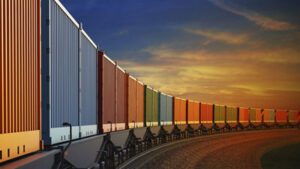
The Ministry of Infrastructure of Ukraine agreed with the proposal of Ukrzaliznytsia (UZ) to increase tariffs for the transportation of goods by 70%.
Minister Oleksandr Kubrakov signed the corresponding order No. 441 “On amendments to the coefficients applied to the tariffs of the Collection of tariffs for the carriage of goods by rail within Ukraine and related services” on June 22, and it was registered with the Ministry of Justice on June 24.
Unlike several previous increases last year, this time the coefficients have been increased equally – by 70% – for all 20 types of cargo.
“From July 1, 2022, the Ministry of Infrastructure will carry out a planned indexation of tariffs for freight transportation,” Oleksandr Kamyshin, the head of the board of Ukrzaliznytsia, announced in the announcement of a press conference scheduled for June 29.
According to the explanatory note to the draft order, which Interfax-Ukraine got acquainted with, UZ plans to receive an additional over UAH 11 billion by the end of 2022 thanks to this increase in tariffs.
The company indicated that in the first five months of this year, due to the war, cargo transportation fell by 2.9 times – to 27.1 million tons, including in domestic traffic by 2.7 times – to 14.5 million tons, for export – 2.5 times, up to 10.8 million tons, for import – 6.4 times, up to 1.6 million tons, while transit fell almost 10 times – up to 0.3 million tons.
Ukrzaliznytsia also indicated that its estimated cost of restoring war damage would exceed UAH 100 billion.
As reported with reference to the order of the Ministry of Infrastructure of October 29, 2021, since the beginning of 2022, tariffs for the transportation of a group of goods of the 1st tariff class by rail have increased by 9%.
This was preceded by a decision to increase tariffs from August 17, 2021 for cargo transportation of a group of goods of the 1st and 2nd tariff classes by 8%, and from January 2022 – by 20.4% and 6.5%, respectively.
At that time, UZ estimated additional revenues from tariff increases at UAH 2 billion in 2021 and UAH 12.3 billion in 2022.
Ukrzaliznytsia in 2021, according to preliminary data, received UAH 457 million in net profit against a loss of UAH 11.9 billion a year earlier.



