
National bank of Ukraine’s official rates as of 08/06/22
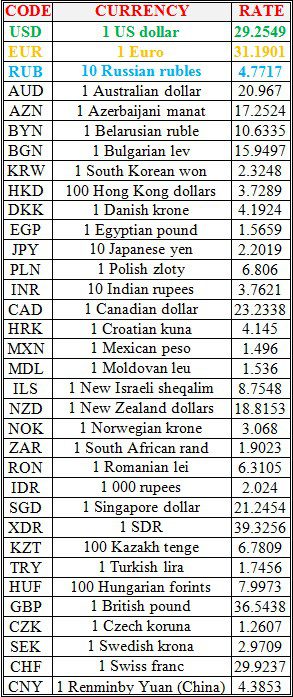
Source: National Bank of Ukraine
Official rates of banking metals from national bank as of June 08
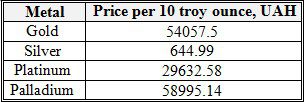
One troy ounce=31.10 grams

President of Ukraine Volodymyr Zelensky has chosen Ukrainian tennis player Elina Svitolina as the second ambassador of the UNITED 24 national brand, the President’s Office of Ukraine reported.
Svitolina’s presentation by the second ambassador of the UNITED24 fundraising platform took place during an online meeting with the head of state, Deputy Prime Minister, Minister of Digital Transformation Mykhailo Fedorov and platform coordinator Yaroslav Hres, the press service of the President’s Office said Tuesday evening.
In addition, the first UNITED 24 ambassador Andriy Shevchenko joined the videoconference, together with whom Svitolina will continue to unite the world sports community around helping Ukraine.
The President thanked Svitolina for the active position that the athlete has taken since the first days of the war, and noted that it is important to talk about Ukraine in the world.
The President’s Office also stressed that at the end of July, a charity game of the first racket of the world Iga Świątek is planned under the patronage of Svitolina.
During the first four weeks of the UNITED 24 fundraising platform, more than $52.5 million was raised for the needs of Ukraine.
As reported, on May 18, Zelensky signed a decree on the establishment of the UNITED 24 national brand and congratulated the first ambassador of this brand – the legendary Ukrainian football player and coach Andriy Shevchenko.
On June 7, the Ministry of Youth and Sports opened a special account in the National Bank of Ukraine for donations within the framework of the UNITED24 Restoration Fund initiative.

On Tuesday, June 7, the Ministry of Education and Science of Ukraine and Mitacs signed a Memorandum of Cooperation, according to which 60 students will do internships under the Mitacs Globalink Research Internship program this summer, Ukrainian Ambassador Yulia Kovaliv said.
“600 Ukrainian students and scientists will be able to do internships at Canadian universities. A memorandum of cooperation was signed today by the Ministry of Education and Science of Ukraine and Mitacs, and this summer 60 students will be doing internships under the Mitacs Globalink Research Internship program,” she wrote on Twitter on the night of Tuesday to Wednesday.
Kovaliv thanked the Government of Canada and Mitacs for supporting Ukraine and for the decision to stop scientific ties and cooperation with Russian institutions.
Average monthly wage by region in Jan 2022, UAH
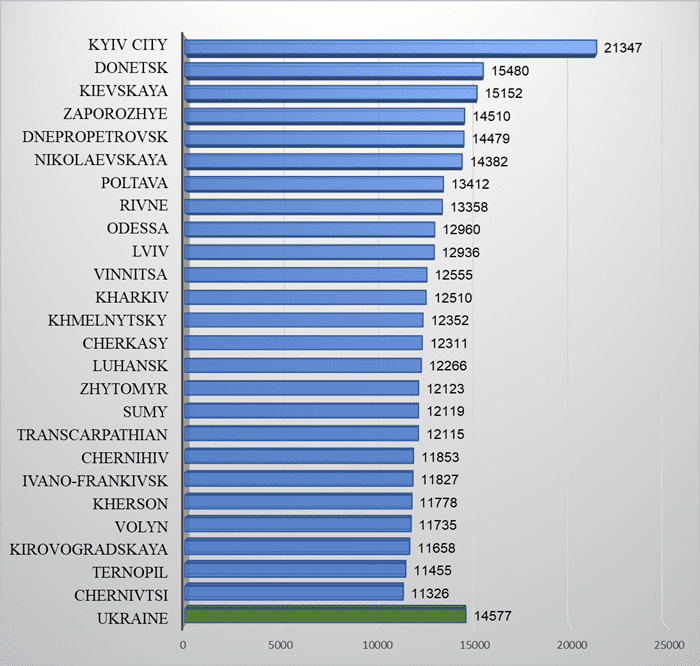
SSC of Ukraine
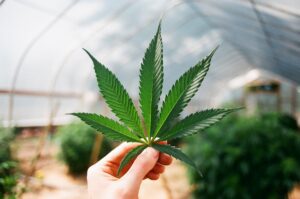
The Cabinet of Ministers of Ukraine has supported a bill on the use of medical cannabis preparations for the treatment of certain diseases, Minister of Health of Ukraine Viktor Lyashko said on his Facebook page.
“We have prepared a legislative framework to ensure the full production cycle of cannabis-based drugs in Ukraine: from cultivation and processing to full-fledged production,” Lyashko said.
He also noted that cannabis medicines should not be identified with narcotic substances, since they do not have a psychoactive effect, and the measures for regulating their circulation are different.
“Medical” cannabis contains cannabidiol, which does not have a pronounced psychoactive effect, so it is not interesting for recreational use. At the same time, we still propose to establish strict control over the cultivation, production and sale of drugs, understanding the sensitivity of this issue in society,” Lyashko explained.
Cannabis-based preparations are used to reduce pain, muscle spasms and cramps, treat anorexia, PTSD and anxiety disorders. In addition, they are used in the treatment of certain types of epilepsy, glaucoma, psoriasis, parkinsonism, and multiple sclerosis. An important task of this medicine is to alleviate pain and suffering for seriously ill and palliative patients, including cancer patients, patients with HIV.



