

JSC Kyiv Electric Car Repair Plant, part of the structure of Ukrzaliznytsia, in January-March 2022 received a net loss of UAH 10.96 million against a net profit of UAH 2.61 million for the same period in 2021.
According to the interim financial report of the enterprise, published in the information disclosure system of the National Securities and Stock Market Commission, its net income in the first quarter decreased by 40.7% – to UAH 77.37 million.
The plant received a gross loss of UAH 3.37 million (against a profit of UAH 6.74 million a year earlier), almost UAH 10 million of loss was received from operating activities.
According to the plant, in the first quarter of this year, it sold five repaired electrical sections for UAH 75.63 million (in January-March 2021 – nine sections for UAH 118.5 million), two wheel sets and three electric machines (a year earlier – one pair and 108 electric machines).
Kyiv Electric Car Repair Plant was founded in 1868 as a workshop for the repair of steam locomotives and wagons. It specializes in the overhaul of electric trains for the railways of Ukraine, the repair of components and assemblies, electric machines, electric motors and wheelsets, the manufacture of spare parts.

UNIQA and UNIQA Life insurance companies (Kyiv), which are part of the non-banking financial group UNIQA Ukraine, paid out UAH 77.5 million in insurance claims to customers in April this year, according to the website of UNIQA.
At the same time, it is noted that under auto insurance contracts the total amount of insurance payments was UAH 22.2 million, of which payments for KASKO – UAH 16.1 million, for OSAGO – UAH 6.1 million.
The amount of payments under voluntary medical insurance contracts totaled UAH 31.9 million. The amount of life insurance payments is UAH 4.7 million.
The largest payment was UAH 12.2 million under the insurance contract for construction and installation risks.
UNIQA medical assistance for the reporting period processed more than 37,608 appeals, technical assistance – more than 9,532, the report says.
UNIQA Group (Austria) entered the Ukrainian market in 2006. Its companies in Ukraine – UNIQA and UNIQA Life with headquarters in Kyiv, offer most types of risk and life insurance through a nationwide network.

During the period of martial law, the Verkhovna Rada has simplified the export, import and transit of agricultural products to Ukraine, which will expand the access of farmers to fertilizers and genetic material of farm animals, as well as support the Ukrainian organic industry.
Relevant bill No. 7264 on uninterrupted production and supply of agricultural products during martial law was adopted as a whole at a meeting on May 12 by the votes of 313 MPs, with the required 226 votes, MP Yaroslav Zhelezniak (the Holos faction) said on his Telegram channel on Thursday.
“The task of the state is to simplify farming under martial law as much as possible and reduce the bureaucratic burden on business and government bodies. This applies, in particular, to the state registration of pesticides and agrochemicals, which is extremely important during the spring sowing campaign in 2022. Also it is important to support niche agriculture and organic production,” according to an explanatory note to the bill.
The bill abolishes state registration of agrochemicals imported into Ukraine, including some types of nitrogen fertilizers, ammonium nitrates, ammonia in aqueous solution, thiosulfates, potassium, calcium and aluminum phosphates, borates, zinc chelate and a number of others mineral fertilizers until the end of martial law and for 90 days after its cancellation.
In addition to the simplified import of such types of fertilizers, the bill cancels the state registration procedure for their production, sale, use and advertising.
Bill No. 7264 also proposes, until July 1, 2024, to allow organic producers to use the label “organic,” “biodynamic,” “biological,” “ecological,” “organic,” even if they are not operators of organic products in accordance with law No. 2496-VIII on the turnover of organic products.
According to the explanatory note to the document, this initiative allows Ukrainian producers of organic products that produced according to EU standards, but did not meet the status of an operator of organic products according to Ukrainian standards, to switch to Ukrainian production standards without an additional transition period. It also allows them to qualify for government support.
The bill expands the list of entities that can take samples and conduct phytosanitary examination, in particular, introduces a simplified procedure for involving private laboratory employees in examination until the end of martial law and 90 years after it is canceled, and also authorizes agronomists-inspectors to conduct such inspections to conduct an audit on certification.
In addition, the bill allows the import of cargoes of live animals in transit through countries where there are cases of disease from the list of the World Organisation for Animal Health to Ukraine. According to the authors of the bill, this will allow the Ukrainian livestock industry to gain access to modern breeding genetic material from the EU countries and expand the diversity of breeding material of agricultural animals in Ukraine.
During the discussion of the document at the second reading, the MPs supported the amendment of MP Oleh Kulinich (the deputy group Dovira), specifying that state registration of pesticides is not required in cases where the active ingredient of the pesticide is marked in the EU Pesticides Database as permitted for use.
ANIMALS, FERTILIZERS, IMPORT, PHYTOSANITARY CERTIFICATES, RADA
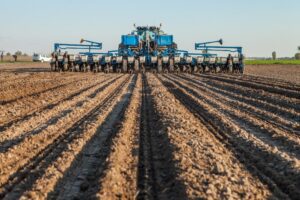
State-controlled PrivatBank (Kyiv) on May 9 began accepting applications for financing the purchase of fixed assets for a total amount of UAH 500 million, which include agricultural machinery, commercial vehicles and special equipment.
The launch of the corresponding program was announced in a press release from the financial institution.
The bank also announced the completion on May 13 of the Agroseason lending program for agricultural producers, carried out to finance the 2022 sowing campaign under the state program 5-7-9% with interest compensation.
It is specified that over 2,400 Ukrainian agricultural enterprises and farmers have already received loans for UAH 6 billion.
PrivatBank clarified that the Cabinet of Ministers of Ukraine by resolution No. 28 set the deadline for issuing loans for the sowing campaign until May 31, 2022. Since the bank is currently processing more than 2,000 loan applications, it will limit the acceptance of applications on May 13 in order to have time to process those already received before the deadline set by the government.
The financial institution recalled that under the terms of the state program, lending was available to Ukrainian agricultural producers for a period of six months with compensation from the state up to 0% per annum in the amount of up to UAH 60 million.
As reported, Ukrainian banking institutions for the period from mid-March to May 5 provided loans to farmers under the state program to support the sowing campaign in 2022 for a total of UAH 19.82 billion, including loans and portfolio guarantees for the week of April 28-May 5 for UAH 4.87 billion.
AGRICULTURAL, COMMERCIAL EQUIPMENT FOR UAH 500 MLN, LEND, PRIVATBANK
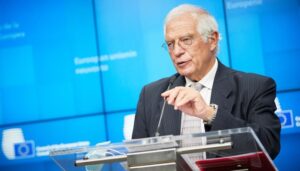
The European Union will provide an additional EUR 500 million in military assistance to Ukraine, bringing the total amount of aid to EUR 2 billion, High Representative of the EU for Foreign Affairs and Security Policy Josep Borrell said on Friday.
He said the European Union would provide a new tranche of EUR 500 million to provide military assistance to Ukraine, thus, bringing the total amount to EUR 2 billion.
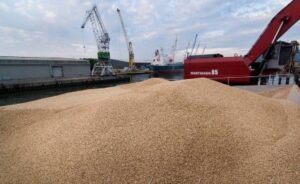
The export of Ukrainian agricultural products through the EU countries, taking into account deliveries through the Danube river ports, cannot exceed 1.5 million tonnes per month under any circumstances, while before the blockade of its seaports by the Russian troops, the country could monthly transship over 5 million tonnes of agricultural crops per month.
An opinion about a need for Ukraine to work on the launch of new logistics routes and export directions was expressed by First Deputy Minister of Agrarian Policy and Food Taras Vysotsky during the expert discussion “Blocked trade: can Ukraine increase export capacity” on Friday.
“We preliminary calculated that up to 1.5 million tonnes are still the maximum. Therefore, I think that we can count on this until May, and then only alternative directions,” Vysotsky said.
He clarified that Ukraine has enough agricultural products for export, and Ukrainian farmers can supply as much grain as they need to foreign markets, and the volume of its exports is limited only by logistics.
As reported with reference to Minister of Agrarian Policy Mykola Solsky, in April 2022 Ukraine exported 1.09 million tonnes of grain mainly through Romanian ports, which is more than five times higher than in March.
According to him, most of the export deliveries from Ukraine were carried out in April through the Danube river ports, since the Ukrainian Black Sea ports are blocked by Russian warships.
At the same time, the logistics of Ukrainian agricultural products through Romania may become more complicated and slow down in June, when a new crop of Romanian, Serbian, Hungarian and Bulgarian winter wheat and barley will begin to arrive at the seaports of this country and will create competition with supplies from Ukraine.



