

Oil prices are falling on Thursday after a strong rise in the previous session.
The cost of July futures for Brent on London’s ICE Futures Exchange stood at $76.73 a barrel by 8:15 a.m. Thursday, down $0.23 (0.3%) from the close of the previous session. Those contracts rose $2.05 (2.7%) to $76.96 a barrel on Wednesday.
The price of WTI futures for June oil fell by $0.23 (0.32%) to $72.6 per barrel at electronic auctions of New York Mercantile Exchange (NYMEX) by that time. The contract value grew by $1.97 (2.8%) to $72.83 per barrel at the end of previous session.
Support to the market on Wednesday was given by the statements of U.S. President Joe Biden, who again expressed optimism about negotiations on the state debt ceiling issue, notes Market Watch.
“I am confident that we will have an agreement and the U.S. will not default,” Biden said while speaking at the White House.
“Investors’ hopes that the U.S. government debt limit problem will be resolved soon are increasing,” notes StoneX analyst Fawad Razakzada. – Biden’s statement led to an increase in appetite for risk in world markets, including oil”.
However, the market was constrained by the U.S. Department of Energy data which showed an increase in oil inventories in the country for the second week in a row.
Last week commercial inventories in the U.S. rose by 5.04 million barrels, a record high over the past 12 weeks. Analysts had expected a decline of 2 million barrels.
Gasoline inventories declined by 1.38 million barrels, while distillate stocks increased by 80,000 barrels. Experts forecasted reduction by 2 million barrels and 1.5 million barrels respectively.
Balance of transactions on purchase and sale of non-cash and cash foreign currency by bank customers, mln USD
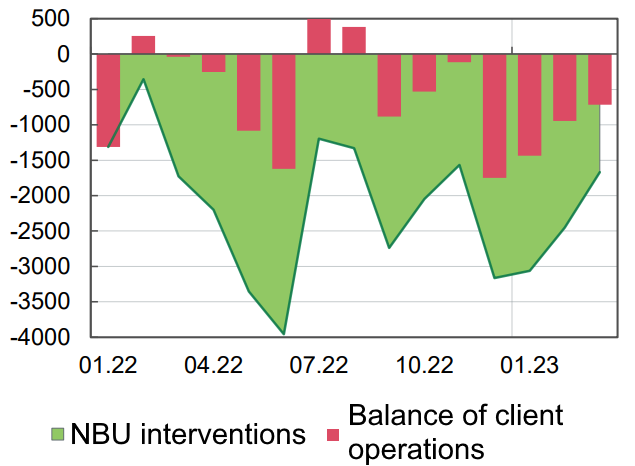
Source: Open4Business.com.ua and experts.news
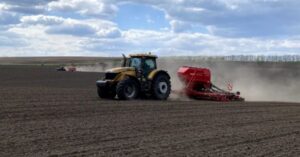
Kernel Agro-Industrial Group, as of mid-May, has fulfilled 95% of its plans to sow spring crops, allocating 35% of the area for sunflower and 18% for soybeans, the company said on Facebook.
“Agroclimatic features of the current season: a large amount of precipitation in March and April, a high level of subsurface water in some regions and, accordingly, the waterlogging of much of the fields – have significantly adjusted the production program of agricultural enterprises “Kernel”,” the company said in its information.
As reported, the sunflower accounts for 35% of sown area, or 120 thousand hectares, the corn – 24%, or 85 thousand hectares, the soybean – 18%, or 65 thousand hectares.
Moreover, winter wheat accounts for 17%, or 60.4 thousand hectares in the structure of areas under crops. Areas under rape and perennial grasses are traditionally insignificant, the holding said.
It is stated that Kharkiv cluster was able to carry out seeding on 28 thousand hectares, and another 1 thousand hectares were left without treatment because of security reasons, as these lands are located 40 km from the front line – in Kupiansky area. As of May 16, 100% of the planned areas for the season were sown in the cluster.
According to Alexander Zvyagintsev, deputy head of production of the Kharkiv cluster, 35% of the area is planted to winter wheat, 30% to sunflower, 15% to winter rape, 10% to corn, and 10% to soybeans.
Druzhba Nova” cluster team in Sumy region took 177 thousand hectares of arable land for the future harvest, while 7 thousand hectares near the Russian border were left uncultivated.
Druzhba Nova” cluster head for production, Igor Tihonchuk, said that corn and sunflower are already being sown; 20% and 35% of the crop is under crop cultivation correspondingly. Sowing of soybeans, which will take 24% of the area, will be completed by May 25. Sowing of winter wheat will occupy 17% of the area.
According to the holding, because of the oversaturated fields, some early spring technological operations have been canceled, replaced or shifted in time. The shift in timing affected the beginning of the sowing season, which in all regions began in late April, which is two weeks later than the traditional dates.
Kernel Agronomic reported favorable sowing conditions for sunflower and corn, which were sown in parallel to accelerate the pace of the sowing season.
“Most agroclusters have completed corn and sunflower seeding and are completing soybean seeding. This is a heat-loving crop, the conditions for sowing which were not favorable until May 5-6. Despite the vagaries of weather, 80% of areas for the next soybean crop we plan to sow at the optimum time for the crop, “- summed up the agricultural holding.
“Kernel” before the war was the world’s number one producer of sunflower oil (about 7% of world production) and its export (about 12%), as well as the biggest producer and seller of bottled sunflower oil in Ukraine. The company was also engaged in cultivation of other agricultural products and their sale.
In FY2022 (July-2021 – June-2022), the holding posted a net loss of $41 mln versus $506 mln net profit in the previous FY, while its revenue decreased by 5% to $5.332 bln and EBITDA decreased by 3.7 times to $220 mln.

Ukraine in April 2023 exported 6.55 thousand tons of dairy products, which is 27% less than in March, while imports increased by 3% and reached 5.17 thousand tons, the Ukrainian Club of Agrarian Business (UCAB) said.
“Despite the fact that some bans have been lifted, they had a very negative impact on the foreign economic situation in the industry. The last time such export volumes were observed a year ago, before the European Parliament supported the termination of import duties on Ukrainian agricultural products”, – UCAB analyst Maxim Gopka said.
According to the experts, the main reasons for the decrease of export were the blockade of import of Ukrainian agricultural products to the EU, difficulties with transit through East European countries and passive demand in the world.
UCAB points out that the decline in supplies can be observed in almost all categories without exception: unthickened milk and cream – by 33%, to 1.66 thousand tons; condensed milk and cream – by 40%, to 988 tons; yogurt and kefir – 17%, to 200 tons.
Exports of milk whey decreased by 17% to 1.03 thousand tons; butter – by 4% to 808 tons; ice cream – by 2% to 824 tons; cheese of all kinds – by 33% to 515 tons.
The Association also stressed that the export of dairy products to Poland fell in April by 29% compared to March and amounted to 242 tons.
The largest importers of Ukrainian products remained Moldova, Kazakhstan and Azerbaijan.
As for imports, the biggest growth – by 74% to 142 tons – was observed for milk and cream, the UCAB stated.
Changes in consolidated budget expenditures in 2021-2023 (%)
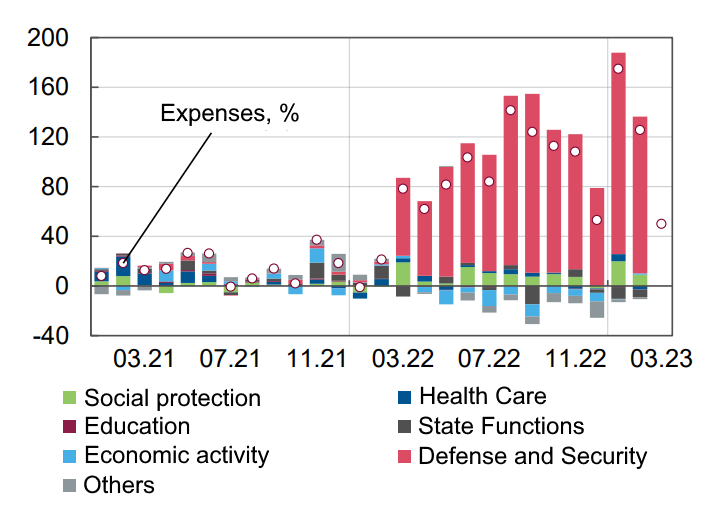
Source: Open4Business.com.ua and experts.news

Commodity output of Kyiv Cardboard and Paper Mill (Kyiv CPM, Obukhiv, Kyiv region), the leader of Ukrainian industry according to this indicator in January-April 2023 amounted to 2 billion 457.5 million UAH, which is 21.7% more than the same indicator of the first quarter of 2022.
According to statistics from UkrPapir association, provided to Interfax-Ukraine news agency, the plant has slowed down a little bit the growth rate of this index compared to the same period last year (in January-March the increase exceeded 27%).
In terms of volume production of corrugated boxes at the plant increased by 47.8% – to 70.06 million square meters. Production of cardboard increased by 26.3% to 55.37 thousand tons, due to the growth of containerboard output by 55.2% to 36.38 thousand tons, while the production of cardboard boxes decreased by 34% to 7.54 thousand tons.
At the same time, the output of backing paper for the manufacture of sanitary and hygiene products retains the negative trend, although slowed down – in January-April it fell by 27% to 14.29 thousand tons, while the production of toilet paper rolls fell by 29.6% to 78 million pieces.
Combine, despite the reduction in production of toilet paper, retains leadership in the production of toilet paper in Ukraine: a total of 180.9 million rolls (9% less) were produced by the main companies in the industry over four months.
According to the profile association, received from the major enterprises of the industry, a total of 172.76 tons of paper and cardboard (almost 14% more), and 155.30 million square meters of cardboard boxes (+26.3%) were produced in Ukraine in January-April 2023.
At the same time, the increase in these figures compared with the same period last year is largely due to the low comparative base of March 2022 – the first full month of full-scale invasion by Russia, when many companies have suspended their work.
Interfax-Ukraine Agency in the press-service of the plant, describing the current situation in the markets of branch products, explained that the market of corrugated products has decreased by 35-40%, taking into account the fall in demand for it in conditions of war.
“The situation with sanitary products is similar. In addition, in addition to the overall level of the economy, its demand is influenced by the number of people – the main consumer. Today, a large number of people have left Ukraine, many remain in the occupied territories, therefore, accordingly, the market has also decreased. The reduction in market volume is, depending on the segment from 18 to 35%,” – the company said.
In addition, there is a redistribution of demand in the segments of these products – the consumer saves money, so it reduces costs in the non-basic categories (napkins, towels) and focuses on the main – toilet paper.
“It has become much more difficult to export products: high logistics costs virtually eliminate the possibility of selling to the Middle East and North Africa. It is difficult to compete in Europe, because the cost of logistics “eats up” the possible earnings. In addition, because of the war, few companies are ready to sign long-term contracts, because because of all the possible risks it is difficult to guarantee a regular supply from Ukraine,” says the company.
At the same time, the plant is active in humanitarian work, including the allocation of more than UAH 0.5 million monthly in support of medical and educational institutions, public and volunteer organizations. Earlier it provided thousands of mobile corrugated beds and corrugated stools for the displaced people in Cherkasy, Znamenka, equipped hospital shelters and, in particular, the Kharkiv metro.
Among recent initiatives is the purchase of warm kits for children in the territories of active fighting and a humanitarian mission to deliver food kits to the liberated Izyum.
Besides, according to the press service, despite the cancellation of the employer’s guarantee for the average wage in July last year, the plant continued paying the mobilized employees, which is the 10th part of the whole workforce.
Kiev KBC is one of Europe’s largest cardboard and paper companies, employing over 2.5 thousand people.
As it was reported, in 2022 the mill produced 7 billion 432 million UAH, which is 3.5% less than in 2021.
Pulp Mill Holding (Austria) owns 100% of shares of KKBK PJSC.



